


Chronic weight dissatisfaction predicts type 2 diabetes risk: Aerobic Center Longitudinal Study
Supporting Files

-
Mar 03 2014
-
Details
-
Alternative Title:Health Psychol
-
Personal Author:
-
Description:Objective
Weight dissatisfaction, defined as discordance between actual and goal weight, may be associated with increased risk for several obesity-related comorbidities. The purpose of the study was to examine the association between weight dissatisfaction and risk of developing type 2 diabetes.
Methods
This longitudinal study used data from 9,584 adults enrolled in the Aerobics Center Longitudinal Study with an average of 5.1±4.1 years of follow-up. Key variables included multiple measures of measured weight, self-reported goal weight, and incident diabetes. Weight dissatisfaction was defined as being above the median of measured weight minus goal weight. Cox proportional hazards regression estimated hazard ratios (HR) and 95% confidence intervals (95%CI) for diabetes incidence by weight dissatisfaction.
Results
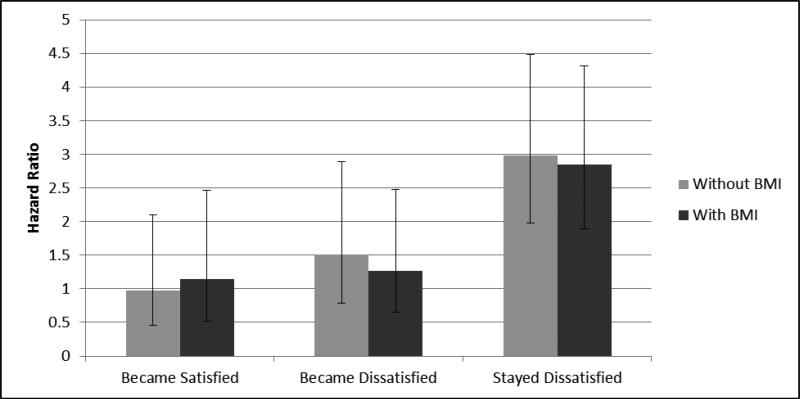
HRs for time-until-diabetes diagnosis revealed that family history of diabetes (HR=1.46, 95%CI=1.13-1.90), age (HR=1.03, 95%CI=1.02-1.04), and weight dissatisfaction (HR=1.83, 95%CI=1.50-2.25) at baseline were statistically significant predictors. Longitudinally, higher risk was observed in individuals who either stayed dissatisfied (HR=2.98, 95%CI=1.98-4.48) or became dissatisfied (HR=1.51, 95%CI=0.79-2.89), compared to those who either stayed satisfied (HR=1.00, referent) or became satisfied (HR=0.98, 95%CI=0.46-2.10). After additional adjustment for BMI, the elevated HR for those who remained dissatisfied compared to those who remained satisfied persisted (HR=2.85, 95%CI=1.89-4.31).
Conclusions
Chronic weight dissatisfaction increased type 2 diabetes risk. Weight dissatisfaction, regardless of BMI, represents a potentially important psychophysiological modifier of the relationships between BMI and risk of type 2 diabetes and warrants greater attention in future studies of chronic disease risk.
-
Subjects:
-
Source:Health Psychol. 33(8):912-919.
-
Pubmed ID:24588630
-
Pubmed Central ID:PMC4115022
-
Document Type:
-
Funding:3U48DP001936-01/DP/NCCDPHP CDC HHS/United States ; AG06945/AG/NIA NIH HHS/United States ; DK088195/DK/NIDDK NIH HHS/United States ; HL62508/HL/NHLBI NIH HHS/United States ; K05 CA136975/CA/NCI NIH HHS/United States ; R01 AG006945/AG/NIA NIH HHS/United States ; U54 CA153461/CA/NCI NIH HHS/United States
-
Volume:33
-
Issue:8
-
Collection(s):
-
Main Document Checksum:urn:sha256:487ea612b5470f36006798360b9151a330742c6abb8ce791c7fdcc1fbb6892e3
-
Download URL:
-
File Type:
 [PDF
- 447.78 KB
]
[PDF
- 447.78 KB
]
Supporting Files


ON THIS PAGE

CDC STACKS serves as an archival repository of CDC-published products including
scientific findings,
journal articles, guidelines, recommendations, or other public health information authored or
co-authored by CDC or funded partners.
As a repository, CDC STACKS retains documents in their original published format to ensure public access to scientific information.
As a repository, CDC STACKS retains documents in their original published format to ensure public access to scientific information.
You May Also Like
COLLECTION
CDC Public Access