


Diabetes Self-Management Education Patterns in a US Population-based Cohort of Youth with Type 1 Diabetes
Supporting Files

-
2014 Jan-Feb
-
File Language:
English
Details
-
Alternative Title:Diabetes Educ
-
Personal Author:
-
Corporate Authors:
-
Description:Purpose
The purpose of this study is to describe: 1) the receipt of diabetes self-management education (DSME) in a large, diverse cohort of US youth with type 1 diabetes (T1DM); 2) the segregation of self-reported DSME variables into domains; and 3) the demographic and clinical characteristics of youth who receive DSME.
Methods
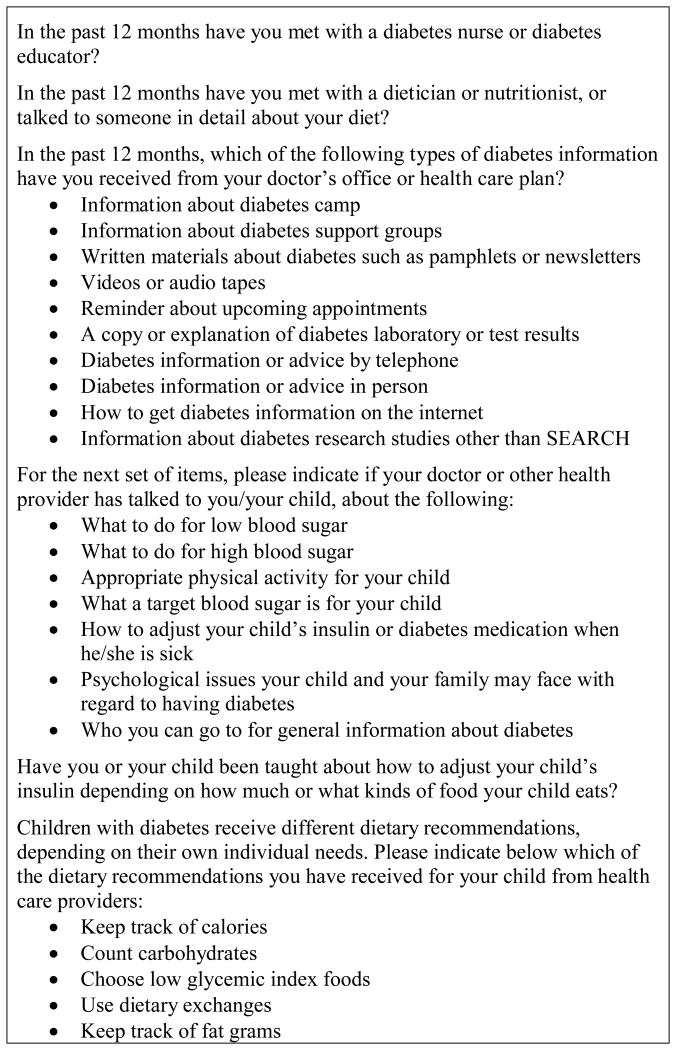
Data are from the US population-based cohort, SEARCH for Diabetes in Youth. A cross-sectional analysis was employed using data from 1273 youth < 20 years of age at time of diagnosis of T1DM. Clusters of 19 self-reported DSME variables were derived using factor analysis and their associations with demographic and clinical characteristics were evaluated using polytomous logistic regression.
Results
Nearly all participants reported receiving DSME content consistent with ‘survival skills’ (e.g., target blood glucose and what to do for low or high blood glucose), yet gaps in continuing education were identified [e.g., fewer than half of participants reported receiving specific medical nutrition therapy (MNT) recommendations]. Five DSME clusters were explored: Receipt of Specific MNT Recommendations, Receipt of Diabetes Information Resources, Receipt of Clinic Visit Information, Receipt of Specific Diabetes Information, and Met with Educator or Nutritionist. Factor scores were significantly associated with demographic and clinical characteristics, including race/ethnicity, socioeconomic status, and diabetes self-management practices.
Conclusions
Health care providers should work together to address reported gaps in DSME in order to improve patient care.
-
Subjects:
-
Source:Diabetes Educ. 40(1):29-39.
-
Pubmed ID:24248833
-
Pubmed Central ID:PMC4076934
-
Document Type:
-
Funding:P30 DK057516/DK/NIDDK NIH HHS/United States ; 1U18DP002709/DP/NCCDPHP CDC HHS/United States ; U48/CCU819241-3/PHS HHS/United States ; M01RR00037/RR/NCRR NIH HHS/United States ; U01 DP000247/DP/NCCDPHP CDC HHS/United States ; U18 DP002710/DP/NCCDPHP CDC HHS/United States ; U18DP002714/DP/NCCDPHP CDC HHS/United States ; DP-05-069/DP/NCCDPHP CDC HHS/United States ; U48/CCU419249/PHS HHS/United States ; M01 RR000069/RR/NCRR NIH HHS/United States ; U18DP002708-01/DP/NCCDPHP CDC HHS/United States ; 200-2010-35171/PHS HHS/United States ; U18 DP002714/DP/NCCDPHP CDC HHS/United States ; U01 DP000248/DP/NCCDPHP CDC HHS/United States ; U48/CCU919219/PHS HHS/United States ; M01 RR000037/RR/NCRR NIH HHS/United States ; DP-10-001/DP/NCCDPHP CDC HHS/United States ; U01 DP000244/DP/NCCDPHP CDC HHS/United States ; 00097/PHS HHS/United States ; U18DP000247-06A1/DP/NCCDPHP CDC HHS/United States ; U48/CCU519239/PHS HHS/United States ; U18DP002710-01/DP/NCCDPHP CDC HHS/United States ; M01RR00069/RR/NCRR NIH HHS/United States ; UL1 RR025014/RR/NCRR NIH HHS/United States ; UL1 RR029882/RR/NCRR NIH HHS/United States ; U58/CCU019235-4/PHS HHS/United States ; U18 DP002709/DP/NCCDPHP CDC HHS/United States ; UL1RR026314-01/RR/NCRR NIH HHS/United States ; UL1 TR001082/TR/NCATS NIH HHS/United States ; P30DK57516/DK/NIDDK NIH HHS/United States ; U01 DP000250/DP/NCCDPHP CDC HHS/United States ; U01 DP000246/DP/NCCDPHP CDC HHS/United States ; U01 DP000254/DP/NCCDPHP CDC HHS/United States ; UL1 RR026314/RR/NCRR NIH HHS/United States ; U18 DP002708/DP/NCCDPHP CDC HHS/United States ; UL1RR029882/RR/NCRR NIH HHS/United States ; HIR 10-001/HX/HSRD VA/United States
-
Place as Subject:
-
Volume:40
-
Issue:1
-
Collection(s):
-
Main Document Checksum:urn:sha256:d95f1c38dd9a6b5cd1b3797512e63198a47046d9a8861982fe88dc49db2bf82a
-
Download URL:
-
File Type:
 [PDF
- 1.09 MB
]
[PDF
- 1.09 MB
]
Supporting Files


File Language:
English
ON THIS PAGE


CDC STACKS serves as an archival repository of CDC-published products including
scientific findings,
journal articles, guidelines, recommendations, or other public health information authored or
co-authored by CDC or funded partners.
As a repository, CDC STACKS retains documents in their original published format to ensure public access to scientific information.
As a repository, CDC STACKS retains documents in their original published format to ensure public access to scientific information.
You May Also Like
COLLECTION
CDC Public Access