



Impact of Adjuvant Chemotherapy on Long-Term Employment of Early-Stage Breast Cancer Survivors
Supporting Files

-
Apr 28 2014
-
Available in CDC Stacks on 2015-06-15T00:00:00Z
Details
-
Alternative Title:Cancer
-
Personal Author:
-
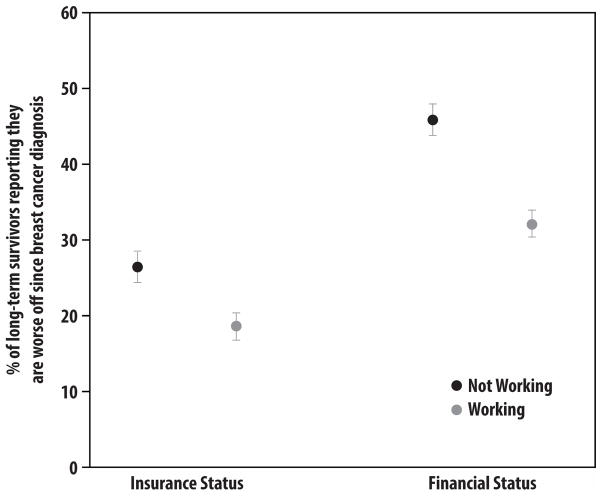
Description:Background ; Many women with early-stage breast cancer are working at the time of diagnosis and survive without recurrence. The short-term impact of chemotherapy receipt on employment has been demonstrated, but the long-term impact merits further research. ; Methods ; We conducted a longitudinal multicenter cohort study of women diagnosed with non-metastatic breast cancer in 2005–2007, as reported to the population-based Los Angeles and Detroit SEER registries. Of 3133 individuals sent surveys, 2290 (73%) completed a baseline survey soon after diagnosis and 1536 (68%) completed a four-year follow-up questionnaire. ; Results ; Of the 1026 patients aged <65 at diagnosis whose breast cancer did not recur and who responded to both surveys, 746 (76%) worked for pay before diagnosis. Of these, 236 (30%) were no longer working at follow-up. Women who received chemotherapy as part of initial treatment were less likely to work at follow-up (38% vs. 27%, p=0.003). Chemotherapy receipt at the time of diagnosis (OR 1.4, p=0.04) was independently associated with unemployment during survivorship in a multivariable model. Many women who were not employed in the survivorship period wanted to work: 50% reported that it was important for them to work and 31% were actively seeking work. ; Conclusions ; Unemployment among breast cancer survivors four years after diagnosis is often undesired and appears related to the receipt of chemotherapy during initial treatment. These findings should be considered when patients decide whether to receive adjuvant chemotherapy, particularly when expected benefit is low.
-
Subjects:
-
Source:Cancer. 120(12):1854-1862.
-
Pubmed ID:24777606
-
Pubmed Central ID:PMC4047155
-
Document Type:
-
Funding:1U58DP00807-01/DP/NCCDPHP CDC HHS/United States ; K05 CA111340/CA/NCI NIH HHS/United States ; K05CA111340/CA/NCI NIH HHS/United States ; N01-PC-35139/PC/NCI NIH HHS/United States ; N01-PC-35145/PC/NCI NIH HHS/United States ; N01-PC-54404/PC/NCI NIH HHS/United States ; N01PC35139/CA/NCI NIH HHS/United States ; N01PC35145/CA/NCI NIH HHS/United States ; N01PC54404/CA/NCI NIH HHS/United States ; R01 CA088370/CA/NCI NIH HHS/United States ; R01 CA109696/CA/NCI NIH HHS/United States
-
Volume:120
-
Issue:12
-
Download URL:
-
File Type:
 [PDF - 574.12 KB]
 -
Collection(s):
-
Main Document Checksum:urn:sha256:87bc35f80545ddba8b5b600cb62f8df823996ab927f33808089b64e67006e519
Supporting Files


 Was this page helpful?
 Found an issue?



CDC STACKS serves as an archival repository of CDC-published products including
scientific findings, journal articles, guidelines, recommendations, or other public health information authored or
co-authored by CDC or funded partners.
As a repository, CDC STACKS retains documents in their original published format to ensure public access to scientific information.
As a repository, CDC STACKS retains documents in their original published format to ensure public access to scientific information.
You May Also Like
COLLECTION
CDC Public Access