


Feasibility and Diagnostic Accuracy of Brief Health Literacy and Numeracy Screening Instruments in an Urban Emergency Department
Supporting Files

-
2 2014
File Language:
English
Details
-
Alternative Title:Acad Emerg Med
-
Personal Author:
-
Description:Objectives
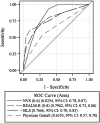
To evaluate the diagnostic accuracy of five health literacy screening instruments in emergency department (ED) patients: the Rapid Evaluation of Adult Literacy in Medicine-Revised (REALM-R), the Newest Vital Sign (NVS), Single Item Literacy Screens (SILS), health numeracy, and physician gestalt. A secondary objective was to evaluate the feasibility of these instruments as measured by administration time, time on task, and interruptions during test administration.
Methods
This was a prospective observational cross-sectional study of a convenience sampling of adult patients presenting during March 2011 and February 2012 to one urban university-affiliated ED. Subjects were consenting non-critically ill, English-speaking patients over the age of 18 years without aphasia, dementia, mental retardation, or inability to communicate. The diagnostic test characteristics of the REALM-R, NVS, SILS, health numeracy, and physician gestalt were quantitatively assessed by using the short Test of Functional Health Literacy in Adults (S-TOHFLA). A score of 22 or less was the criterion standard for limited health literacy (LHL).
Results
Four hundred thirty-five participants were enrolled, with mean age of 45 years (SD ±15.7 years) and 18% had less than a high school education. As defined by an S-TOHFLA score of 22 or less, the prevalence of LHL was 23.9%. In contrast, the NVS, REALM-R, and physician gestalt identified 64.8%, 48.5%, and 35% of participants as LHL, respectively. A normal NVS screen was the most useful test to exclude LHL, with a negative likelihood ratio of 0.04 (95% CI = 0.01 to 0.17). When abnormal, none of the screening instruments, including physician gestalt, significantly increased the post-test probability of LHL. The NVS and REALM-R require 3 and 5 minutes less time to administer than the S-TOHFLA. Administration of the REALM-R is associated with less test interruptions.
Conclusions
One-quarter of these ED patients had marginal or inadequate health literacy. Among the brief screening instruments evaluated, a normal Newest Vital Sign result accurately reduced the probability of limited health literacy, although it will identify two-thirds of ED patients as high-risk for limited health literacy. None of the brief screening instruments significantly increases the probability of limited health literacy when abnormal.
-
Subjects:
-
Source:Acad Emerg Med. 21(2):137-146
-
Pubmed ID:24673669
-
Pubmed Central ID:PMC4042843
-
Document Type:
-
Funding:R21 HS020309/HS/AHRQ HHSUnited States/ ; P30 DK092950/DK/NIDDK NIH HHSUnited States/ ; U54 CA153460/CA/NCI NIH HHSUnited States/ ; P50 CA95815/CA/NCI NIH HHSUnited States/ ; TL1 RR024995/RR/NCRR NIH HHSUnited States/ ; R01 CA168608/CA/NCI NIH HHSUnited States/ ; UL1 TR000448/TR/NCATS NIH HHSUnited States/ ; TL1 TR000449/TR/NCATS NIH HHSUnited States/ ; 1KM1CA156708-01/CA/NCI NIH HHSUnited States/ ; KM1CA156708/CA/NCI NIH HHSUnited States/ ; KM1 CA156708/CA/NCI NIH HHSUnited States/ ; KL2 TR000450/TR/NCATS NIH HHSUnited States/ ; U58 DP003435/DP/NCCDPHP CDC HHSUnited States/ ; 3U54CA153460-03S1/CA/NCI NIH HHSUnited States/ ; UL1 RR024992/RR/NCRR NIH HHSUnited States/ ; P50 CA095815/CA/NCI NIH HHSUnited States/ ; KL2 RR024994/RR/NCRR NIH HHSUnited States/ ; U58 DP0003435/DP/NCCDPHP CDC HHSUnited States/
-
Volume:21
-
Issue:2
-
Collection(s):
-
Main Document Checksum:urn:sha256:c07811cbc6df4cc7054cafa92e3536dac566188fd7c64780c0e654cba2737346
-
Download URL:
-
File Type:
 [PDF
- 265.25 KB
]
[PDF
- 265.25 KB
]
Supporting Files


File Language:
English
ON THIS PAGE



CDC STACKS serves as an archival repository of CDC-published products including
scientific findings,
journal articles, guidelines, recommendations, or other public health information authored or
co-authored by CDC or funded partners.
As a repository, CDC STACKS retains documents in their original published format to ensure public access to scientific information.
As a repository, CDC STACKS retains documents in their original published format to ensure public access to scientific information.
You May Also Like
COLLECTION
CDC Public Access