


Daily Bathing with Chlorhexidine-Based Soap and the Prevention of Staphylococcus aureus Transmission and Infection
Supporting Files

-
Jan 24 2014
-
Details
-
Alternative Title:Infect Control Hosp Epidemiol
-
Personal Author:
-
Description:Objective
Determine if daily bathing with chlorhexidine-based soap decreased methicillin-resistant Staphylococcus aureus (MRSA) transmission and ICU-acquired S. aureus infection among ICU patients.
Design
Prospective pre-post-intervention study with control unit
Setting
1,250 bed tertiary-care teaching hospital
Patients
Medical and surgical intensive care unit (ICU) patients
Methods
Active surveillance for MRSA colonization was performed in both ICUs. In June 2005, a chlorhexidine bathing protocol was implemented in the surgical ICU. Changes in S. aureus transmission and infection rate before and after implementation were analyzed using time-series methodology.
Results
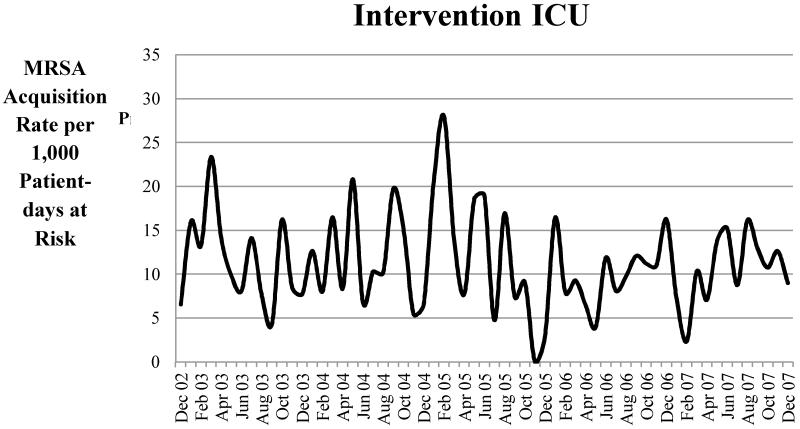
The intervention unit had a 20.68% decrease in MRSA acquisition after institution of the bathing protocol [pre-intervention 12.64 vs. post-intervention 10.03 cases/1000 patient-days-at-risk (95% CI: −5.19 – −0.04, p = 0.046)]. There was no significant change in MRSA acquisition in the control ICU during the study period [10.97 pre-June 2005 vs. 11.33/1000 patient-days at risk post-June 2005 (95% CI −37.40 – 15.19, p = 0.40)]. There was a 20.77% decrease in all S. aureus (including MRSA) acquisition in the intervention ICU from 2002-2007 [19.73 pre-intervention to 15.63 cases per 1000 patient-days at risk post-intervention (95% CI −7.25 – −0.95, p=0.012)]. The incidence of ICU-acquired MRSA infections decreased by 41.37% in the intervention ICU (1.96 pre-intervention vs. 1.15 infections per 1000 patient-days at risk post-intervention; p=0.001).
Conclusions
Institution of daily chlorhexidine bathing in an ICU resulted in a decrease in the transmission of S. aureus, including MRSA. These data support the use of routine daily chlorhexidine baths to decrease rates of S. aureus transmission and infections.
-
Subjects:
-
Source:Infect Control Hosp Epidemiol. 35(3):243-250.
-
Pubmed ID:24521588
-
Pubmed Central ID:PMC4013781
-
Document Type:
-
Funding:
-
Volume:35
-
Issue:3
-
Collection(s):
-
Main Document Checksum:urn:sha-512:d0a68ad95e98f337369b4cc169d2e81bcb8acc4792ad8ae66395611bb0d699bdb6ed53fafb51da59aef7551931f667d1f26b3aff4e16a8206ded73042130c62d
-
Download URL:
-
File Type:
 [PDF
- 372.78 KB
]
[PDF
- 372.78 KB
]
Supporting Files


ON THIS PAGE

CDC STACKS serves as an archival repository of CDC-published products including
scientific findings,
journal articles, guidelines, recommendations, or other public health information authored or
co-authored by CDC or funded partners.
As a repository, CDC STACKS retains documents in their original published format to ensure public access to scientific information.
As a repository, CDC STACKS retains documents in their original published format to ensure public access to scientific information.
You May Also Like
COLLECTION
CDC Public Access