


Prevalence, patterns and predictors of substance use among Latino migrant men in a new receiving community
Supporting Files

-
12 15 2013
-
File Language:
English
Details
-
Alternative Title:Drug Alcohol Depend
-
Personal Author:
-
Description:Background
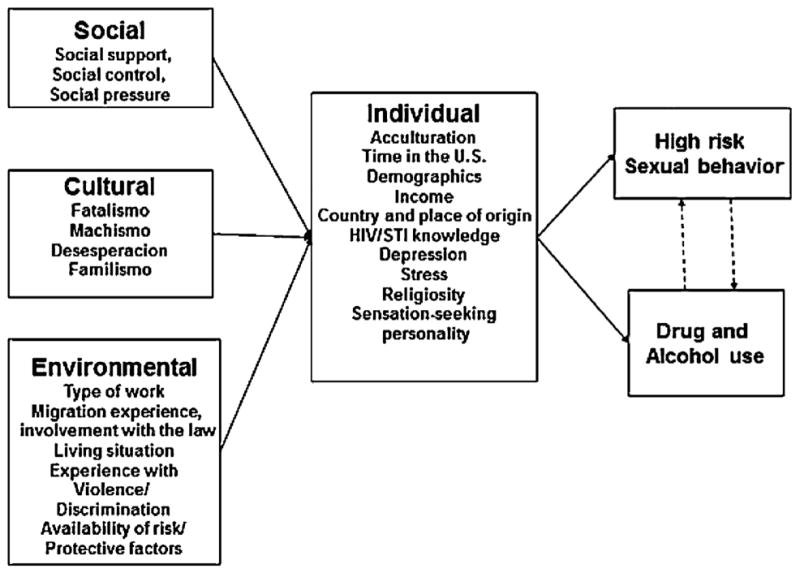
The purpose of this study was to evaluate the prevalence, patterns and predictors (individual, social, cultural, and environmental) of illicit drug use and binge drinking in a cohort of Latino migrant men (LMM) in a new receiving community.
Methods
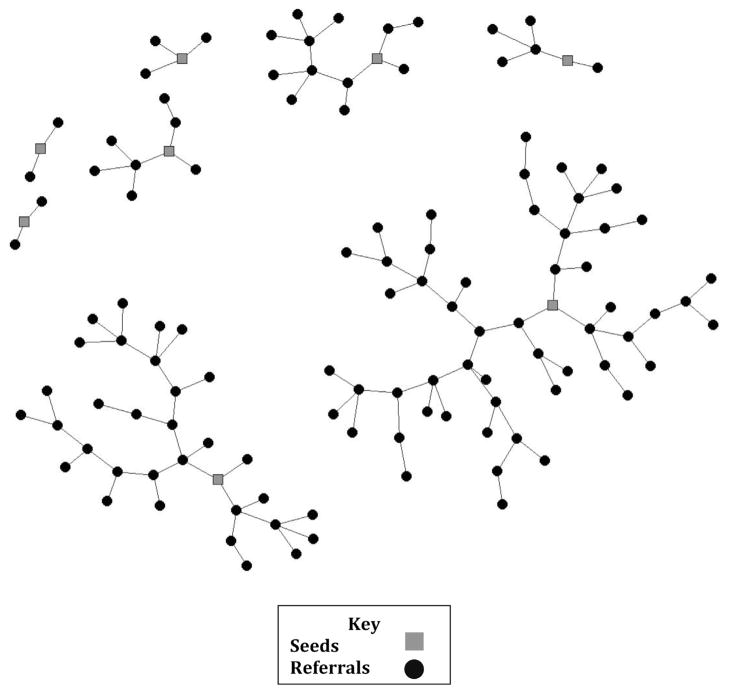
A cohort of LMM in New Orleans (n = 125) was assembled in 2007 using respondent driven sampling and interviewed quarterly for 18 months regarding past month substance use and other potential covariates. Baseline frequencies were weighted using RDSAT and longitudinal analyses included generalized estimating equations (GEE) and the Cochran–Armitage test for trends.
Results
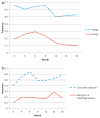
At baseline, substance use behaviors were: drug use 15.0% (range 7.3–25.0%) and binge drinking 58.3% (range 43.6–74.6%). All three of these behaviors decreased over follow-up (P < 0.01). Baseline alcohol dependence and drug problem were 11.8% (range 5.6–24.3%) and 0.08% (range 0.00–2.7%) and both remained the same over time. Baseline rate of chlamydia was 9% (range 0.00–22.4%); all men tested negative for gonorrhea, HIV, and syphilis. For both binge drinking and drug use, having sex with a female sex worker was associated with increased risk, whereas belonging to a club or organization was associated with less risk. Additional factors associated with increased drug use were: having a friend in New Orleans upon arrival, symptoms of depression, and working in construction. An additional factor associated with less binge drinking was having family in New Orleans upon arrival.
Conclusion
Among LMM, substance use is influenced by social and environmental factors. Interventions increase community connectedness may help decrease usage.
-
Subjects:
-
Keywords:
-
Source:Drug Alcohol Depend. 2013; 133(3):814-824
-
Pubmed ID:24099968
-
Pubmed Central ID:PMC3993992
-
Document Type:
-
Funding:R21 DA030269/DA/NIDA NIH HHSUnited States/ ; H25 PS604346-16/PS/NCHHSTP CDC HHSUnited States/ ; R25 DA026401/DA/NIDA NIH HHSUnited States/ ; R21DA030269-01A1/DA/NIDA NIH HHSUnited States/ ; F30 DA033729/DA/NIDA NIH HHSUnited States/ ; R25DA0264/DA/NIDA NIH HHSUnited States/ ; R21 DA026806/DA/NIDA NIH HHSUnited States/ ; 1R21DA026806/DA/NIDA NIH HHSUnited States/ ; F30DA033729/DA/NIDA NIH HHSUnited States/
-
Volume:133
-
Issue:3
-
Collection(s):
-
Main Document Checksum:urn:sha256:c6209a586f321181eb1f839781b2c62d202c736ebaaf931c55eed4f7c9fdadec
-
Download URL:
-
File Type:
 [PDF
- 692.38 KB
]
[PDF
- 692.38 KB
]
Supporting Files


File Language:
English
ON THIS PAGE



CDC STACKS serves as an archival repository of CDC-published products including
scientific findings,
journal articles, guidelines, recommendations, or other public health information authored or
co-authored by CDC or funded partners.
As a repository, CDC STACKS retains documents in their original published format to ensure public access to scientific information.
As a repository, CDC STACKS retains documents in their original published format to ensure public access to scientific information.
You May Also Like
COLLECTION
CDC Public Access