


Human Papillomavirus Prevalence in Invasive Anal Cancers in the United States prior to Vaccine Introduction
Supporting Files

-
Oct 2013
-
File Language:
English
Details
-
Alternative Title:J Low Genit Tract Dis
-
Personal Author:Steinau, M ; Unger, ER ; Hernandez, BY ; Goodman, MT ; Copeland, G ; Hopenhayn, C ; Cozen, W ; Saber, MS ; Huang, Y ; Peters, ES ; Lynch, CF ; Wilkinson, EJ ; Rajeevan, MS ; Lyu, C ; Saraiya, M
-
Description:Objective
Conduct a representative survey of Human papillomavirus (HPV) prevalence and its genotype distribution in invasive anal cancer specimens in the U.S.
Methods
Population-based archival anal cancer specimens were identified from Florida, Kentucky, Louisiana and Michigan cancer registries and SEER tissue repositories in Hawaii, Iowa and Los Angeles. Sections from one representative block per case were used for DNA extraction. All extracts were assayed first by Linear Array and re-tested with INNO-LiPA if inadequate or HPV negative.
Results
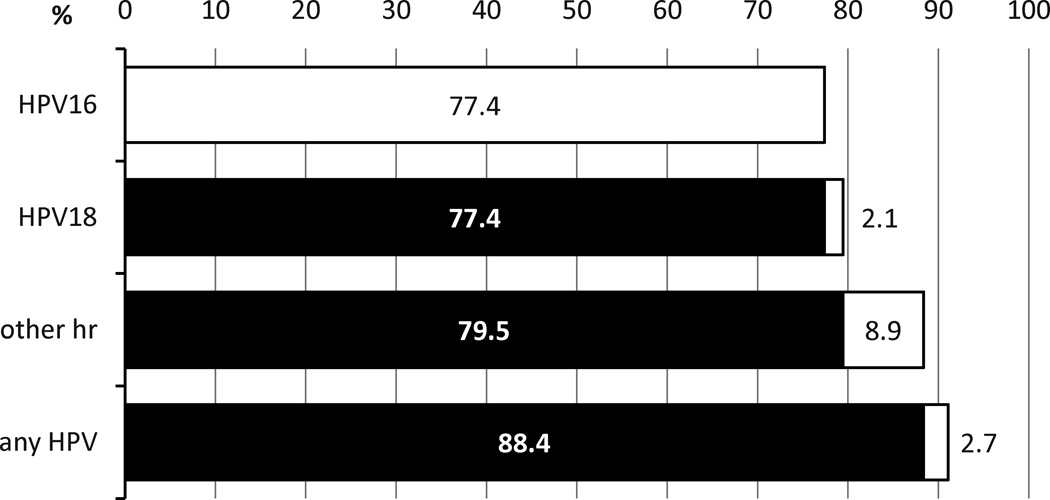
Among 146 unique invasive anal cancer cases, 93 (63.7%) were from women and 53 (36.3%) from men. HPV (any type) was detected in 133 (91.1%) cases and 129 (88.4%) contained at least one high risk type, most (80.1%) as a single genotype. HPV16 had the highest prevalence (113 cases, 77.4%); HPV6, 11, 18 and 33 were also found multiple times. Among HPV16 positive cases, 37% were identified as prototype variant Ep and 63% were non-prototypes: 33% Em, 12% E-G131G, 5% Af1, 4% AA/NA-1, 3% E-C109G, 3% E-G131T, 2% As and 1% Af2. No significant differences in the distributions of HPV (any), high-risk types, or HPV16/18 were seen between gender, race or age group.
Conclusions
The establishment of pre-vaccine HPV prevalence in the U.S. is critical to the surveillance of vaccine efficacy. Almost 80% of anal cancers were positive for the vaccine types HPV16 or HPV18 and in 70% these were the only types detected suggesting that a high proportion might be preventable by current vaccines.
-
Subjects:
-
Source:J Low Genit Tract Dis. 17(4):397-403.
-
Pubmed ID:23609590
-
Pubmed Central ID:PMC3982183
-
Document Type:
-
Funding:1U58DP000807-3/DP/NCCDPHP CDC HHS/United States ; 5U58DP000769-5/DP/NCCDPHP CDC HHS/United States ; 5U58DP000810-5/DP/NCCDPHP CDC HHS/United States ; 5U58DP000812-5/DP/NCCDPHP CDC HHS/United States ; 5U58DP000844-5/DP/NCCDPHP CDC HHS/United States ; N01-PC 2010-00035/PC/NCI NIH HHS/United States ; N01-PC-35137/PC/NCI NIH HHS/United States ; N01-PC-35139/PC/NCI NIH HHS/United States ; N01-PC-35143/PC/NCI NIH HHS/United States ; N01PC35143/CA/NCI NIH HHS/United States
-
Place as Subject:
-
Volume:17
-
Issue:4
-
Collection(s):
-
Main Document Checksum:urn:sha256:509e60a0811d99e08203e30e229326c228ac8e8f42cde15dd6a4525d6352bbba
-
Download URL:
-
File Type:
 [PDF
- 339.72 KB
]
[PDF
- 339.72 KB
]
Supporting Files


File Language:
English
ON THIS PAGE


CDC STACKS serves as an archival repository of CDC-published products including
scientific findings,
journal articles, guidelines, recommendations, or other public health information authored or
co-authored by CDC or funded partners.
As a repository, CDC STACKS retains documents in their original published format to ensure public access to scientific information.
As a repository, CDC STACKS retains documents in their original published format to ensure public access to scientific information.
You May Also Like
COLLECTION
CDC Public Access