



Body mass and smoking are modifiable risk factors for recurrent bladder cancer
Supporting Files

-
Oct 10 2013
-
Available in CDC Stacks on 2015-02-01T00:00:00Z
Details
-
Alternative Title:Cancer
-
Personal Author:Wyszynski, Asaf ; Tanyos, Sam A. ; Rees, Judy R. ; Marsit, Carmen J. ; Kelsey, Karl T. ; Schned, Alan R. ; Pendleton, Eben M. ; Celaya, Maria O. ; Zens, Michael S. ; Karagas, Margaret R. ; Andrew, Angeline S.
-
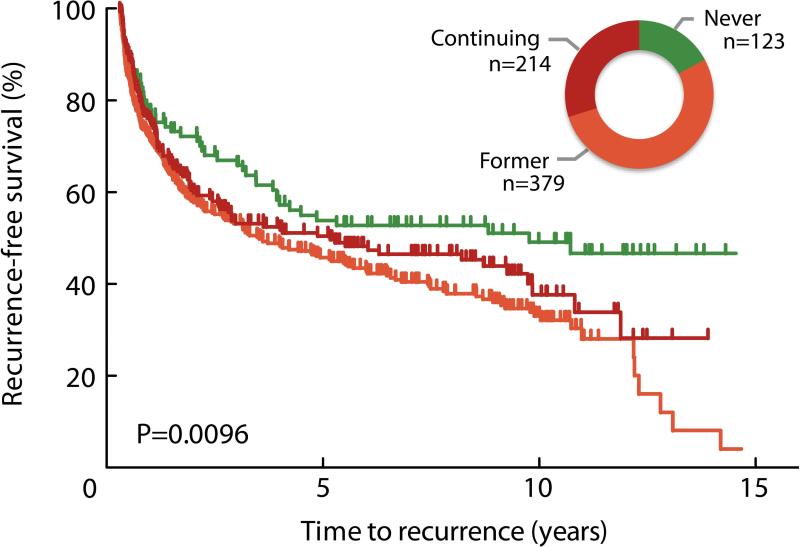
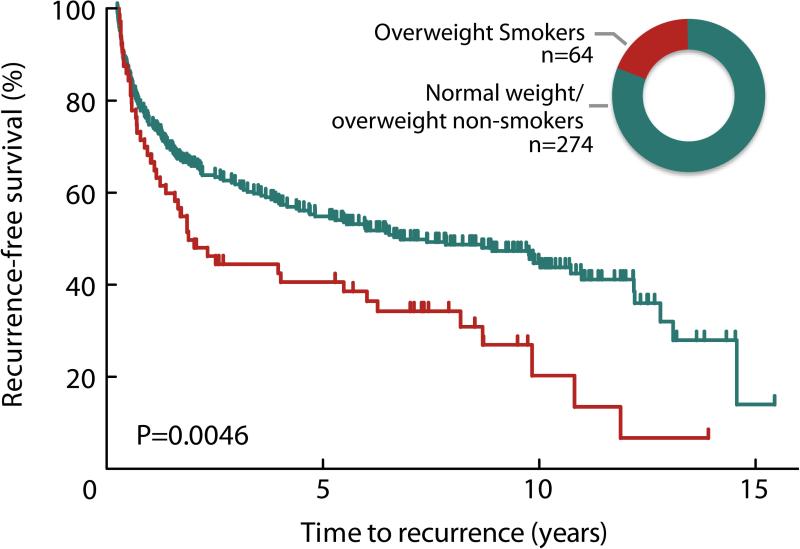
Description:Background ; In the Western world, bladder cancer is the fourth most common cancer in men and the eighth most common in women. Recurrences frequently occur and continued surveillance is necessary to identify and treat recurrent tumors. Efforts to identify risk factors that are potentially modifiable to reduce the rate of recurrence are needed. ; Methods ; We investigated cigarette smoking behavior and body mass index (BMI) at diagnosis for associations with bladder cancer recurrence in a population-based study of 726 bladder cancer patients in New Hampshire, US. Patients diagnosed with non-muscle invasive urothelial-cell carcinoma were followed to ascertain long-term prognosis. Analysis of time to recurrence was performed using multivariate Cox regression models. ; Results ; Smokers experienced shorter time to recurrence (continuing smoker HR 1.51 95%CI 1.08-2.13). Although being overweight (BMI>24.9 kg/m2) at diagnosis was not a strong independent factor (HR 1.33 95%CI 0.94-1.89), among continuing smokers, being overweight more than doubled the risk of recurrence compared to smokers of normal weight (HR 2.67 95%CI 1.14-6.28). ; Conclusions ; These observational results suggest that adiposity is a risk factor for bladder cancer recurrence, particularly among tobacco users. Future intervention studies are warranted to evaluate whether both smoking cessation and weight reduction strategies reduce bladder tumor recurrences.
-
Subjects:
-
Source:Cancer. 120(3):408-414.
-
Pubmed ID:24122218
-
Pubmed Central ID:PMC3946933
-
Document Type:
-
Funding:CA121382/CA/NCI NIH HHS/United States ; CA82354/CA/NCI NIH HHS/United States ; ES00002/ES/NIEHS NIH HHS/United States ; ES05947/ES/NIEHS NIH HHS/United States ; ES07373/ES/NIEHS NIH HHS/United States ; K07 CA102327/CA/NCI NIH HHS/United States ; K07CA102327/CA/NCI NIH HHS/United States ; P20 GM103534/GM/NIGMS NIH HHS/United States ; P20 RR018787/RR/NCRR NIH HHS/United States ; P20 RR024475/RR/NCRR NIH HHS/United States ; P30 ES000002/ES/NIEHS NIH HHS/United States ; P42 ES005947/ES/NIEHS NIH HHS/United States ; P42 ES007373/ES/NIEHS NIH HHS/United States ; R01 CA082354/CA/NCI NIH HHS/United States ; R03 CA121382/CA/NCI NIH HHS/United States ; R21 CA182659/CA/NCI NIH HHS/United States ; RR018787/RR/NCRR NIH HHS/United States ; U58/DP000798/DP/NCCDPHP CDC HHS/United States
-
Volume:120
-
Issue:3
-
Download URL:
-
File Type:
 [PDF - 626.22 KB]
 -
Collection(s):
-
Main Document Checksum:urn:sha256:c0aa8dd20d6a1339352ff8cf00cf5e32c3db0e43ca206690a12aac152fa5ae55
Supporting Files


 Was this page helpful?
 Found an issue?



CDC STACKS serves as an archival repository of CDC-published products including
scientific findings, journal articles, guidelines, recommendations, or other public health information authored or
co-authored by CDC or funded partners.
As a repository, CDC STACKS retains documents in their original published format to ensure public access to scientific information.
As a repository, CDC STACKS retains documents in their original published format to ensure public access to scientific information.
You May Also Like
COLLECTION
CDC Public Access