


A randomized trial of the clinical utility of genetic testing for obesity: Design and implementation considerations
Supporting Files

-
2 2014
-
File Language:
English
Details
-
Alternative Title:Clin Trials
-
Personal Author:
-
Description:Background
Obesity rates in the United States have escalated in recent decades and present a major challenge in public health prevention efforts. Currently, testing to identify genetic risk for obesity is readily available through several direct-to-consumer companies. Despite the availability of this type of testing, there is a paucity of evidence as to whether providing people with personal genetic information on obesity risk will facilitate or impede desired behavioral responses.
Purpose
We describe the key issues in the design and implementation of a randomized controlled trial examining the clinical utility of providing genetic risk information for obesity.
Methods
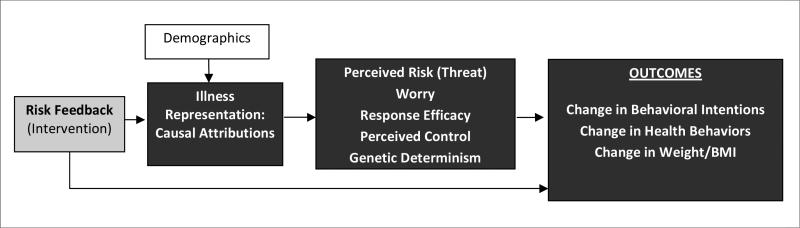
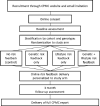
Participants are being recruited from the Coriell Personalized Medicine Collaborative, an ongoing, longitudinal research cohort study designed to determine the utility of personal genome information in health management and clinical decision-making. The primary focus of the ancillary Obesity Risk Communication Study is to determine whether genetic risk information added value to traditional communication efforts for obesity, which are based on lifestyle risk factors. The trial employs a 2x2 factorial design in order to examine the effects of providing genetic risk information for obesity, alone or in combination with lifestyle risk information, on participants’ psychological responses, behavioral intentions, health behaviors, and weight.
Results
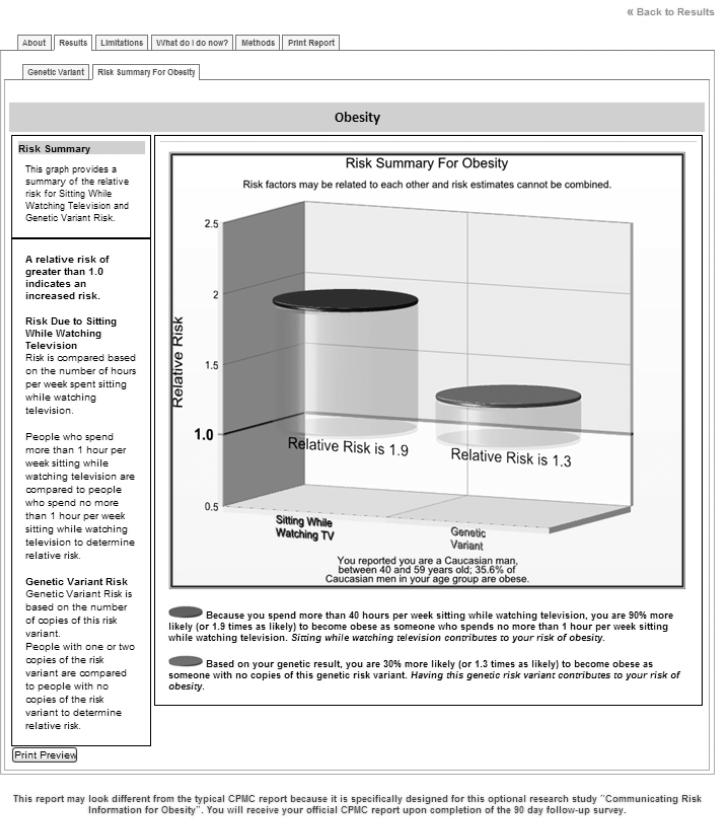
The factorial design generated four experimental arms based on communication of estimated risk to participants: 1) no risk feedback (control), 2) genetic risk only, 3) lifestyle risk only, 4) both genetic and lifestyle risk (combined). Key issues in study design pertained to the selection of algorithms to estimate lifestyle risk and determination of information to be provided to participants assigned to each experimental arm to achieve a balance between clinical standards and methodological rigor. Following the launch of the trial in September 2011, implementation challenges pertaining to low enrollment and differential attrition became apparent and required immediate attention and modifications to the study protocol. Although monitoring of these efforts is ongoing, initial observations show a doubling of enrollment and reduced attrition.
Limitations
The trial is evaluating the short-term impact of providing obesity risk information as participants are followed for only 3 months. This study is built upon the structure of an existing personalized medicine study wherein participants have been provided with genetic information for other diseases. This nesting in a larger study may attenuate the effects of obesity risk information and has implications for the generalizability of study findings.
Conclusions
This randomized trial examines value of obesity genetic information, both when provided independently and when combined with lifestyle risk assessment, to motivate individuals to engage in healthy lifestyle behaviors. Study findings will guide future intervention efforts to effectively communicate genetic risk information.
-
Subjects:
-
Source:Clin Trials. 11(1):102-113
-
Pubmed ID:24216219
-
Pubmed Central ID:PMC3946398
-
Document Type:
-
Funding:K07 CA131103/CA/NCI NIH HHSUnited States/ ; U48 DP001922/DP/NCCDPHP CDC HHSUnited States/ ; AG27841/AG/NIA NIH HHSUnited States/ ; HG02213/HG/NHGRI NIH HHSUnited States/ ; HG005092/HG/NHGRI NIH HHSUnited States/ ; U48DP001922/DP/NCCDPHP CDC HHSUnited States/ ; K24 AG027841/AG/NIA NIH HHSUnited States/ ; HG006500/HG/NHGRI NIH HHSUnited States/ ; R01 HG002213/HG/NHGRI NIH HHSUnited States/ ; R01 HG005092/HG/NHGRI NIH HHSUnited States/ ; K07CA131103/CA/NCI NIH HHSUnited States/ ; R21 HG006073/HG/NHGRI NIH HHSUnited States/ ; HG003170/HG/NHGRI NIH HHSUnited States/ ; P50 HG003170/HG/NHGRI NIH HHSUnited States/ ; U01 HG006500/HG/NHGRI NIH HHSUnited States/
-
Volume:11
-
Issue:1
-
Collection(s):
-
Main Document Checksum:urn:sha256:c30cf3569d4981907d2b836c7978d6d25cfae568c8f3ab7baf0494255eb60127
-
Download URL:
-
File Type:
 [PDF
- 1.28 MB
]
[PDF
- 1.28 MB
]
Supporting Files


File Language:
English
ON THIS PAGE



CDC STACKS serves as an archival repository of CDC-published products including
scientific findings,
journal articles, guidelines, recommendations, or other public health information authored or
co-authored by CDC or funded partners.
As a repository, CDC STACKS retains documents in their original published format to ensure public access to scientific information.
As a repository, CDC STACKS retains documents in their original published format to ensure public access to scientific information.
You May Also Like
COLLECTION
CDC Public Access