



Pet Ownership May Attenuate Loneliness Among Older Adult Primary Care Patients Who Live Alone
Supporting Files

-
2013/09/18
-
Available in CDC Stacks on April 01, 2015, 12:00 AM
Details
-
Alternative Title:Aging Ment Health
-
Personal Author:
-
Description:Objectives
Older adults who report feelings of loneliness are at increased risk for a range of negative physical and mental health outcomes, including early mortality. Identifying potential sources of social connectedness, such as pet ownership, could add to the understanding of how to promote health and well-being in older adults. The aim of this study is to describe the association of pet ownership and loneliness.
Methods
The current study utilizes cross-sectional survey data from a sample (N = 830) of older adult primary care patients (age > 60 years).
Results
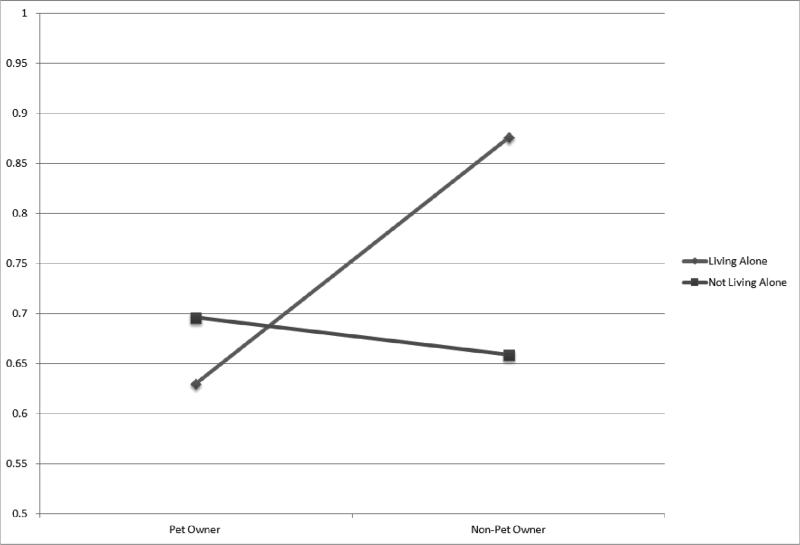
Pet owners were 36% less likely than non-pet owners to report loneliness, in a model controlling for age, living status (i.e., alone vs. not alone), happy mood, and seasonal residency (adjOR = 0.64, 95% CI = 0.41-0.98, p <.05). An interaction was found between pet ownership and living status (b = −1.60, p < .001) in which living alone and not owning a pet was associated with the greatest odds of reporting feelings of loneliness.
Conclusions
Findings suggest that pet ownership may confer benefits for well-being, including attenuating feelings of loneliness and its related sequelae, among older adults who live alone. -
Subjects:
-
Source:Aging Ment Health. 18(3):394-399.
-
Pubmed ID:24047314
-
Pubmed Central ID:PMC3944143
-
Document Type:
-
Funding:
-
Genre:
-
Volume:18
-
Issue:3
-
Download URL:
-
File Type:
 [PDF - 338.66 KB]
 -
Collection(s):
-
Main Document Checksum:urn:sha-512:d5f7c99eaa671049d335649703362c20e5e9e111a98149c56c9dc5c1f7f4286e7eaefd8b3810060ab5f1d8ac8fac28155f5951d99c15ffb16e6c06fca52408e8
Supporting Files


 Was this page helpful?
 Found an issue?


CDC STACKS serves as an archival repository of CDC-published products including
scientific findings, journal articles, guidelines, recommendations, or other public health information authored or
co-authored by CDC or funded partners.
As a repository, CDC STACKS retains documents in their original published format to ensure public access to scientific information.
As a repository, CDC STACKS retains documents in their original published format to ensure public access to scientific information.
You May Also Like
COLLECTION
CDC Public Access