


Comparing Study Populations of Men Who Have Sex with Men: Evaluating Consistency Within Repeat Studies and Across Studies in the Seattle Area Using Different Recruitment Methodologies
Supporting Files

-
Apr 2014
-
Details
-
Alternative Title:AIDS Behav
-
Personal Author:
-
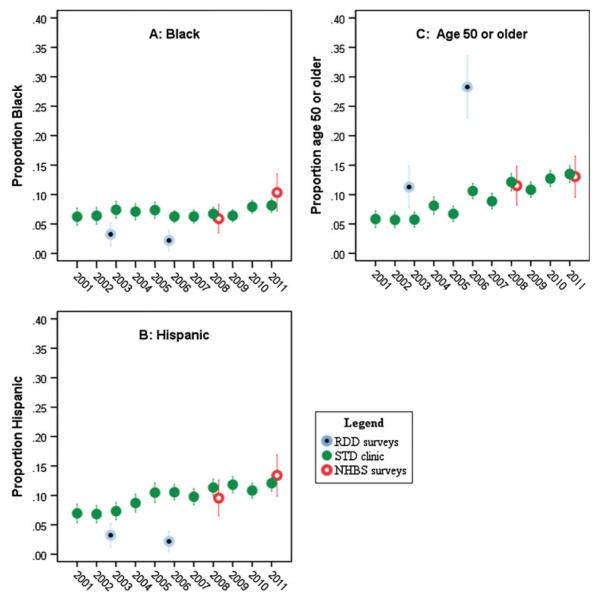
Description:There is no gold standard for recruiting unbiased samples of men who have sex with men (MSM). To assess differing recruitment methods, we compared Seattle-area MSM samples from: venue-day-time sampling-based National HIV Behavioral Surveillance (NHBS) surveys in 2008 and 2011, random-digit-dialed (RDD) surveys in 2003 and 2006, and STD clinic patient data 2001-2011. We compared sociodemographics, sexual and drug-associated behavior, and HIV status and testing. There was generally good consistency between the two NHBS surveys and within STD clinic data across time. NHBS participants reported higher levels of drug-associated and lower levels of sexual risk than STD clinic patients. RDD participants differed from the other study populations in sociodemographics and some risk behaviors. While neither NHBS nor the STD clinic study populations may be representative of all MSM, both appear to provide consistent samples of MSM subpopulations across time that can provide useful information to guide HIV prevention.
-
Subjects:
-
Source:AIDS Behav. 2013; 18(0 3):370-381.
-
Pubmed ID:23900958
-
Pubmed Central ID:PMC3909017
-
Document Type:
-
Funding:
-
Volume:18
-
Collection(s):
-
Main Document Checksum:urn:sha256:a5a53245c3d88ad7da8a91725863536547ae53afd602c9f6afa21bfc14bc5e50
-
Download URL:
-
File Type:
 [PDF
- 684.83 KB
]
[PDF
- 684.83 KB
]
Supporting Files


ON THIS PAGE



CDC STACKS serves as an archival repository of CDC-published products including
scientific findings,
journal articles, guidelines, recommendations, or other public health information authored or
co-authored by CDC or funded partners.
As a repository, CDC STACKS retains documents in their original published format to ensure public access to scientific information.
As a repository, CDC STACKS retains documents in their original published format to ensure public access to scientific information.
You May Also Like
COLLECTION
CDC Public Access