


Behind the Cascade: Analyzing Spatial Patterns along the HIV Care Continuum
Supporting Files

-
Nov 1 2013
-
Details
-
Alternative Title:J Acquir Immune Defic Syndr
-
Personal Author:
-
Description:Background
Successful HIV treatment as prevention requires individuals to be tested, aware of their status, linked to and retained in care, and virally suppressed. Spatial analysis may be useful for monitoring HIV care by identifying geographic areas with poor outcomes.
Methods
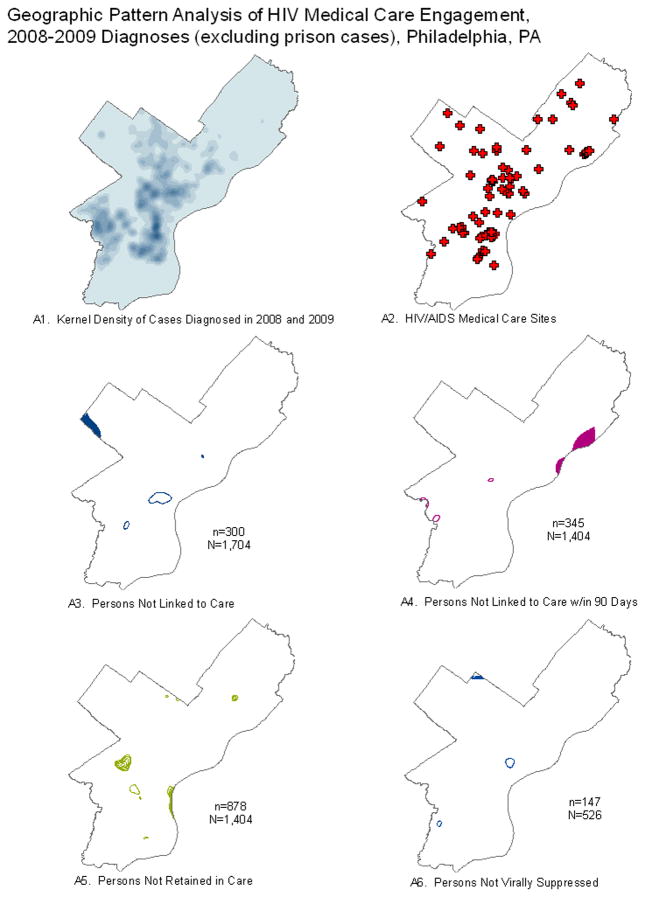
Retrospective cohort of 1,704 people newly diagnosed with HIV identified from Philadelphia’s Enhanced HIV/AIDS Reporting System in 2008–2009, with follow-up to 2011. Outcomes of interest were not linked to care, not linked to care within 90 days, not retained in care, and not virally suppressed. Spatial patterns were analyzed using K-functions to identify ‘hot spots’ for targeted intervention. Geographic components were included in regression analyses along with demographic factors to determine their impact on each outcome.
Results
Overall, 1,404 persons (82%) linked to care; 75% (1,059/1,404) linked within 90 days; 37% (526/1,059) were retained in care; and 72% (379/526) achieved viral suppression. 59 census tracts were in ‘hot spots’, with no overlap between outcomes. Persons residing in geographic areas identified by the local K-function analyses were more likely to not link to care (AOR 1.76 [95% CI 1.30–2.40]), not link to care within 90 days (1.49, 1.12–1.99), not be retained in care (1.84, 1.39–2.43), and not be virally suppressed (3.23, 1.87–5.59) than persons not residing in the identified areas.
Conclusion
This study is the first to identify spatial patterns as a strong independent predictor of linkage to care, retention in care, and viral suppression. Spatial analyses are a valuable tool for characterizing the HIV epidemic and treatment cascade.
-
Subjects:
-
Source:J Acquir Immune Defic Syndr. 64(0 1):S42-S51.
-
Pubmed ID:24126447
-
Pubmed Central ID:PMC3891372
-
Document Type:
-
Funding:(PS13-130202/PS/NCHHSTP CDC HHS/United States ; 5P30AI087714/AI/NIAID NIH HHS/United States ; K23 MH097647/MH/NIMH NIH HHS/United States ; K23-MH097647/MH/NIMH NIH HHS/United States ; P30 AI045008/AI/NIAID NIH HHS/United States ; P30-AI-45008/AI/NIAID NIH HHS/United States ; U62/003959/PHS HHS/United States
-
Volume:64
-
Collection(s):
-
Main Document Checksum:urn:sha256:4e60d67ffc1ca493b972bbab0f1ff8366a9e9d6513c22015f2ec11fed5d8777f
-
Download URL:
-
File Type:
 [PDF
- 611.01 KB
]
[PDF
- 611.01 KB
]
Supporting Files


ON THIS PAGE


CDC STACKS serves as an archival repository of CDC-published products including
scientific findings,
journal articles, guidelines, recommendations, or other public health information authored or
co-authored by CDC or funded partners.
As a repository, CDC STACKS retains documents in their original published format to ensure public access to scientific information.
As a repository, CDC STACKS retains documents in their original published format to ensure public access to scientific information.
You May Also Like
COLLECTION
CDC Public Access