



Iron deficiency modifies gene expression variation induced by augmented hypoxia sensing
Supporting Files

-
Aug 28 2013
-
Available in CDC Stacks on 2015-01-01T00:00:00Z
Details
-
Alternative Title:Blood Cells Mol Dis
-
Personal Author:Zhang, Xu ; Zhang, Wei ; Ma, Shwu-Fan ; Miasniakova, Galina ; Sergueeva, Adelina ; Ammosova, Tatiana ; Xu, Min ; Nekhai, Sergei ; Nourai, Mehdi ; Wade, Michael S. ; Prchal, Josef T. ; Garcia, Joe G. N. ; Machado, Roberto F. ; Gordeuk, Victor R.
-
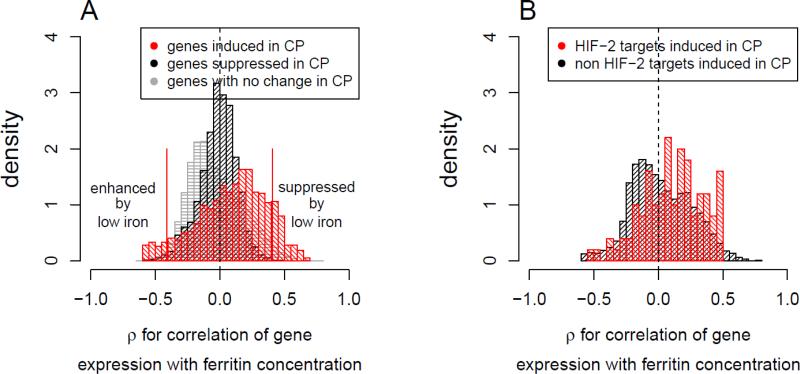
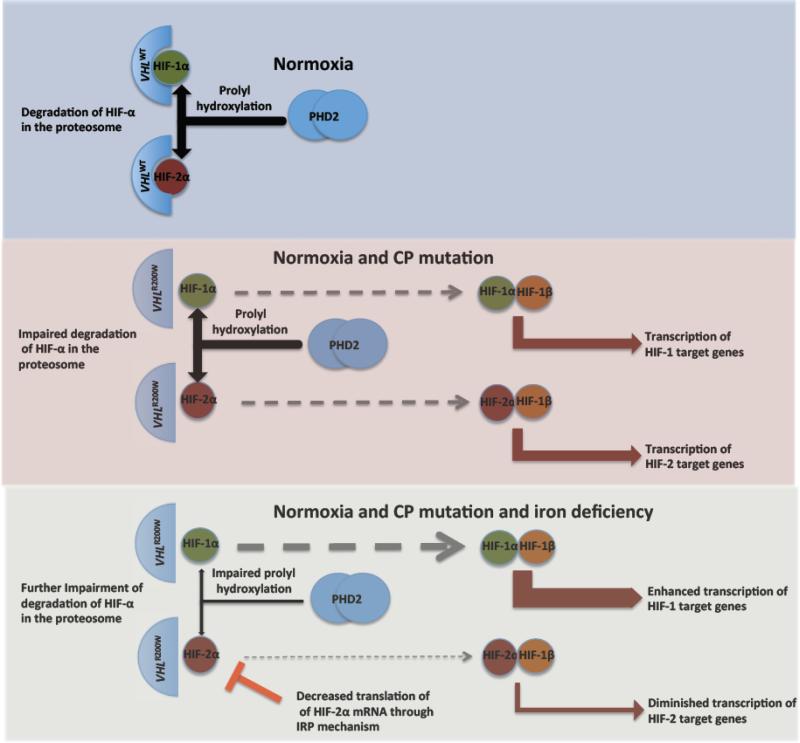
Description:In congenital Chuvash polycythemia (CP), VHL(R200W) homozygosity leads to elevated hypoxia inducible factor (HIF) levels at normoxia. CP is often treated by phlebotomy resulting in iron deficiency, permitting us to examine the separate and synergistic effects of iron deficiency and HIF signaling on gene expression. We compared peripheral blood mononuclear cell gene expression profiles of eight VHL(R200W) homozygotes with 17 wildtype individuals with normal iron status and found 812 up-regulated and 2120 down-regulated genes at false discovery rate of 0.05. Among differential genes we identified three major gene regulation modules involving induction of innate immune responses, alteration of carbohydrate and lipid metabolism, and down-regulation of cell proliferation, stress-induced apoptosis and T-cell activation. These observations suggest molecular mechanisms for previous observations in CP of lower blood sugar without increased insulin and low oncogenic potential. Studies including 16 additional VHL(R200W) homozygotes with low ferritin indicated that iron deficiency enhanced the induction effect of VHL(R200W) for 50 genes including hemoglobin synthesis loci but suppressed the effect for 107 genes enriched for HIF-2 targets. This pattern is consistent with potentiation of HIF-1α protein stability by iron deficiency but a trend for down-regulation of HIF-2α translation by iron deficiency overriding an increase in HIF-2α protein stability.
-
Subjects:
- Article
- Anemia, Iron-Deficiency
- Basic Helix-Loop-Helix Transcription Factors
- Blood Glucose
- Gene Expression Regulation
- Homozygote
- Humans
- Hypoxia
- Hypoxia-Inducible Factor 1, alpha Subunit
- Immunity, Innate
- Insulin
- Iron
- Leukocytes, Mononuclear
- Phlebotomy
- Polycythemia
- Protein Stability
- Signal Transduction
- Von Hippel-Lindau Tumor Suppressor Protein
-
Source:Blood Cells Mol Dis. 2013; 52(1):35-45.
-
Pubmed ID:23993337
-
Pubmed Central ID:PMC3852195
-
Document Type:
-
Funding:R01 HL079912-04/HL/NHLBI NIH HHS/United States ; P01CA108671/CA/NCI NIH HHS/United States ; R01 HL111656/HL/NHLBI NIH HHS/United States ; SC1 GM082325/GM/NIGMS NIH HHS/United States ; R01 HL125005/HL/NHLBI NIH HHS/United States ; G12 MD007597/MD/NIMHD NIH HHS/United States ; G12 RR003048/RR/NCRR NIH HHS/United States ; K23 HL098454/HL/NHLBI NIH HHS/United States ; P30 HL107253/HL/NHLBI NIH HHS/United States ; P50 HL118006/HL/NHLBI NIH HHS/United States ; P01 CA108671/CA/NCI NIH HHS/United States ; 8G12MD007597/MD/NIMHD NIH HHS/United States ; MO1-PR10284/PR/OCPHP CDC HHS/United States ; 1P30HL107253/HL/NHLBI NIH HHS/United States ; R25 HL003679/HL/NHLBI NIH HHS/United States ; R01 HL079912/HL/NHLBI NIH HHS/United States ; R01HL111656/HL/NHLBI NIH HHS/United States ; 2 R25-HL03679-08/HL/NHLBI NIH HHS/United States ; SC1GM082325/GM/NIGMS NIH HHS/United States ; M01 RR010284/RR/NCRR NIH HHS/United States ; K23HL098454/HL/NHLBI NIH HHS/United States ; UH1 HL003679/HL/NHLBI NIH HHS/United States ; 2G12RR003048/RR/NCRR NIH HHS/United States
-
Volume:52
-
Issue:1
-
Download URL:
-
File Type:
 [PDF - 1.75 MB]
 -
Collection(s):
-
Main Document Checksum:urn:sha256:919e865448ee9a8643a489cf6eb9722f063474e037c6d0a538c14978f0248fef
Supporting Files


 Was this page helpful?
 Found an issue?



CDC STACKS serves as an archival repository of CDC-published products including
scientific findings, journal articles, guidelines, recommendations, or other public health information authored or
co-authored by CDC or funded partners.
As a repository, CDC STACKS retains documents in their original published format to ensure public access to scientific information.
As a repository, CDC STACKS retains documents in their original published format to ensure public access to scientific information.
You May Also Like
COLLECTION
CDC Public Access