



A Logic Model for Community Engagement within the CTSA Consortium: Can We Measure What We Model?
Supporting Files

-
2013/10/01
-
Available in CDC Stacks on 2014-10-01T00:00:00Z
File Language:
English
Details
-
Alternative Title:Acad Med
-
Personal Author:
-
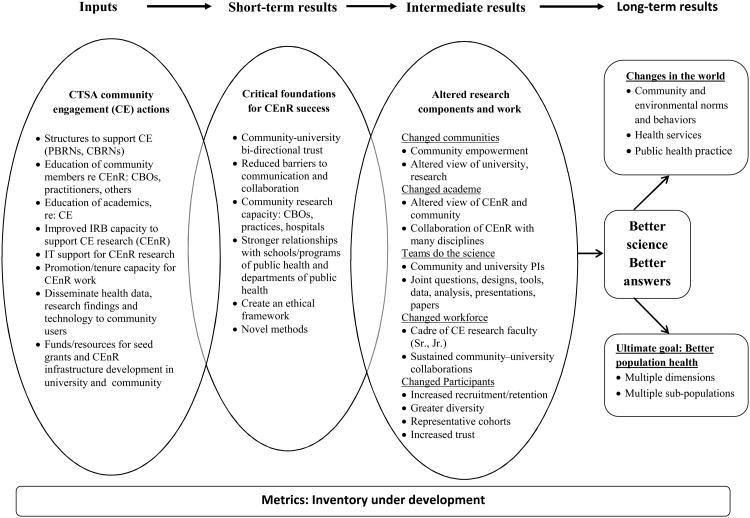
Description:The Clinical and Translational Science Award (CTSA) initiative calls on academic health centers to engage communities around a clinical research relationship measured ultimately in terms of public health. Among a few initiatives involving university accountability for advancing public interests, a small CTSA workgroup devised a community engagement (CE) logic model that organizes common activities within a university-community infrastructure to facilitate CE in research. Whereas the model focuses on the range of institutional CE inputs, it purposefully does not include an approach for assessing how CE influences research implementation and outcomes. Rather, with communities and individuals beginning to transition into new research roles, this article emphasizes studying CE through specific relationship types and assessing how expanded research teams contribute to the full spectrum of translational science.The authors propose a typology consisting of three relationship types-engagement, collaboration, and shared leadership-to provide a foundation for investigating community-academic contributions to the new CTSA research paradigm. The typology shifts attention from specific community-academic activities and, instead, encourages analyses focused on measuring the strength of relationships through variables like synergy and trust. The collaborative study of CE relationships will inform an understanding of CTSA infrastructure development in support of translational research and its goal, which is expressed in the logic model: better science, better answers, better population health.
-
Subjects:
-
Source:Acad Med. 88(10):1430-1436
-
Pubmed ID:23752038
-
Pubmed Central ID:PMC3784628
-
Document Type:
-
Funding:UL1TR000430/TR/NCATS NIH HHSUnited States/ ; UL1 RR024999/RR/NCRR NIH HHSUnited States/ ; UL1 TR001449/TR/NCATS NIH HHSUnited States/ ; UL1 RR024128/RR/NCRR NIH HHSUnited States/ ; UL1 RR031977/RR/NCRR NIH HHSUnited States/ ; UL1 TR001120/TR/NCATS NIH HHSUnited States/ ; UL1RR024999/RR/NCRR NIH HHSUnited States/ ; P30 DK092949/DK/NIDDK NIH HHSUnited States/ ; UL1RR024128/RR/NCRR NIH HHSUnited States/ ; U48-DP001944/DP/NCCDPHP CDC HHSUnited States/ ; U48 DP001944/DP/NCCDPHP CDC HHSUnited States/ ; UL1 TR000430/TR/NCATS NIH HHSUnited States/ ; UL1RR031977/RR/NCRR NIH HHSUnited States/ ; U48DP001944/ACL/ACL HHSUnited States/ ; UL1RR024143/RR/NCRR NIH HHSUnited States/ ; UL1 RR025767/RR/NCRR NIH HHSUnited States/ ; UL1RR025767/RR/NCRR NIH HHSUnited States/ ; UL1 RR024143/RR/NCRR NIH HHSUnited States/
-
Genre:
-
Volume:88
-
Issue:10
-
Download URL:
-
File Type:
 [PDF - 533.42 KB]
 -
Collection(s):
-
Main Document Checksum:urn:sha-512:7f53d4c65de834df34943b923ad5ef8ba82ce1679f303ee890130f54bfe38103a45f378d6137e705561449c55b6c28e219a3f4096d89e1c4e85ff71e564010c0
Supporting Files


File Language:
English
 Was this page helpful?
 Found an issue?

CDC STACKS serves as an archival repository of CDC-published products including
scientific findings, journal articles, guidelines, recommendations, or other public health information authored or
co-authored by CDC or funded partners.
As a repository, CDC STACKS retains documents in their original published format to ensure public access to scientific information.
As a repository, CDC STACKS retains documents in their original published format to ensure public access to scientific information.
You May Also Like
COLLECTION
CDC Public Access