



EPIDEMIOLOGY OF KNEE INJURIES AMONG US HIGH SCHOOL ATHLETES, 2005/06–2010/11
Supporting Files

-
Mar 2013
-
Available in CDC Stacks on 2014-03-01T00:00:00Z
File Language:
English
Details
-
Alternative Title:Med Sci Sports Exerc
-
Personal Author:
-
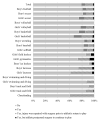
Description:Purpose ; US high school athletes sustain millions of injuries annually. Detailed patterns of knee injuries, among the most costly sports injuries, remain largely unknown. We hypothesize that patterns of knee injuries in US high school sports differ by sport and gender. ; Methods ; US High school sports-related injury data were collected for 20 sports using the National High School Sports-Related Injury Surveillance System, High School RIO™. Knee injury rates, rate ratios, and injury proportion ratios were calculated. ; Results ; From 2005/06–2010/11, 5,116 knee injuries occurred during 17,172,376 athlete exposures (AEs) for an overall rate of 2.98 knee injuries per 10,000 AEs. Knee injuries were more common in competition than practice (RR 3.53, 95% CI 3.34–3.73). Football had the highest knee injury rate (6.29 per 10,000 AEs) followed by girls’ soccer (4.53) and girls’ gymnastics (4.23). Girls had significantly higher knee injury rates than boys in gender-comparable sports (soccer, volleyball, basketball, baseball/softball, lacrosse, swimming and diving, and track and field) (RR 1.52, 95% CI 1.39–1.65). The most commonly involved structure was the MCL (reported in 36.1% of knee injuries), followed by the patella/patellar tendon (29.5%), ACL (25.4%), meniscus (23.0%), LCL (7.9%), and PCL (2.4%). Girls were significantly more likely to sustain ACL injuries in gender-comparable sports (RR 2.38, 95% CI 1.91–2.95). Overall, 21.2% of knee injuries were treated with surgery; girls were more often treated with surgery than boys in gender-comparable sports (IPR 1.30, 95% CI 1.11–1.53). ; Conclusions ; Knee injury patterns differ by sport and gender. Continuing efforts to develop preventive interventions could reduce the burden of these injuries.
-
Subjects:
-
Source:Med Sci Sports Exerc. 2012; 45(3):462-469.
-
Pubmed ID:23059869
-
Pubmed Central ID:PMC3768257
-
Document Type:
-
Funding:
-
Place as Subject:
-
Volume:45
-
Issue:3
-
Download URL:
-
File Type:
 [PDF - 383.49 KB]
 -
Collection(s):
-
Main Document Checksum:urn:sha256:8564dd7ab30818d5be887ffabc4484b88e7a8a4b6dcd501ccf26db10b13babef
Supporting Files


File Language:
English
 Was this page helpful?
 Found an issue?


CDC STACKS serves as an archival repository of CDC-published products including
scientific findings, journal articles, guidelines, recommendations, or other public health information authored or
co-authored by CDC or funded partners.
As a repository, CDC STACKS retains documents in their original published format to ensure public access to scientific information.
As a repository, CDC STACKS retains documents in their original published format to ensure public access to scientific information.
You May Also Like
COLLECTION
CDC Public Access