



Angiotensin Receptor Blockers and Risk of Prostate Cancer among United States Veterans
Supporting Files

-
May 17 2013
-
Available in CDC Stacks on 2014-07-01T00:00:00Z
File Language:
English
Details
-
Alternative Title:J Clin Pharmacol
-
Personal Author:
-
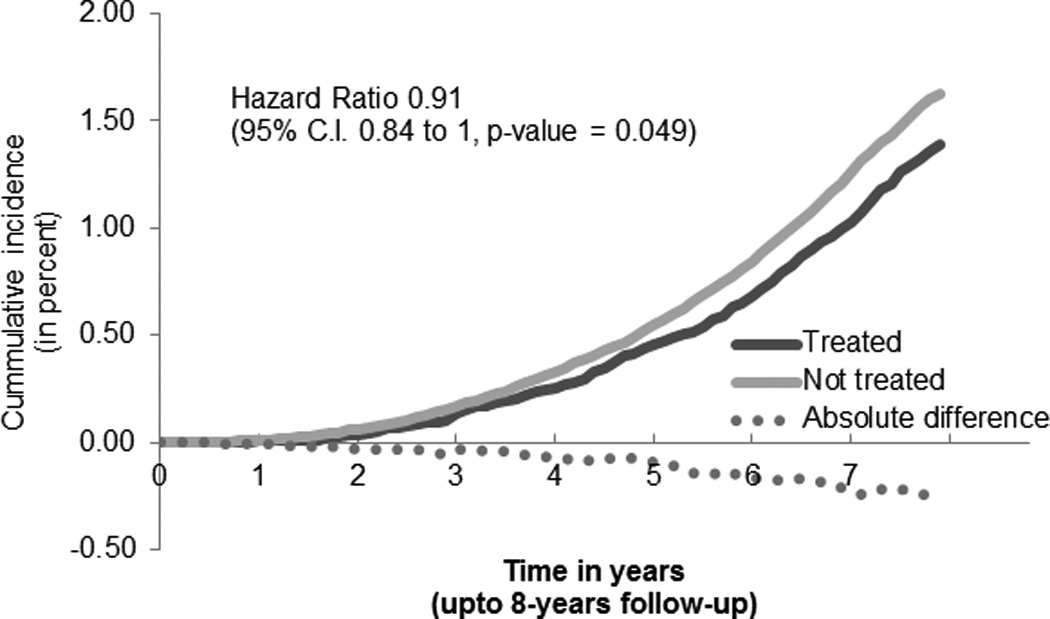
Description:Objectives ; To address concerns regarding increased risk of prostate cancer (PrCA) among Angiotensin Receptor Blocker users, we used national retrospective data from the Department of Veterans Affairs (VA) through the Veterans Affairs Informatics and Computing Infrastructure (VINCI). ; Methods ; We identified a total of 543,824 unique Veterans who were classified into either ARB treated or not-treated in 1:15 ratio. The two groups were balanced using inverse probability of treatment weights. A double-robust cox-proportional hazards model was used to estimate the hazard ratio for PrCA incidence. To evaluate for a potential Gleason score stage migration we conducted weighted Cochrane-Armitage test. ; Results ; Post weighting, the rates of PrCA in treated and not-treated groups were 506 (1.5%) and 8,269 (1.6%), respectively; representing a hazard ratio of (0.91, p-value 0.049). There was no significant difference in Gleason scores between the two groups. ; Conclusions ; We found a small, but statistically significant, reduction in the incidence of clinically detected PrCA among patients assigned to receive ARB with no countervailing effect on degree of differentiation (as indicated by Gleason score). Findings from this study support FDA’s recent conclusion that ARB use does not increase risk of incident PrCA.
-
Subjects:
-
Source:J Clin Pharmacol. 53(7):773-778.
-
Pubmed ID:23686462
-
Pubmed Central ID:PMC3768141
-
Document Type:
-
Funding:
-
Place as Subject:
-
Volume:53
-
Issue:7
-
Download URL:
-
File Type:
 [PDF - 298.48 KB]
 -
Collection(s):
-
Main Document Checksum:urn:sha256:a26da7cfc229ea31a1f8393322d17dfeafba43a437bbd15a3ea5c16f62e56e40
Supporting Files


File Language:
English
 Was this page helpful?
 Found an issue?

CDC STACKS serves as an archival repository of CDC-published products including
scientific findings, journal articles, guidelines, recommendations, or other public health information authored or
co-authored by CDC or funded partners.
As a repository, CDC STACKS retains documents in their original published format to ensure public access to scientific information.
As a repository, CDC STACKS retains documents in their original published format to ensure public access to scientific information.
You May Also Like
COLLECTION
CDC Public Access