


Missed Opportunities for Early Infant HIV Diagnosis: Results of A National Study in South Africa
Supporting Files

-
Mar 01 2015
-
File Language:
English
Details
-
Alternative Title:J Acquir Immune Defic Syndr
-
Personal Author:
-
Description:Background:
Services to diagnose early infant HIV infection should be offered at the 6-week immunization visit. Despite high 6-week immunization attendance, the coverage of early infant diagnosis (EID) is low in many sub-Saharan countries. We explored reasons for such missed opportunities at 6-week immunization visits.
Methods:
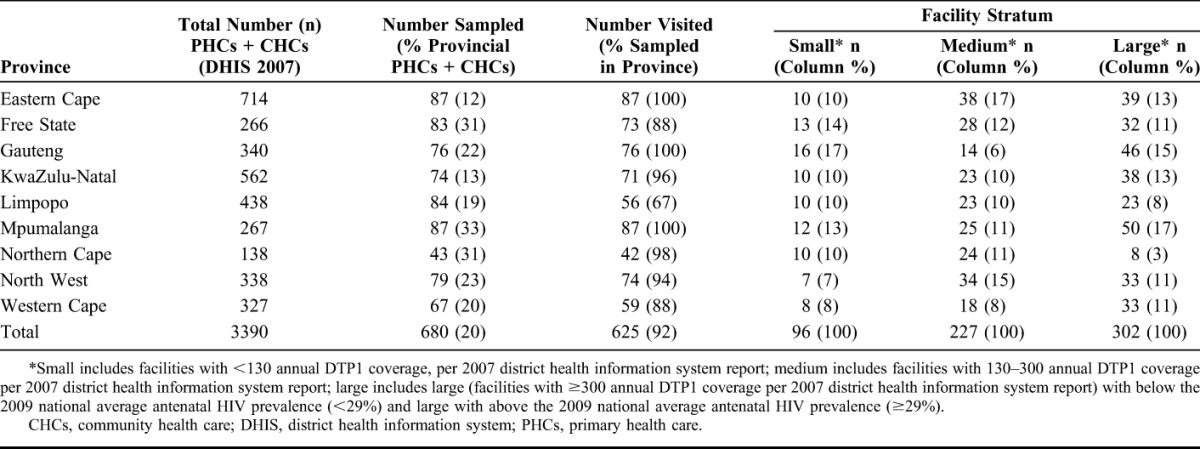
We used data from 2 cross-sectional surveys conducted in 2010 in South Africa. A national assessment was undertaken among randomly selected public facilities (n = 625) to ascertain procedures for EID. A subsample of these facilities (n = 565) was revisited to assess the HIV status of 4- to 8-week-old infants receiving 6-week immunization. We examined potential missed opportunities for EID. We used logistic regression to assess factors influencing maternal intention to report for EID at 6-week immunization visits.
Results:
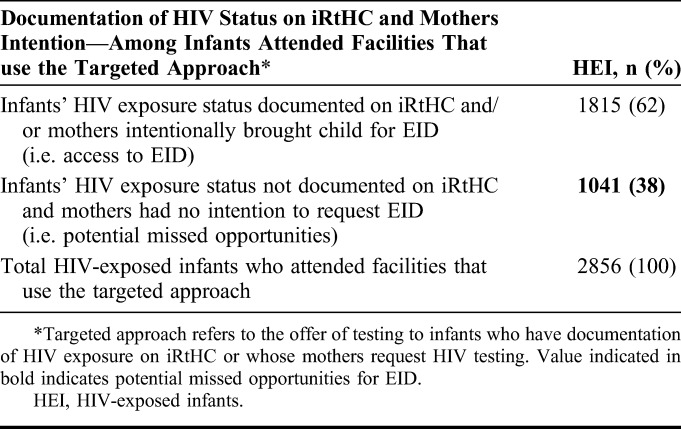
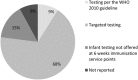
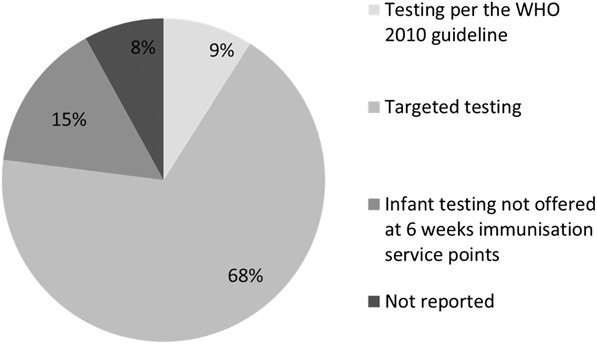
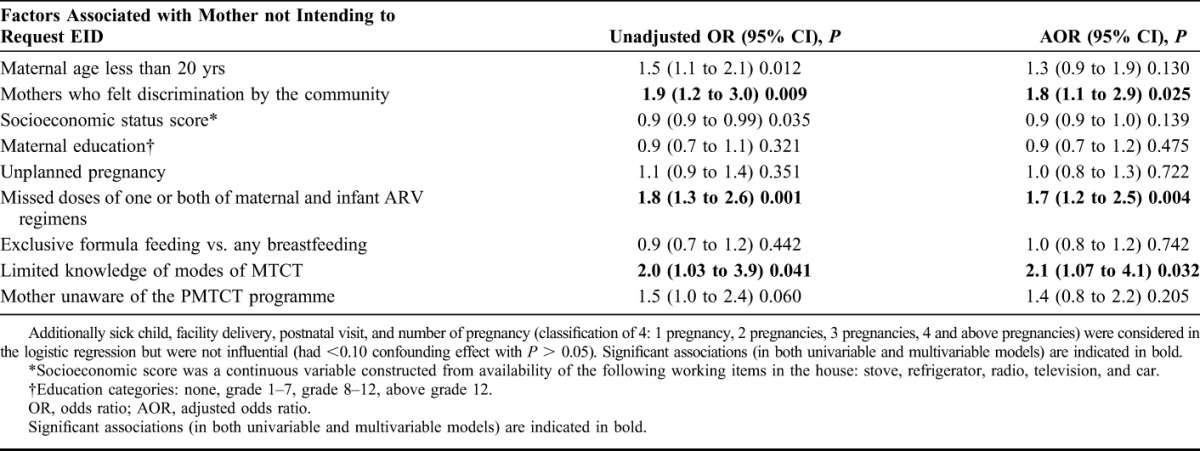
EID services were available in >95% of facilities and 72% of immunization service points (ISPs). The majority (68%) of ISPs provide EID for infants with reported or documented (on infant's Road-to-Health Chart/booklet—iRtHC) HIV exposure. Only 9% of ISPs offered provider-initiated counseling and testing for infants of undocumented/unknown HIV exposure. Interviews with self-reported HIV-positive mothers at ISPs revealed that only 55% had their HIV status documented on their iRtHC and 35% intended to request EID during 6-week immunization. Maternal nonreporting for EID was associated with fear of discrimination, poor adherence to antiretrovirals, and inadequate knowledge about mother-to-child HIV transmission.
Conclusions:
Missed opportunities for EID were attributed to poor documentation of HIV status on iRtHC, inadequate maternal knowledge about mother-to-child HIV transmission, fear of discrimination, and the lack of provider-initiated counseling and testing service for undocumented, unknown, or undeclared HIV-exposed infants.
-
Subjects:
-
Source:J Acquir Immune Defic Syndr. 2014; 68(3):e26-e32
-
Pubmed ID:25469521
-
Pubmed Central ID:PMC4337585
-
Document Type:
-
Funding:
-
Place as Subject:
-
Location:
-
Volume:68
-
Issue:3
-
Collection(s):
-
Main Document Checksum:urn:sha256:8a6406b385bd0a77d9b4434e70bf3ceb509459ca0510f131e6167cd5e2f77e84
-
Download URL:
-
File Type:
 [PDF
- 594.16 KB
]
[PDF
- 594.16 KB
]
Supporting Files


File Language:
English
ON THIS PAGE




CDC STACKS serves as an archival repository of CDC-published products including
scientific findings,
journal articles, guidelines, recommendations, or other public health information authored or
co-authored by CDC or funded partners.
As a repository, CDC STACKS retains documents in their original published format to ensure public access to scientific information.
As a repository, CDC STACKS retains documents in their original published format to ensure public access to scientific information.
You May Also Like
COLLECTION
CDC Public Access