


Epidemiology and Molecular Characterization of Cryptosporidium spp. in Humans, Wild Primates, and Domesticated Animals in the Greater Gombe Ecosystem, Tanzania
Supporting Files
Public Domain

-
Feb 20 2015
-
File Language:
English
Details
-
Alternative Title:PLoS Negl Trop Dis
-
Personal Author:
-
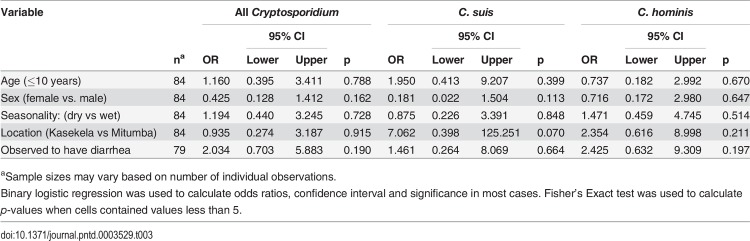
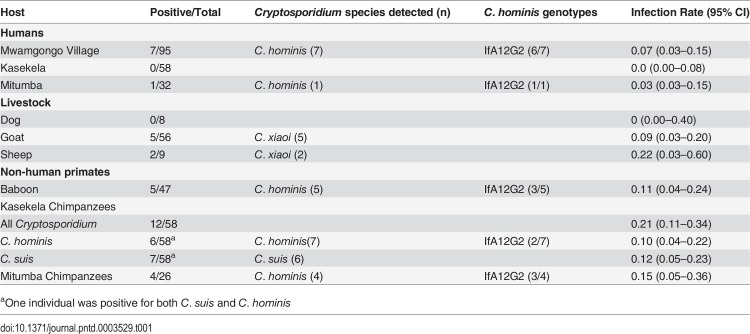
Description:Cryptosporidium is an important zoonotic parasite globally. Few studies have examined the ecology and epidemiology of this pathogen in rural tropical systems characterized by high rates of overlap among humans, domesticated animals, and wildlife. We investigated risk factors for Cryptosporidium infection and assessed cross-species transmission potential among people, non-human primates, and domestic animals in the Gombe Ecosystem, Kigoma District, Tanzania. A cross-sectional survey was designed to determine the occurrence and risk factors for Cryptosporidium infection in humans, domestic animals and wildlife living in and around Gombe National Park. Diagnostic PCR revealed Cryptosporidium infection rates of 4.3% in humans, 16.0% in non-human primates, and 9.6% in livestock. Local streams sampled were negative. DNA sequencing uncovered a complex epidemiology for Cryptosporidium in this system, with humans, baboons and a subset of chimpanzees infected with C. hominis subtype IfA12G2; another subset of chimpanzees infected with C. suis; and all positive goats and sheep infected with C. xiaoi. For humans, residence location was associated with increased risk of infection in Mwamgongo village compared to one camp (Kasekela), and there was an increased odds for infection when living in a household with another positive person. Fecal consistency and other gastrointestinal signs did not predict Cryptosporidium infection. Despite a high degree of habitat overlap between village people and livestock, our results suggest that there are distinct Cryptosporidium transmission dynamics for humans and livestock in this system. The dominance of C. hominis subtype IfA12G2 among humans and non-human primates suggest cross-species transmission. Interestingly, a subset of chimpanzees was infected with C. suis. We hypothesize that there is cross-species transmission from bush pigs (Potaochoerus larvatus) to chimpanzees in Gombe forest, since domesticated pigs are regionally absent. Our findings demonstrate a complex nature of Cryptosporidium in sympatric primates, including humans, and stress the need for further studies.
-
Subjects:
-
Source:PLoS Negl Trop Dis. 9(2).
-
Document Type:
-
Place as Subject:
-
Volume:9
-
Issue:2
-
Collection(s):
-
Main Document Checksum:urn:sha256:e43fbbd377f6e1fc1c3dc84eb0437be3cecec4a2d9469be9220652f472f3e168
-
Download URL:
-
File Type:
 [PDF
- 230.18 KB
]
[PDF
- 230.18 KB
]
Supporting Files


File Language:
English
ON THIS PAGE



CDC STACKS serves as an archival repository of CDC-published products including
scientific findings,
journal articles, guidelines, recommendations, or other public health information authored or
co-authored by CDC or funded partners.
As a repository, CDC STACKS retains documents in their original published format to ensure public access to scientific information.
As a repository, CDC STACKS retains documents in their original published format to ensure public access to scientific information.
You May Also Like
COLLECTION
CDC Public Access