


Distribution of Ashtma by Occupation: Washington State Behavioral Risk Factor Surveillance System Data, 2006-2009
Supporting Files

-
2014/07/15
-
File Language:
English
Details
-
Journal Article:J Asthma
-
Personal Author:
-
Description:Objective
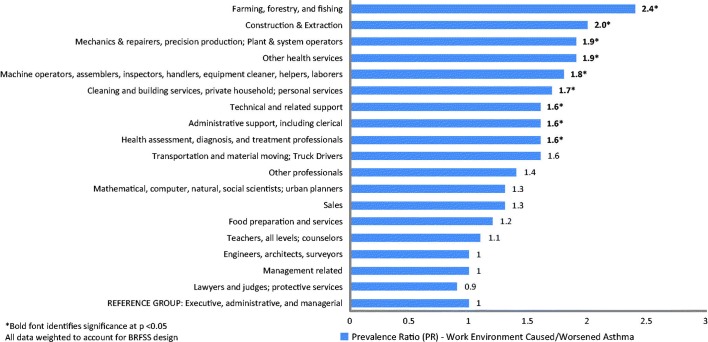
Objective: To estimate the prevalence of asthma in workers by occupation in Washington State. Methods: Data from the 2006–2009 Behavioral Risk Factor Surveillance System (BRFSS) and the BRFSS Asthma Call-Back Survey (ACBS) in Washington State (WA) were analyzed. Using state-added and coded Industry and Occupation questions, we calculated prevalence ratios (PRs) for 19 occupational groups. Results: Of the 41 935 respondents who were currently employed during 2006–2009, the prevalence of current asthma was 8.1% [95% confidence interval (CI) 7.8–8.5%] When compared with the reference group of executive, administration and managerial occupations, three occupational groups had significantly (p < 0.05) higher PRs of current asthma: “Teachers, all levels, and Counselors’ (PR 1.3, 95% CI 1.1–1. 6%); ‘Administrative Support, including Clerical” (PR 1. 5, 95% CI 1.2–1.9%); and “Other Health Services” (PR 1.5, 95% CI 1.2–1.9). Half of the 2511 ACBS respondent workers (55.1%) indicated that they believed exposure at work had caused or worsened their asthma, but only 10.7% had ever spoken with a health care professional about their asthma being work related. Conclusions: Some occupations have a higher prevalence of current asthma than other occupations. The systematic collection of industry and occupation data can help identify worker populations with a high burden of asthma and can be used to target disease prevention efforts as well as to aid clinician recognition and treatment. Workers indicated that work-related asthma exposures are not discussed with their health care provider and this communication gap has implications for asthma management.
-
Subjects:
-
Keywords:Author Keywords: BRFSS; Industry; Lung Disease; Occupational Asthma; Occupational Health; Prevalence; Work Related Respiration; Respiratory-system-disorders; Pulmonary-function; Pulmonary-system; Pulmonary-system-disorders; Diseases; Exposure-levels; Workers; Work-environment; Bronchial-asthma; Statistical-analysis; Risk-factors;
-
Source:J Asthma. 2014; 51(10):1035-1042.
-
Pubmed ID:24995660
-
Pubmed Central ID:PMC4266043
-
Document Type:
-
Funding:
-
Genre:
-
Place as Subject:
-
CIO:
-
Topic:
-
Location:
-
Pages in Document:8 pdf pages
-
Volume:51
-
Issue:10
-
NIOSHTIC Number:nn:20045842
-
Federal Fiscal Year:2015
-
Performing Organization:Washington State Department of Labor and Industries
-
Peer Reviewed:True
-
Collection(s):
-
Main Document Checksum:urn:sha-512:cbdaf22cebf38d21a72a761c340e1c1844bda1fd3c90c424bef87ffb0ebea1b2227f3021a54bc48ee8fb73185888102929ea5123f965df92549620eb6cb48331
-
Download URL:
-
File Type:
 [PDF
- 199.44 KB
]
[PDF
- 199.44 KB
]
Supporting Files


File Language:
English
ON THIS PAGE

CDC STACKS serves as an archival repository of CDC-published products including
scientific findings,
journal articles, guidelines, recommendations, or other public health information authored or
co-authored by CDC or funded partners.
As a repository, CDC STACKS retains documents in their original published format to ensure public access to scientific information.
As a repository, CDC STACKS retains documents in their original published format to ensure public access to scientific information.
You May Also Like