


Comparison of Vector Competence of Aedes mediovittatus and Aedes aegypti for Dengue Virus: Implications for Dengue Control in the Caribbean
Supporting Files
Public Domain

-
Feb 06 2015
-
Details
-
Alternative Title:PLoS Negl Trop Dis
-
Personal Author:
-
Description:Background
Aedes mediovittatus mosquitoes are found throughout the Greater Antilles in the Caribbean and often share the same larval habitats with Ae. Aegypti, the primary vector for dengue virus (DENV). Implementation of vector control measures to control dengue that specifically target Ae. Aegypti may not control DENV transmission in Puerto Rico (PR). Even if Ae. Aegypti is eliminated or DENV refractory mosquitoes are released, DENV transmission may not cease when other competent mosquito species like Ae. Mediovittatus are present. To compare vector competence of Ae. Mediovittatus and Ae. Aegypti mosquitoes, we studied relative infection and transmission rates for all four DENV serotypes.
Methods
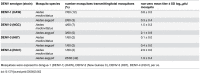
To compare the vector competence of Ae. Mediovittatus and Ae. Aegypti, mosquitoes were exposed to DENV 1–4 per os at viral titers of 5–6 logs plaque-forming unit (pfu) equivalents. At 14 days post infectious bloodmeal, viral RNA was extracted and tested by qRT-PCR to determine infection and transmission rates. Infection and transmission rates were analyzed with a generalized linear model assuming a binomial distribution.
Results
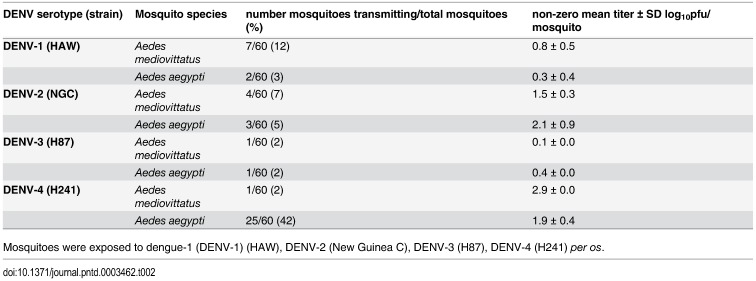
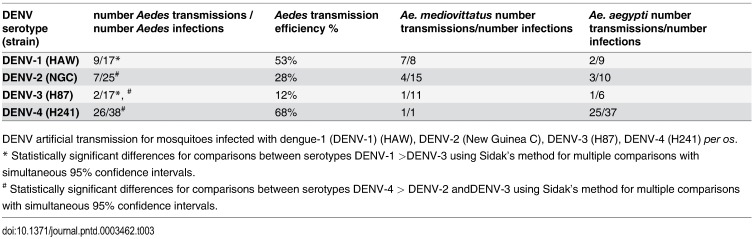
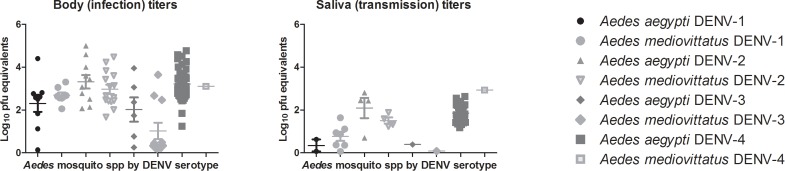
Ae. Aegypti had significantly higher DENV-4 infection and transmission rates than Ae. mediovittatus.
Conclusions
This study determined that Ae. Mediovittatus is a competent DENV vector. Therefore dengue prevention programs in PR and the Caribbean should consider both Ae. Mediovittatus and Ae. Aegypti mosquitoes in their vector control programs.
-
Subjects:
-
Source:PLoS Negl Trop Dis. 9(2).
-
Document Type:
-
Volume:9
-
Issue:2
-
Collection(s):
-
Main Document Checksum:urn:sha256:d7fc20980507b838f408062731b8505bdc53dfcc8ef125ef40f8edd6d63eba84
-
Download URL:
-
File Type:
 [PDF
- 257.66 KB
]
[PDF
- 257.66 KB
]
Supporting Files


ON THIS PAGE




CDC STACKS serves as an archival repository of CDC-published products including
scientific findings,
journal articles, guidelines, recommendations, or other public health information authored or
co-authored by CDC or funded partners.
As a repository, CDC STACKS retains documents in their original published format to ensure public access to scientific information.
As a repository, CDC STACKS retains documents in their original published format to ensure public access to scientific information.
You May Also Like
COLLECTION
CDC Public Access