


Evaluating preservation methods for identifying Anopheles gambiae s.s. and Anopheles arabiensis complex mosquitoes species using near infra-red spectroscopy
Supporting Files
Public Domain

-
Jan 27 2015
File Language:
English
Details
-
Alternative Title:Parasit Vectors
-
Personal Author:
-
Description:Background
Near-infrared spectroscopy (NIRS) has been successfully used on fresh and RNAlater®-preserved members of the Anopheles gambiae complex to identify sibling species and age. No preservation methods other than using RNAlater® have been tested to preserve mosquitoes for species identification using NIRS. However, RNAlater® is not the most practical preservative for field settings because it is expensive, requires basic laboratory conditions for storage and is not widely available in sub-Saharan Africa. The aim of this study was to test several cheaper and more field-friendly preservation methods for identifying sibling species of the An. gambiae complex using NIRS.
Methods
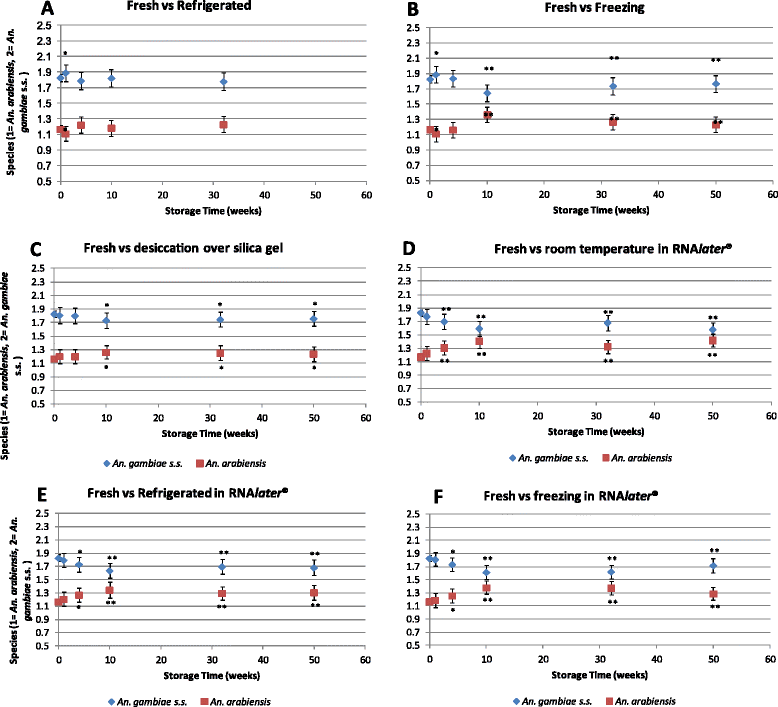
In this study we describe the use of NIRS to identify sibling species of preserved An. gambiae s. s. and An. arabiensis. Mosquitoes of each species were placed in sample tubes and preserved using one of the following preservation methods: (i) refrigeration at 4°C, (ii) freezing at −20°C, (iii) drying over a silica-gel desiccant, (iv) submersion in RNAlater® at room temperature, (v) submersion in RNAlater® at 4°C, and (vi) submersion in RNAlater® at −20°C. Mosquitoes were preserved for 1, 4, 10, 32 or 50 weeks before they were scanned.
Results
Storage at 4°C was the only preservation method that, up to 32 weeks, did not result in significantly lower predicted values than those obtained from fresh insects. After 50 weeks, however, refrigerated samples did not give meaningful results. When storing for 50 weeks, desiccating samples over silica gel was the best preservation method, with a partial least squares regression cross-validation of >80%. Predictive data values were analyzed using a generalized linear model.
Conclusion
NIRS can be used to identify species of desiccated Anopheles gambiae s.s. and Anopheles arabiensis for up to 50 weeks of storage with more than 80% accuracy.
-
Subjects:
-
Source:Parasit Vectors. 8.
-
Document Type:
-
Volume:8
-
Collection(s):
-
Main Document Checksum:urn:sha256:c39ffaa7cf600682c3e7e64215e3d6503fd7b7c7b480d0d45161d36cdf0bb484
-
Download URL:
-
File Type:
 [PDF
- 589.80 KB
]
[PDF
- 589.80 KB
]
Supporting Files


File Language:
English
ON THIS PAGE


CDC STACKS serves as an archival repository of CDC-published products including
scientific findings,
journal articles, guidelines, recommendations, or other public health information authored or
co-authored by CDC or funded partners.
As a repository, CDC STACKS retains documents in their original published format to ensure public access to scientific information.
As a repository, CDC STACKS retains documents in their original published format to ensure public access to scientific information.
You May Also Like
COLLECTION
CDC Public Access