



Mosquitoes Used to Draw Blood for Arbovirus Viremia Determinations in Small Vertebrates
Supporting Files
Public Domain

-
Jun 05 2014
File Language:
English
Details
-
Alternative Title:PLoS One
-
Personal Author:
-
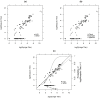
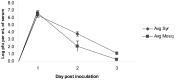
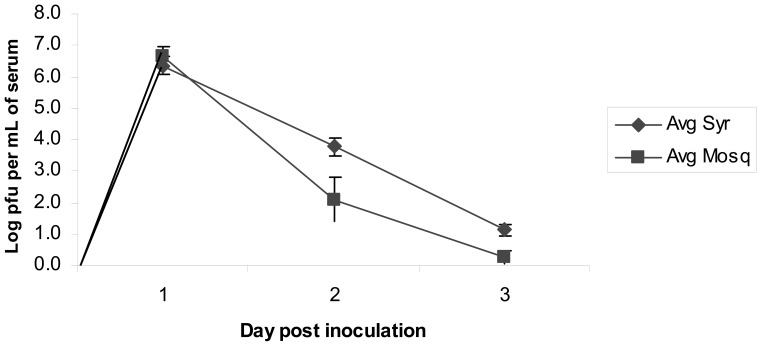
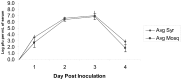
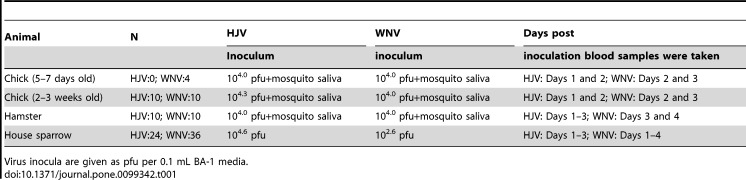
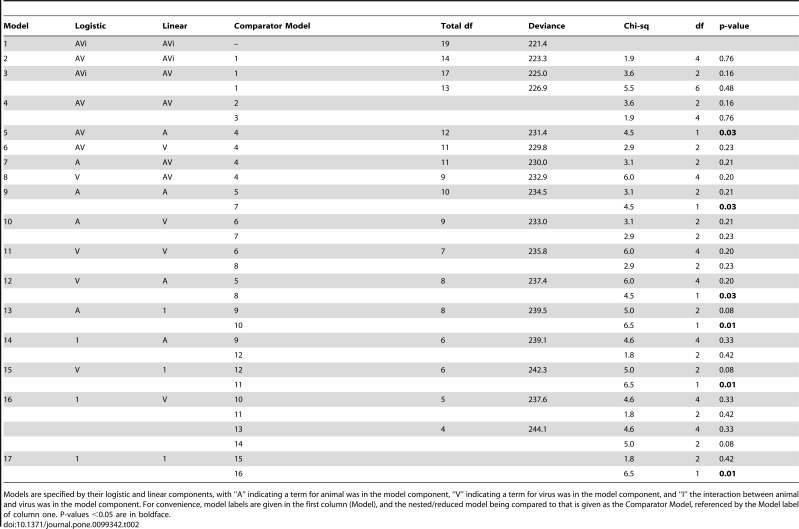
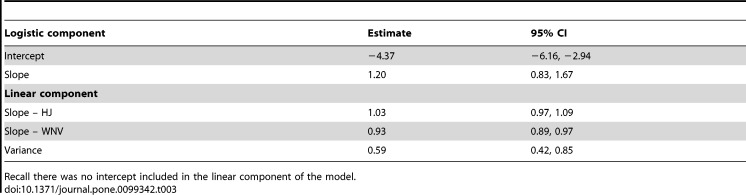
Description:Serial samples from the same individuals may be required for certain virological studies, however, some small animals cannot easily be blood-sampled. Therefore, we evaluated the use of Culex quinquefasciatus Say and Aedes albopictus Skuse mosquitoes as "biological syringes" to draw blood for virus titer determinations in small vertebrates. Groups of chicks (Gallus gallus), hamsters (Mesocricetus auratus), and house sparrows (Passer domesticus) were experimentally infected with West Nile virus (WNV) or Highlands J virus (HJV). In general, good correlation was seen between mosquito- and syringe-derived blood samples at titers ≥5.0 log10 pfu/mL serum as compared with titers <5.0 log10 pfu/mL serum for chicks, hamsters, and sparrows. Ninety-two percent (24/26) of sparrows with virus titers >105 pfu/mL serum had mosquito- and syringe-derived titers within one log of each other. Sparrow viremia profiles generated from single mosquito blood meals and syringe were not significantly different (p>0.05). This technique is valuable for assessing the roles of small vertebrates in the ecologies of arboviruses, and could be used in applications beyond virology and infectious diseases, when <10 µL of whole blood is required.
-
Subjects:
-
Source:PLoS One. 2014; 9(6).
-
Document Type:
-
Volume:9
-
Issue:6
-
Download URL:
-
File Type:
 [PDF - 435.26 KB]
 -
Collection(s):
-
Main Document Checksum:urn:sha256:5783d560fc999806eaf99cb01d07b7f10604c652b7148cce8bb20be873d7933b
Supporting Files


File Language:
English
 Was this page helpful?
 Found an issue?





CDC STACKS serves as an archival repository of CDC-published products including
scientific findings, journal articles, guidelines, recommendations, or other public health information authored or
co-authored by CDC or funded partners.
As a repository, CDC STACKS retains documents in their original published format to ensure public access to scientific information.
As a repository, CDC STACKS retains documents in their original published format to ensure public access to scientific information.
You May Also Like
COLLECTION
CDC Public Access