


Distinguishing highly-related outbreak-associated Clostridium botulinum type A(B) strains
Supporting Files
Public Domain

-
Jul 16 2014
-
File Language:
English
Details
-
Alternative Title:BMC Microbiol
-
Personal Author:
-
Description:Background
In the United States, most Clostridium botulinum type A strains isolated during laboratory investigations of human botulism demonstrate the presence of an expressed type A botulinum neurotoxin (BoNT/A) gene and an unexpressed BoNT/B gene. These strains are designated type A(B). The most common pulsed-field gel electrophoresis (PFGE) pattern in the C. botulinum PulseNet database is composed of A(B) strains. The purpose of this study was to evaluate the ability of genome sequencing and multi-loci variable number of tandem repeat analysis (MLVA) to differentiate such strains.
Results
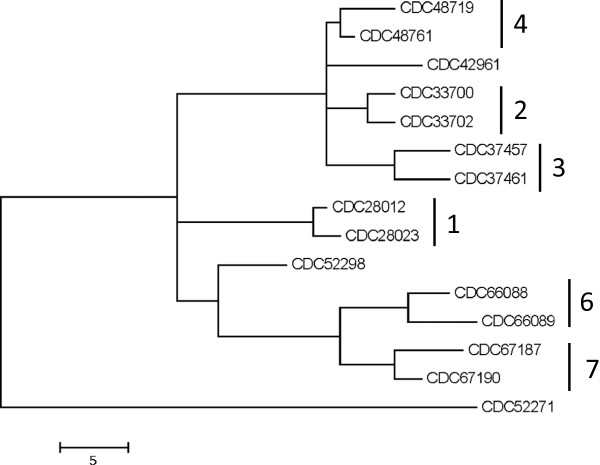
The genome sequences of type A(B) strains evaluated in this study are closely related and cluster together compared to other available C. botulinum Group I genomes. In silico multilocus sequence typing (MLST) analysis (7-loci) was unable to differentiate any of the type A(B) strains isolated from seven different outbreak investigations evaluated in this study. A 15-locus MLVA scheme demonstrated an improved ability to differentiate these strains, however, repeat unit variation among the strains was restricted to only two loci. Reference-free single nucleotide polymorphism (SNP) analysis demonstrated the ability to differentiate strains from all of the outbreaks examined and a non-outbreak associated strain.
Conclusions
This study confirms that type A(B) strains that share the same PFGE pattern also share closely-related genome sequences. The lack of a complete type A(B) strain representative genome sequence hinders the ability to assemble genomes by reference mapping and analysis of SNPs at pre-identified sites. However, compared to other methods evaluated in this study, a reference-free SNP analysis demonstrated optimal subtyping utility for type A(B) strains using de novo assembled genome sequences.
-
Subjects:
-
Source:BMC Microbiol. 2014; 14:192.
-
Document Type:
-
Place as Subject:
-
Volume:14
-
Collection(s):
-
Main Document Checksum:urn:sha256:f8b186b4809cc65b8ae3268a4e272ab19606275c472ded3128f336b0194f1656
-
Download URL:
-
File Type:
 [PDF
- 447.51 KB
]
[PDF
- 447.51 KB
]
Supporting Files


File Language:
English
ON THIS PAGE




CDC STACKS serves as an archival repository of CDC-published products including
scientific findings,
journal articles, guidelines, recommendations, or other public health information authored or
co-authored by CDC or funded partners.
As a repository, CDC STACKS retains documents in their original published format to ensure public access to scientific information.
As a repository, CDC STACKS retains documents in their original published format to ensure public access to scientific information.
You May Also Like
COLLECTION
CDC Public Access