


Using a discrete choice experiment to inform the design of programs to promote colon cancer screening for vulnerable populations in North Carolina
Supporting Files
Public Domain

-
Nov 30 2014
-
File Language:
English
Details
-
Alternative Title:BMC Health Serv Res
-
Personal Author:
-
Description:Background
Screening for colorectal cancer (CRC) is suboptimal, particularly for vulnerable populations. Effective intervention programs are needed to increase screening rates. We used a discrete choice experiment (DCE) to learn about how vulnerable individuals in North Carolina value different aspects of CRC screening programs.
Methods
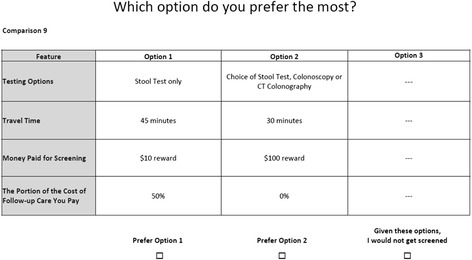
We enrolled English-speaking adults ages 50–75 at average risk of CRC from rural North Carolina communities with low rates of CRC screening, targeting those with public or no insurance and low incomes. Participants received basic information about CRC screening and potential program features, then completed a 16 task DCE and survey questions that examined preferences for four attributes of screening programs: testing options available; travel time required; money paid for screening or rewards for completing screening; and the portion of the cost of follow-up care paid out of pocket. We used Hierarchical Bayesian methods to calculate individual-level utilities for the 4 attributes’ levels and individual-level attribute importance scores. For each individual, the attribute with the highest importance score was considered the most important attribute. Individual utilities were then aggregated to produce mean utilities for each attribute. We also compared DCE-based results with those from direct questions in a post-DCE survey.
Results
We enrolled 150 adults. Mean age was 57.8 (range 50–74); 55% were women; 76% White and 19% African-American; 87% annual household income under $30,000; and 51% were uninsured. Individuals preferred shorter travel; rewards or small copayments compared with large copayments; programs that included stool testing as an option; and greater coverage of follow-up costs. Follow-up cost coverage was most frequently found to be the most important attribute from the DCE (47%); followed by test reward/copayment (33%). From the survey, proportion of follow-up costs paid was most frequently cited as most important (42% of participants), followed by testing options (32%). There was moderate agreement (45%) in attribute importance between the DCE and the single question in the post-DCE survey.
Conclusions
Screening test copayments and follow-up care coverage costs are important program characteristics in this vulnerable, rural population.
Electronic supplementary material
The online version of this article (doi:10.1186/s12913-014-0611-4) contains supplementary material, which is available to authorized users.
-
Subjects:
-
Source:BMC Health Serv Res. 14(1).
-
Document Type:
-
Place as Subject:
-
Volume:14
-
Issue:1
-
Collection(s):
-
Main Document Checksum:urn:sha256:39a8d8b6c0483f043cb5e2ed5324d8f09aa2cda7060ae1c8b8f3561ced62b934
-
Download URL:
-
File Type:
 [PDF
- 301.30 KB
]
[PDF
- 301.30 KB
]
Supporting Files


File Language:
English
ON THIS PAGE


CDC STACKS serves as an archival repository of CDC-published products including
scientific findings,
journal articles, guidelines, recommendations, or other public health information authored or
co-authored by CDC or funded partners.
As a repository, CDC STACKS retains documents in their original published format to ensure public access to scientific information.
As a repository, CDC STACKS retains documents in their original published format to ensure public access to scientific information.
You May Also Like
COLLECTION
CDC Public Access