


Albuminuria According to Status of Autoimmunity and Insulin Sensitivity Among Youth With Type 1 and Type 2 Diabetes
Supporting Files

-
Jul 11 2013
-
File Language:
English
Details
-
Alternative Title:Diabetes Care
-
Personal Author:Mottl, Amy K. ; Lauer, Abigail ; Dabelea, Dana ; Maahs, David M. ; D’Agostino, Ralph B. ; Dolan, Larry M. ; Gilliam, Lisa K. ; Lawrence, Jean M. ; Rodriguez, Beatriz ; Marcovina, Santica M. ; Imperatore, Giuseppina ; Kanakatti Shankar, Roopa ; Afkarian, Maryam ; Reynolds, Kristi ; Liese, Angela D. ; Mauer, Michael ; Mayer-Davis, Elizabeth J.
-
Corporate Authors:
-
Description:OBJECTIVE
To evaluate whether etiologic diabetes type is associated with the degree of albuminuria in children with diabetes.
RESEARCH DESIGN AND METHODS
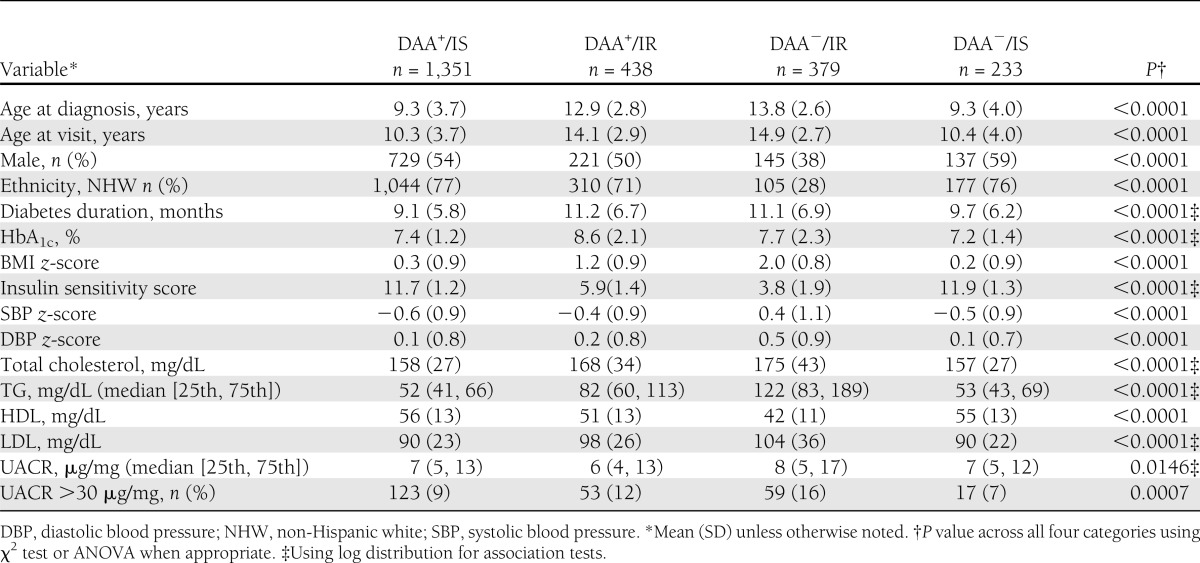
SEARCH is an observational, longitudinal study of children with diabetes. Youth with newly diagnosed diabetes were classified according to diabetes autoantibody (DAA) status and presence of insulin resistance. We defined insulin resistance as an insulin sensitivity score <25th percentile for the United States general youth population. DAA status was based on positivity for the 65-kD isoform of glutamate decarboxylase and insulinoma-associated protein 2 antigens. The four etiologic diabetes type groups were as follows: DAA+/insulin-sensitive (IS) (n = 1,351); DAA+/insulin-resistant (IR) (n = 438); DAA−/IR (n = 379); and DAA−/IS (n = 233). Urinary albumin:creatinine ratio (UACR) was measured from a random urine specimen. Multivariable regression analyses assessed the independent relationship between the four diabetes type groups and magnitude of UACR.
RESULTS
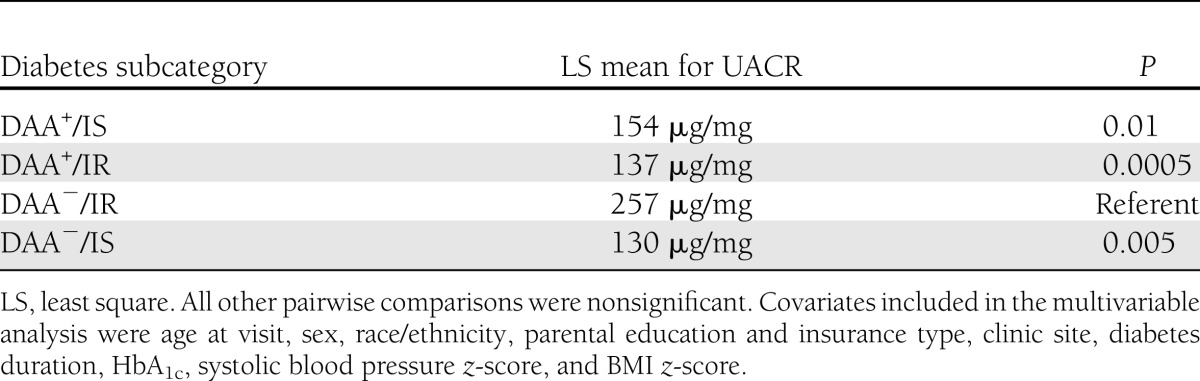
Adjusted UACR means across the four groups were as follows: DAA+/IS = 154 μg/mg; DAA+/IR = 137 μg/mg; DAA−/IR = 257 μg/mg; and DAA−/IS = 131 μg/mg (P < 0.005). Only DAA−/IR was significantly different. We performed post hoc multivariable regression analysis restricted to the two IR groups to explore the contribution of DAA status and insulin sensitivity (continuous) to the difference in UACR between the IR groups. Only insulin sensitivity was significantly associated with UACR (β = −0.54; P < 0.0001).
CONCLUSIONS
In youth with diabetes, the DAA−/IR group had a greater UACR than all other groups, possibly because of the greater magnitude of insulin resistance. Further exploration of the relationships between severity of insulin resistance, autoimmunity, and albuminuria in youth with diabetes is warranted.
-
Subjects:
-
Source:Diabetes Care. 2013; 36(11):3633-3638.
-
Pubmed ID:23846811
-
Pubmed Central ID:PMC3816857
-
Document Type:
-
Funding:00097/PHS HHS/United States ; 1U18DP002709/DP/NCCDPHP CDC HHS/United States ; 1UL1RR026314-01/RR/NCRR NIH HHS/United States ; 200-2010-35171/PHS HHS/United States ; DP-05-06/DP/NCCDPHP CDC HHS/United States ; DP-10-001/DP/NCCDPHP CDC HHS/United States ; K23 DK089017/DK/NIDDK NIH HHS/United States ; M01RR00037/RR/NCRR NIH HHS/United States ; M01RR00069/RR/NCRR NIH HHS/United States ; P30 DK57516/DK/NIDDK NIH HHS/United States ; U01 DP000244/DP/NCCDPHP CDC HHS/United States ; U01 DP000254/DP/NCCDPHP CDC HHS/United States ; U01-DP000246/DP/NCCDPHP CDC HHS/United States ; U01DP000245/DP/NCCDPHP CDC HHS/United States ; U01DP000247/DP/NCCDPHP CDC HHS/United States ; U01DP000248/DP/NCCDPHP CDC HHS/United States ; U01DP000250/DP/NCCDPHP CDC HHS/United States ; U18DP000247-06A1/DP/NCCDPHP CDC HHS/United States ; U18DP002708-01/DP/NCCDPHP CDC HHS/United States ; U18DP002710-01/DP/NCCDPHP CDC HHS/United States ; U18DP002714/DP/NCCDPHP CDC HHS/United States ; U48/CCU419249/PHS HHS/United States ; U48/CCU519239/PHS HHS/United States ; U48/CCU819241-3/PHS HHS/United States ; U48/CCU919219/PHS HHS/United States ; U58/CCU019235-4/PHS HHS/United States ; U58CCU919256/PHS HHS/United States ; UL1 TR000077/TR/NCATS NIH HHS/United States ; UL1RR029882/RR/NCRR NIH HHS/United States
-
Place as Subject:
-
Volume:36
-
Issue:11
-
Collection(s):
-
Main Document Checksum:urn:sha256:1cc0d80f69f039e4217021f86c70fa4f2268a3824412ee1dbbfe6a4d3e53f9fc
-
Download URL:
-
File Type:
 [PDF
- 123.75 KB
]
[PDF
- 123.75 KB
]
Supporting Files


File Language:
English
ON THIS PAGE




CDC STACKS serves as an archival repository of CDC-published products including
scientific findings,
journal articles, guidelines, recommendations, or other public health information authored or
co-authored by CDC or funded partners.
As a repository, CDC STACKS retains documents in their original published format to ensure public access to scientific information.
As a repository, CDC STACKS retains documents in their original published format to ensure public access to scientific information.
You May Also Like
COLLECTION
CDC Public Access