


Bats, emerging infectious diseases, and the rabies paradigm revisited
Supporting Files

-
Jun 20 2011
-
File Language:
English
Details
-
Alternative Title:Emerg Health Threats J
-
Personal Author:
-
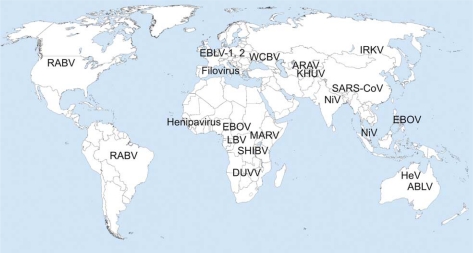
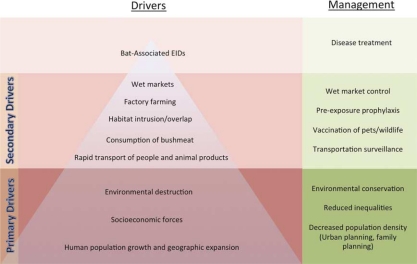
Description:The significance of bats as sources of emerging infectious diseases has been increasingly appreciated, and new data have been accumulated rapidly during recent years. For some emerging pathogens the bat origin has been confirmed (such as lyssaviruses, henipaviruses, coronaviruses), for other it has been suggested (filoviruses). Several recently identified viruses remain to be 'orphan' but have a potential for further emergence (such as Tioman, Menangle, and Pulau viruses). In the present review we summarize information on major bat-associated emerging infections and discuss specific characteristics of bats as carriers of pathogens (from evolutionary, ecological, and immunological positions). We also discuss drivers and forces of an infectious disease emergence and describe various existing and potential approaches for control and prevention of such infections at individual, populational, and societal levels.
-
Subjects:
-
Source:Emerg Health Threats J. 2011; 4.
-
Pubmed ID:24149032
-
Pubmed Central ID:PMC3168224
-
Document Type:
-
Funding:
-
Volume:4
-
Collection(s):
-
Main Document Checksum:urn:sha256:0b52e33c4a8fe5b06313f2b2858493bf862519eb25fa9a4d9e83b5ba61833489
-
Download URL:
-
File Type:
 [PDF
- 355.17 KB
]
[PDF
- 355.17 KB
]
Supporting Files


File Language:
English
ON THIS PAGE



CDC STACKS serves as an archival repository of CDC-published products including
scientific findings,
journal articles, guidelines, recommendations, or other public health information authored or
co-authored by CDC or funded partners.
As a repository, CDC STACKS retains documents in their original published format to ensure public access to scientific information.
As a repository, CDC STACKS retains documents in their original published format to ensure public access to scientific information.
You May Also Like
COLLECTION
CDC Public Access