



Severe Obesity Among Children in New York City Public Elementary and Middle Schools, School Years 2006–07 Through 2010–11
Supporting Files
Public Domain

-
Jul 10 2014
File Language:
English
Details
-
Journal Article:Preventing Chronic Disease (PCD)
-
Personal Author:
-
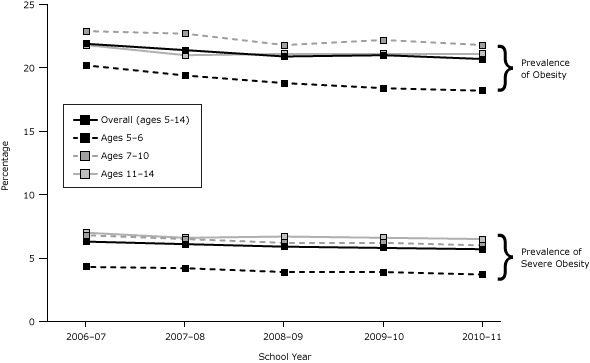
Description:Introduction ; Although studies have shown that childhood obesity overall is on the decline among New York City (NYC) public school children, the prevalence of severe childhood obesity has not been studied. ; Methods ; We used height and weight measurements of 947,765 NYC public school students aged 5 to 14 years in kindergarten through 8th grade (K–8), from school years 2006–07 through 2010–11. We used age- and sex-specific body mass index (BMI) percentiles according to Centers for Disease Control and Prevention growth charts to define childhood obesity (BMI ≥ 95th percentile) and severe childhood obesity (BMI ≥120% of 95th percentile) and to identify biologically implausible values (BIV). Multivariable logistic models tested for trends in obesity and severe obesity prevalence. To evaluate misclassification, we recalculated prevalence estimates for the most recent school year (2010–11) including the student records identified as BIV who were also declared severely obese (BMI ≥ 120% of 95th percentile). We refer to this subgroup of BIVs as “high BIV.” ; Results ; Severe obesity among NYC public school students in grades K–8 decreased 9.5% from the 2006–07 school year (6.3%) to the 2010–11 school year (5.7%), and obesity decreased 5.5% (from 21.9% to 20.7%). The prevalence of severe obesity and obesity was highest among minority, poor, and male children. Severe obesity declined in prevalence among every subgroup, with the greatest effect among white students and wealthy students. Severe obesity prevalence increased with age, and obesity prevalence peaked among those aged 7 to 10 years. For the 2010–11 school year, including high BIVs increased severe obesity prevalence from 5.7% to 6.6% and increased obesity prevalence from 20.7% to 21.5%. ; Conclusion ; Among all subgroups of NYC public school children in grades K–8, the reduction in severe obesity was greater than the reduction in overall obesity. Efforts to decrease obesity in NYC have affected the severely obese; however, monitoring of this specific subgroup should continue because of differences in trends and greater health risks.
-
Subjects:
-
Source:Prev Chronic Dis. 11.
-
ISSN:1545-1151
-
Document Type:
-
Place as Subject:
-
Volume:11
-
Download URL:
-
File Type:
 [PDF - 710.88 KB]
 -
Collection(s):
-
Main Document Checksum:urn:sha-512:19ca628c60418f869ae6fcdd4e6affc8efd021ac7505541eb9f99b92217b1060d61732439b8fed7d3f6fc6d8bf37e6116b7d5598dd95aae39354f7fadb8f8313
Supporting Files


File Language:
English
 Was this page helpful?
 Found an issue?



CDC STACKS serves as an archival repository of CDC-published products including
scientific findings, journal articles, guidelines, recommendations, or other public health information authored or
co-authored by CDC or funded partners.
As a repository, CDC STACKS retains documents in their original published format to ensure public access to scientific information.
As a repository, CDC STACKS retains documents in their original published format to ensure public access to scientific information.
You May Also Like
COLLECTION
Preventing Chronic Disease