


Effect of Partner Violence in Adolescence and Young Adulthood on Blood Pressure and Incident Hypertension
Supporting Files

-
Mar 21 2014
-
File Language:
English
Details
-
Alternative Title:PLoS One
-
Personal Author:
-
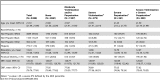
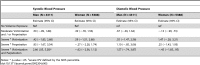
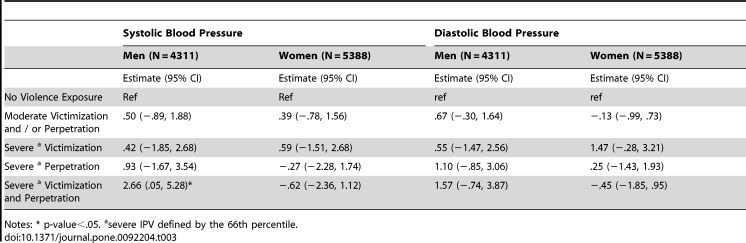
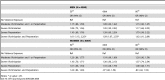
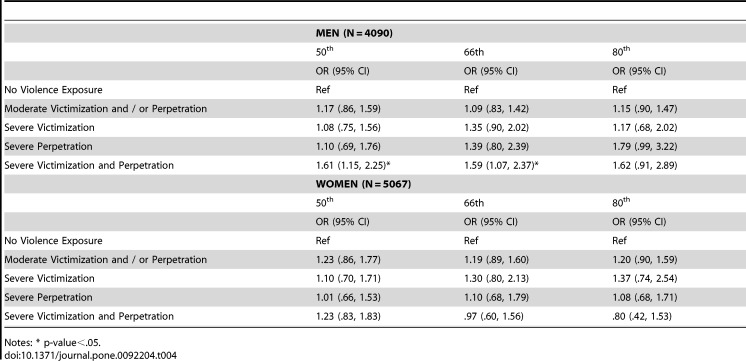
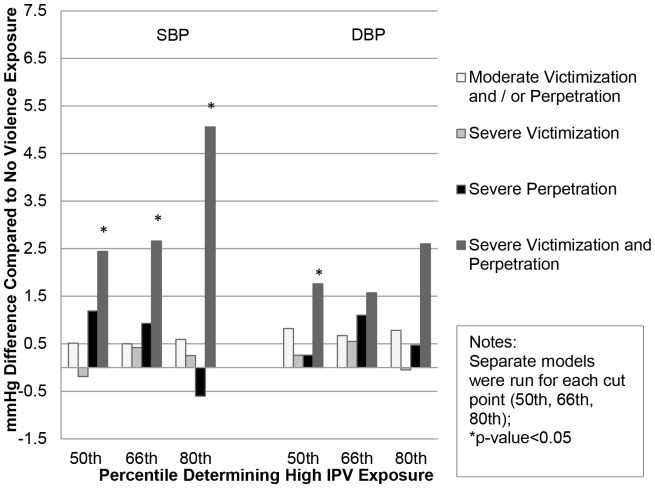
Description:Intimate partner violence has adverse health consequences, but little is known about its association with hypertension. This study investigates sex differences in the relationship between intimate partner violence and blood pressure outcomes. Data included 9,699 participants from waves 3 (2001-02) and 4 (2008-09) of the National Longitudinal Study of Adolescent Health (51% female). Systolic (SBP) and diastolic (DBP) blood pressure and incident hypertension (SBP≥140 mmHg, DBP≥90 mmHg, or taking antihypertensive medication) were ascertained at wave 4. Intimate partner violence was measured at wave 3 with 8 items from the revised Conflict Tactics Scales. Separate victimization and perpetration scores were calculated. Sex-specific indicators of severe victimization and perpetration were created using the 66th percentile among those exposed as a cut point. Sex-specific, linear and logistic regression models were developed adjusting for age, race, financial stress, and education. Thirty-three percent of men and 47% of women reported any intimate partner violence exposure; participants were categorized as having: no exposure, moderate victimization and / or perpetration only, severe victimization, severe perpetration, and severe victimization and perpetration. Men experiencing severe perpetration and victimization had a 2.66 mmHg (95% CI: 0.05, 5.28) higher SBP and a 59% increased odds (OR: 1.59, 95% CI: 1.07, 2.37) of incident hypertension compared to men not exposed to intimate partner violence. No other category of violence was associated with blood pressure outcomes in men. Intimate partner violence was not associated with blood pressure outcomes in women. Intimate partner violence may have long-term consequences for men's hemodynamic health. Screening men for victimization and perpetration may assist clinicians to identify individuals at increased risk of hypertension.
-
Subjects:
-
Source:PLoS One. 2014; 9(3).
-
Pubmed ID:24658452
-
Pubmed Central ID:PMC3962399
-
Document Type:
-
Funding:1P60MD003422/MD/NIMHD NIH HHS/United States ; 5U48DP001939/DP/NCCDPHP CDC HHS/United States ; 8UL1TR000114-02/TR/NCATS NIH HHS/United States ; KL2 TR000113/TR/NCATS NIH HHS/United States ; P01-HD31921/HD/NICHD NIH HHS/United States ; R03HD068045-02/HD/NICHD NIH HHS/United States ; UL1 TR000114/TR/NCATS NIH HHS/United States
-
Volume:9
-
Issue:3
-
Collection(s):
-
Main Document Checksum:urn:sha256:068768663afb5c9a5f3736381d28c3c126cae3e746721d397a0eb43aec8285a7
-
Download URL:
-
File Type:
 [PDF
- 235.58 KB
]
[PDF
- 235.58 KB
]
Supporting Files


File Language:
English
ON THIS PAGE





CDC STACKS serves as an archival repository of CDC-published products including
scientific findings,
journal articles, guidelines, recommendations, or other public health information authored or
co-authored by CDC or funded partners.
As a repository, CDC STACKS retains documents in their original published format to ensure public access to scientific information.
As a repository, CDC STACKS retains documents in their original published format to ensure public access to scientific information.
You May Also Like
COLLECTION
CDC Public Access