



Multiplex Detection of Homo- and Heterodimerization of G Protein-Coupled Receptors by Proximity Biotinylation
Supporting Files

-
Apr 01 2014
File Language:
English
Details
-
Alternative Title:PLoS One
-
Personal Author:
-
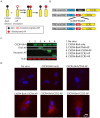
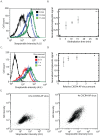
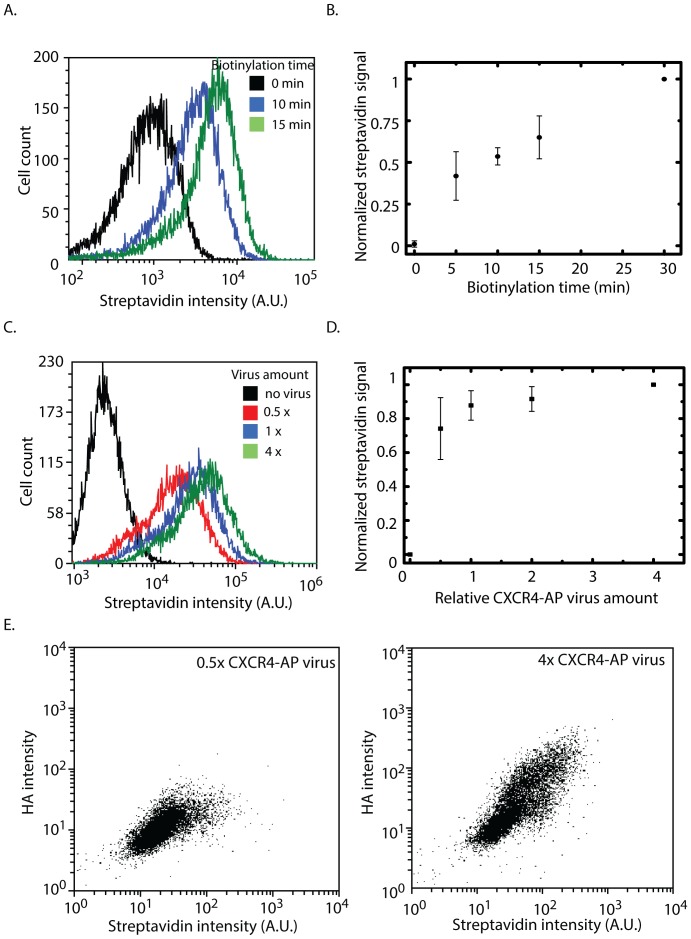
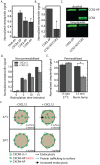
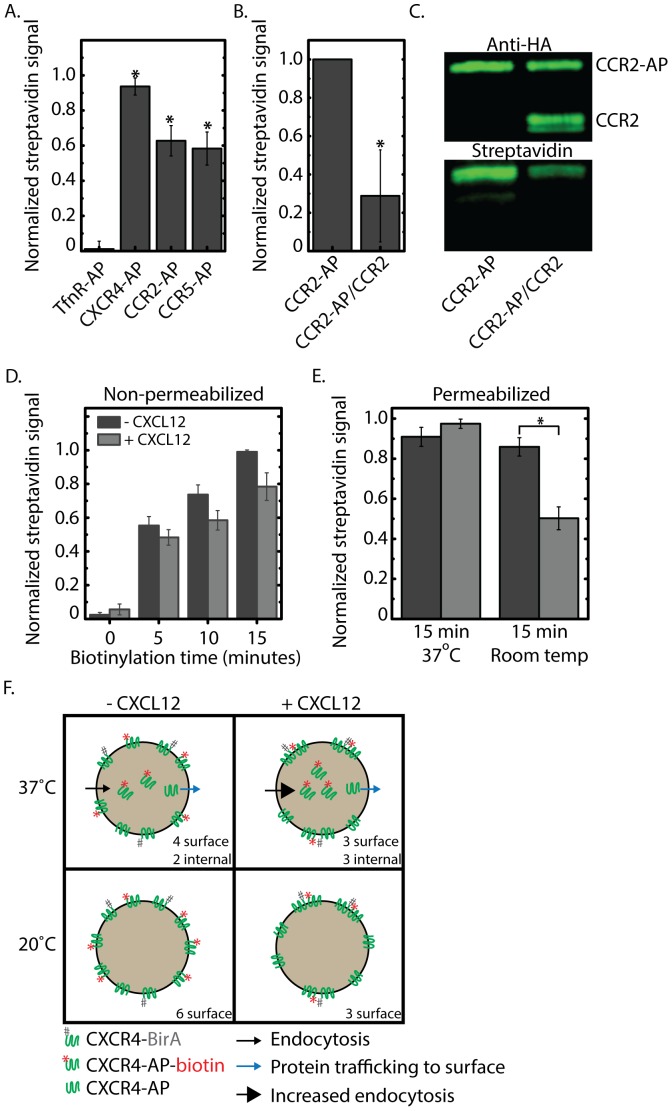
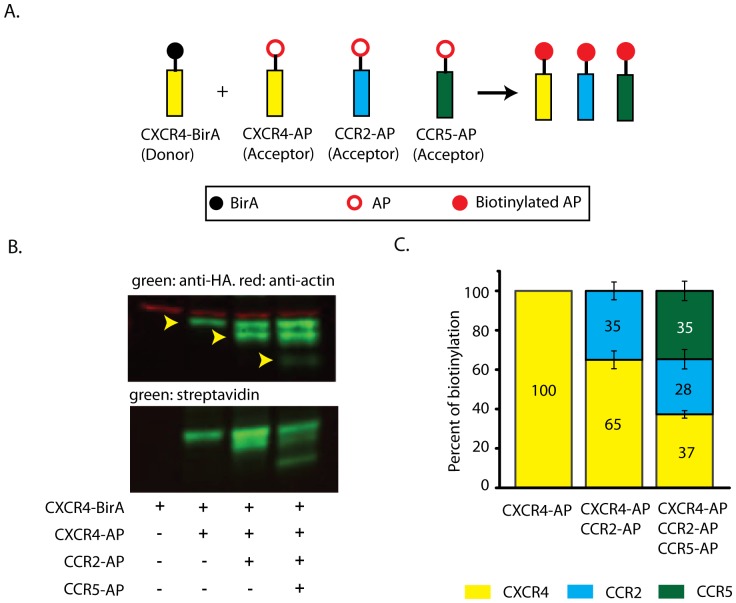
Description:Dimerization of G protein-coupled receptors (GPCRs) represents a potential mechanism by which GPCR functions are regulated. Several resonance energy transfer (RET)-based methods have revealed GPCR homo- and heterodimerization. However, interpretation of an increase in FRET efficiency could be attributed to either dimerization/oligomerization events or conformational changes within an already dimerized/oligomerized receptor complex. Furthermore, RET-based methods can only measure pairwise dimerization, and cannot easily achieve multiplex detection. In this study, we applied proximity-based biotinylation for detecting receptor dimerization by utilizing a specific enzyme-substrate pair that are fused to GPCRs. The biotin ligase BirA is fused to CXCR4 and site-specifically biotinylates an acceptor peptide (AP) in the presence of biotin. As a test case for our newly developed assay, we have characterized the homo-dimerization of chemokine receptor CXCR4 and heterodimerization of CXCR4 with CCR2 or CCR5. The degree of biotinylation varies with the amount of GPCR-AP as well as biotinylation time. Using enzyme/substrate receptor pairs and measuring receptor biotinylation, we demonstrate that CXCR4 can homo-dimerize and hetero-dimerize with CCR2 and CCR5. The effect of CXCL12, agonist for CXCR4, was found to decrease surface biotinylation of CXCR4-AP. This effect is due to a combination of CXCR4 endocytosis and stabilization of CXCR4 homodimers. Finally, when CXCR4-AP, CCR2-AP, and CCR5-AP were expressed together, we observed CXCR4-CXCR4 homodimers and CXCR4-CCR2 and CXCR4-CCR5 heterodimers. The newly developed assay opens new opportunity for multiplex detection for GPCR homo- and heterodimerization within the same cellular context.
-
Subjects:
-
Source:PLoS One. 2014; 9(4).
-
Pubmed ID:24691126
-
Pubmed Central ID:PMC3972117
-
Document Type:
-
Funding:
-
Volume:9
-
Issue:4
-
Collection(s):
-
Main Document Checksum:urn:sha256:be1cc51d98e537f196907cbce73e6dbbf8649781184ada9164b17666ed3c9217
-
Download URL:
-
File Type:
 [PDF
- 1.21 MB
]
[PDF
- 1.21 MB
]
Supporting Files


File Language:
English
 Was this page helpful?
 Found an issue?

CDC STACKS serves as an archival repository of CDC-published products including
scientific findings,
journal articles, guidelines, recommendations, or other public health information authored or
co-authored by CDC or funded partners.
As a repository, CDC STACKS retains documents in their original published format to ensure public access to scientific information.
As a repository, CDC STACKS retains documents in their original published format to ensure public access to scientific information.
You May Also Like
COLLECTION
CDC Public Access