


Temporal Trends in Phthalate Exposures: Findings from the National Health and Nutrition Examination Survey, 2001–2010
Supporting Files

-
Jan 15 2014
Details
-
Alternative Title:Environ Health Perspect
-
Personal Author:
-
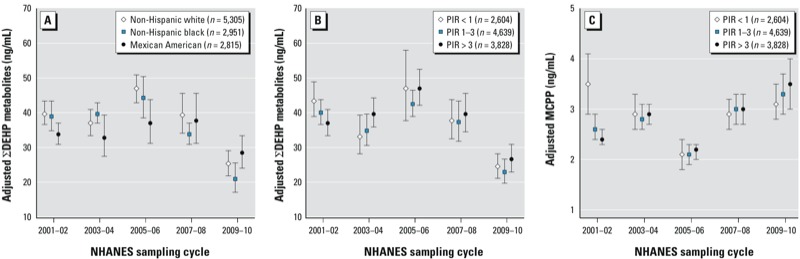
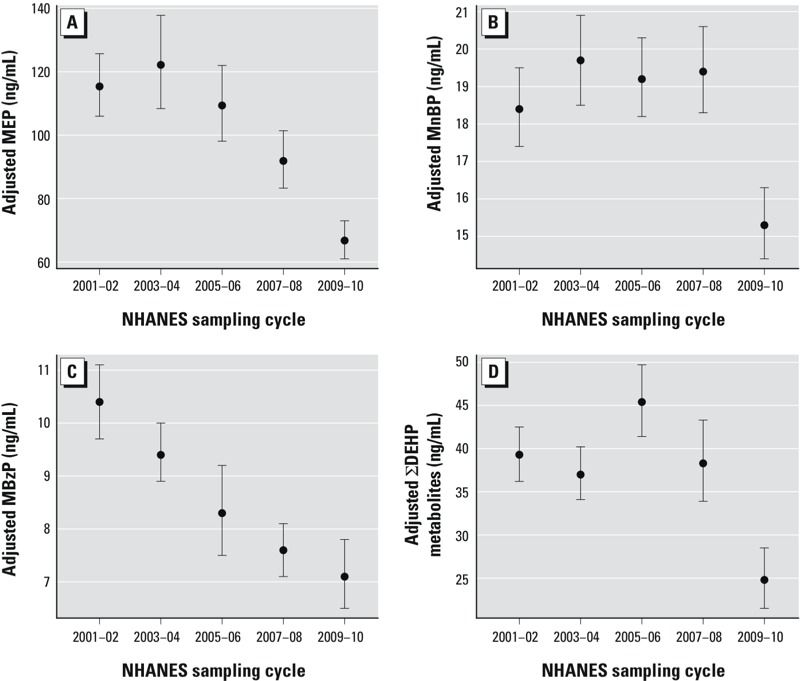
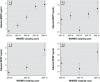
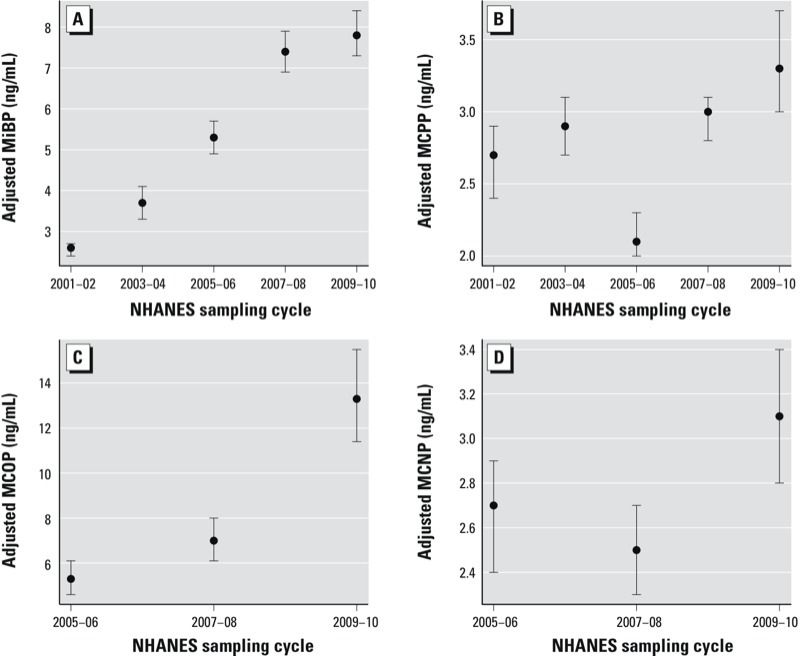
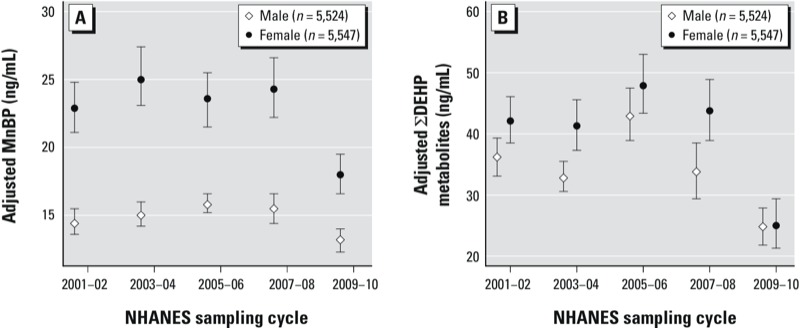
Description:Phthalates are ubiquitous environmental contaminants. Because of potential adverse effects on human health, butylbenzyl phthalate [BBzP; metabolite, monobenzyl phthalate (MBzP)], di-n-butyl phthalate [DnBP; metabolite, mono-n-butyl phthalate (MnBP)], and di(2-ethylhexyl) phthalate (DEHP) are being replaced by substitutes including other phthalates; however, little is known about consequent trends in population-level exposures.|We examined temporal trends in urinary concentrations of phthalate metabolites in the general U.S. population and whether trends vary by sociodemographic characteristics.|We combined data on 11 phthalate metabolites for 11,071 participants from five cycles of the National Health and Nutrition Examination Survey (2001-2010). Percent changes and least square geometric means (LSGMs) were calculated from multivariate regression models.|LSGM concentrations of monoethyl phthalate, MnBP, MBzP, and ΣDEHP metabolites decreased between 2001-2002 and 2009-2010 [percent change (95% CI): -42% (-49, -34); -17% (-23, -9); -32% (-39, -23) and -37% (-46, -26), respectively]. In contrast, LSGM concentrations of monoisobutyl phthalate, mono(3-carboxypropyl) phthalate (MCPP), monocarboxyoctyl phthalate, and monocarboxynonyl phthalate (MCNP) increased over the study period [percent change (95% CI): 206% (178, 236); 25% (8, 45); 149% (102, 207); and 15% (1, 30), respectively]. Trends varied by subpopulations for certain phthalates. For example, LSGM concentrations of ΣDEHP metabolites, MCPP, and MCNP were higher in children than adults, but the gap between groups narrowed over time (pinteraction < 0.01).|Exposure of the U.S. population to phthalates has changed in the last decade. Data gaps make it difficult to explain trends, but legislative activity and advocacy campaigns by nongovernmental organizations may play a role in changing trends.|Zota AZ, Calafat AM, Woodruff TJ. 2014. Temporal trends in phthalate exposures: findings from the National Health and Nutrition Examination Survey, 2001-2010. Environ Health Perspect 122:235-241; http://dx.doi.org/10.1289/ehp.1306681.
-
Subjects:
-
Source:Environ Health Perspect. 122(3):235-241.
-
Document Type:
-
Funding:
-
Place as Subject:
-
Volume:122
-
Issue:3
-
Collection(s):
-
Main Document Checksum:urn:sha256:945f7c42d22b9cade53ddc3dfc5a5410931b1ac20da881deacd67cbd1b5607bc
-
Download URL:
-
File Type:
 [PDF
- 465.28 KB
]
[PDF
- 465.28 KB
]
Supporting Files


ON THIS PAGE



CDC STACKS serves as an archival repository of CDC-published products including
scientific findings,
journal articles, guidelines, recommendations, or other public health information authored or
co-authored by CDC or funded partners.
As a repository, CDC STACKS retains documents in their original published format to ensure public access to scientific information.
As a repository, CDC STACKS retains documents in their original published format to ensure public access to scientific information.
You May Also Like
COLLECTION
CDC Public Access