


Geographic disparities in colorectal cancer survival
Supporting Files

-
Jul 23 2009
File Language:
English
Details
-
Alternative Title:Int J Health Geogr
-
Personal Author:
-
Description:Background
Examining geographic variation in cancer patient survival can help identify important prognostic factors that are linked by geography and generate hypotheses about the underlying causes of survival disparities. In this study, we apply a recently developed spatial scan statistic method, designed for time-to-event data, to determine whether colorectal cancer (CRC) patient survival varies by place of residence after adjusting survival times for several prognostic factors.
Methods
Using data from a population-based, statewide cancer registry, we examined a cohort of 25,040 men and women from New Jersey who were newly diagnosed with local or regional stage colorectal cancer from 1996 through 2003 and followed to the end of 2006. Survival times were adjusted for significant prognostic factors (sex, age, stage at diagnosis, race/ethnicity and census tract socioeconomic deprivation) and evaluated using a spatial scan statistic to identify places where CRC survival was significantly longer or shorter than the statewide experience.
Results
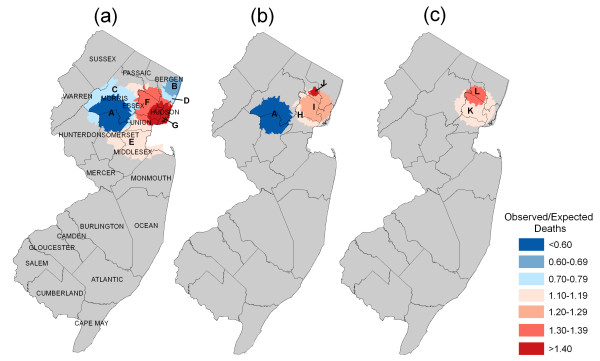
Age, sex and stage adjusted survival times revealed several areas in the northern part of the state where CRC survival was significantly different than expected. The shortest and longest survival areas had an adjusted 5-year survival rate of 73.1% (95% CI 71.5, 74.9) and 88.3% (95% CI 85.4, 91.3) respectively, compared with the state average of 80.0% (95% CI 79.4, 80.5). Analysis of survival times adjusted for age, sex and stage as well as race/ethnicity and area socioeconomic deprivation attenuated the risk of death from CRC in several areas, but survival disparities persisted.
Conclusion
The results suggest that in areas where additional adjustments for race/ethnicity and area socioeconomic deprivation changed the geographic survival patterns and reduced the risk of death from CRC, the adjustment factors may be contributing causes of the disparities. Further studies should focus on specific and modifiable individual and neighborhood factors in the high risk areas that may affect a person's chance of surviving cancer.
-
Subjects:
-
Source:Int J Health Geogr. 2009; 8:48.
-
Pubmed ID:19627576
-
Pubmed Central ID:PMC2724436
-
Document Type:
-
Funding:
-
Place as Subject:
-
Volume:8
-
Collection(s):
-
Main Document Checksum:urn:sha256:4704a9949493b27e1c3bb8d35c1a73499550797f16f5d7ccf0ef82d77d1bad98
-
Download URL:
-
File Type:
 [PDF
- 547.95 KB
]
[PDF
- 547.95 KB
]
Supporting Files


File Language:
English
ON THIS PAGE


CDC STACKS serves as an archival repository of CDC-published products including
scientific findings,
journal articles, guidelines, recommendations, or other public health information authored or
co-authored by CDC or funded partners.
As a repository, CDC STACKS retains documents in their original published format to ensure public access to scientific information.
As a repository, CDC STACKS retains documents in their original published format to ensure public access to scientific information.
You May Also Like
COLLECTION
CDC Public Access