


Incidence of first primary central nervous system tumors in California, 2001–2005
Supporting Files

-
Apr 02 2009
-
File Language:
English
Details
-
Alternative Title:J Neurooncol
-
Personal Author:
-
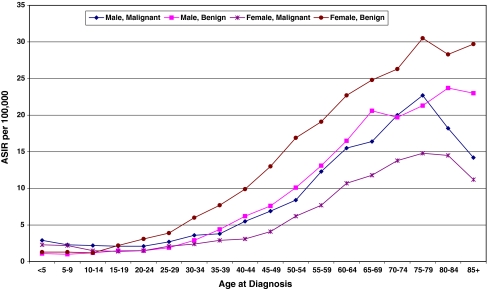
Description:We examined the incidence of first primary central nervous system tumors (PCNST) in California from 2001-2005. This study period represents the first five years of data collection of benign PCNST by the California Cancer Registry. California's age-adjusted incidence rates (AAIR) for malignant and benign PCNST (5.5 and 8.5 per 100,000, respectively). Malignant PCNST were highest among non-Hispanic white males (7.8 per 100,000). Benign PCNST were highest among African American females (10.5 per 100,000). Hispanics, those with the lowest socioeconomic status, and those who lived in rural California were found to be significantly younger at diagnosis. Glioblastoma was the most frequent malignant histology, while meningioma had the highest incidence among benign histologies (2.6 and 4.5 per 100,000, respectively). This study is the first in the US to compare malignant to benign PCNST using a population-based data source. It illustrates the importance of PCNST surveillance in California and in diverse communities.
-
Subjects:
-
Source:J Neurooncol. 94(2):249-261.
-
Pubmed ID:19340398
-
Pubmed Central ID:PMC2724635
-
Document Type:
-
Funding:
-
Place as Subject:
-
Volume:94
-
Issue:2
-
Collection(s):
-
Main Document Checksum:urn:sha256:467b09e42333013c4a418f3084d597194c1c786caf51c19d8c6ed7d245fe3ed1
-
Download URL:
-
File Type:
 [PDF
- 266.29 KB
]
[PDF
- 266.29 KB
]
Supporting Files


File Language:
English
ON THIS PAGE



CDC STACKS serves as an archival repository of CDC-published products including
scientific findings,
journal articles, guidelines, recommendations, or other public health information authored or
co-authored by CDC or funded partners.
As a repository, CDC STACKS retains documents in their original published format to ensure public access to scientific information.
As a repository, CDC STACKS retains documents in their original published format to ensure public access to scientific information.
You May Also Like
COLLECTION
CDC Public Access