



A Niche for Infectious Disease in Environmental Health: Rethinking the Toxicological Paradigm
Supporting Files

-
Apr 12 2010
Details
-
Alternative Title:Environ Health Perspect
-
Personal Author:
-
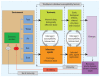
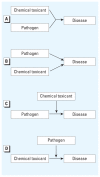
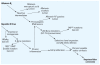
Description:Objective ; In this review we highlight the need to expand the scope of environmental health research, which now focuses largely on the study of toxicants, to incorporate infectious agents. We provide evidence that environmental health research would be strengthened through finding common ground with the tools and approaches of infectious disease research. ; Data sources and extraction ; We conducted a literature review for examples of interactions between toxic agents and infectious diseases, as well as the role of these interactions as risk factors in classic “environmental” diseases. We investigated existing funding sources and research mandates in the United States from the National Science Foundation and the National Institutes of Health, particularly the National Institute of Environmental Health Sciences. ; Data synthesis ; We adapted the toxicological paradigm to guide reintegration of infectious disease into environmental health research and to identify common ground between these two fields as well as opportunities for improving public health through interdisciplinary research. ; Conclusions ; Environmental health encompasses complex disease processes, many of which involve interactions among multiple risk factors, including toxicant exposures, pathogens, and susceptibility. Funding and program mandates for environmental health studies should be expanded to include pathogens in order to capture the true scope of these overlapping risks, thus creating more effective research investments with greater relevance to the complexity of real-world exposures and multifactorial health outcomes. We propose a new model that integrates the toxicology and infectious disease paradigms to facilitate improved collaboration and communication by providing a framework for interdisciplinary research. Pathogens should be part of environmental health research planning and funding allocation, as well as applications such as surveillance and policy development.
-
Subjects:
- Review
- biomarkers
- colon cancer
- conceptual framework
- environmental health
- infectious disease
- liver cancer
- NIEHS
- pathogens
- toxicology
- Colonic Neoplasms
- Ecotoxicology
- Environmental Exposure
- Environmental Health
- Environmental Medicine
- Infectious Disease Medicine
- Interdisciplinary Communication
- Risk Factors
-
Source:Environ Health Perspect. 2010; 118(8):1165-1172.
-
Pubmed ID:20385515
-
Pubmed Central ID:PMC2920090
-
Document Type:
-
Funding:
-
Volume:118
-
Issue:8
-
Download URL:
-
File Type:
 [PDF - 1.10 MB]
 -
Collection(s):
-
Main Document Checksum:urn:sha256:1b51c3b1113ecdc201f75c0917eee49603869bc8d0a18c06b8c186609a80716d
Supporting Files


 Was this page helpful?
 Found an issue?




CDC STACKS serves as an archival repository of CDC-published products including
scientific findings, journal articles, guidelines, recommendations, or other public health information authored or
co-authored by CDC or funded partners.
As a repository, CDC STACKS retains documents in their original published format to ensure public access to scientific information.
As a repository, CDC STACKS retains documents in their original published format to ensure public access to scientific information.
You May Also Like
COLLECTION
CDC Public Access