


Barriers to Insecticide-Treated Mosquito Net Possession 2 Years after a Mass Free Distribution Campaign in Luangwa District, Zambia
Supporting Files

-
Nov 10 2010
-
File Language:
English
Details
-
Alternative Title:PLoS One
-
Personal Author:
-
Description:Background and Methods
Roll Back Malaria set the goal of 100% of households in malaria endemic countries in Africa owning an insecticide-treated mosquito net (ITN) by 2010. Zambia has used mass free distribution campaigns and distribution through antenatal care (ANC) clinics to achieve high coverage.
Methodology and Principal Findings
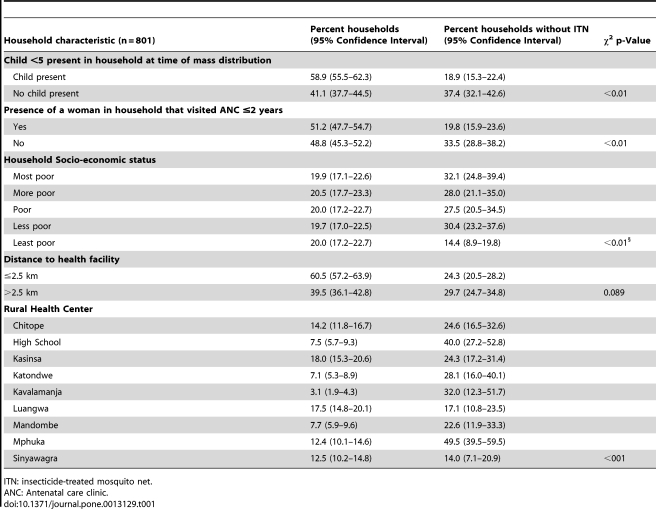
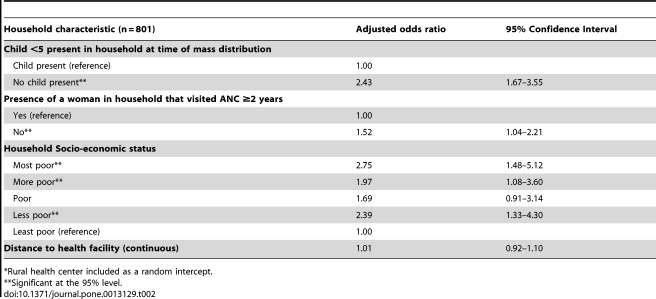
We conducted a probability survey of 801 households in 2008 to assess factors associated with households that lacked an ITN after mass distribution. Community perceptions of barriers to ITN access were also obtained from in-depth interviews with household heads that reported not owning an ITN. Nearly 74% of households in Luangwa district reported owning ≥1 ITN. Logistic regression showed households without a child <5 years old during the ITN distribution campaigns were twice as likely to not have an ITN as those with a child <5 during distribution (Adjusted odds ratio (AOR) = 2.43; 95% confidence interval (CI): 1.67–3.55). Households without a woman who attended an ANC in the past 2 years were more likely to be without ITNs compared to households with a woman who attended an ANC in the past 2 years (AOR = 1.52; 95% CI: 1.04–2.21). In-depth interviews with heads of households without an ITN revealed that old age was a perceived barrier to receiving an ITN during distribution, and that ITNs wore out before they could be replaced.
Conclusions and Significance
Delivery of a large number of ITNs does not translate directly into 100% household coverage. Due to their design, current ITN distribution strategies may miss households occupied by the elderly and those without children or ANC access. ITN distribution strategies targeting the elderly, those with limited access to distribution points, and others most likely to be missed are necessary if 100% ITN coverage of households is to be achieved.
-
Subjects:
-
Source:PLoS One. 5(11).
-
Pubmed ID:21085711
-
Pubmed Central ID:PMC2978084
-
Document Type:
-
Funding:
-
Place as Subject:
-
Volume:5
-
Issue:11
-
Collection(s):
-
Main Document Checksum:urn:sha-512:89f86ae173eb772930d168e8f64990c73c578a1094378ce3417f4aa2ee88a1053f8a826ff256fada235513df5d763f8a139b58ca9a679c4e77e1be26312ee124
-
Download URL:
-
File Type:
 [PDF
- 359.06 KB
]
[PDF
- 359.06 KB
]
Supporting Files


File Language:
English
ON THIS PAGE


CDC STACKS serves as an archival repository of CDC-published products including
scientific findings,
journal articles, guidelines, recommendations, or other public health information authored or
co-authored by CDC or funded partners.
As a repository, CDC STACKS retains documents in their original published format to ensure public access to scientific information.
As a repository, CDC STACKS retains documents in their original published format to ensure public access to scientific information.
You May Also Like
COLLECTION
CDC Public Access