


The impact of mass gatherings and holiday traveling on the course of an influenza pandemic: a computational model
Supporting Files

-
Dec 21 2010
-
File Language:
English
Details
-
Alternative Title:BMC Public Health
-
Personal Author:
-
Description:Background
During the 2009 H1N1 influenza pandemic, concerns arose about the potential negative effects of mass public gatherings and travel on the course of the pandemic. Better understanding the potential effects of temporal changes in social mixing patterns could help public officials determine if and when to cancel large public gatherings or enforce regional travel restrictions, advisories, or surveillance during an epidemic.
Methods
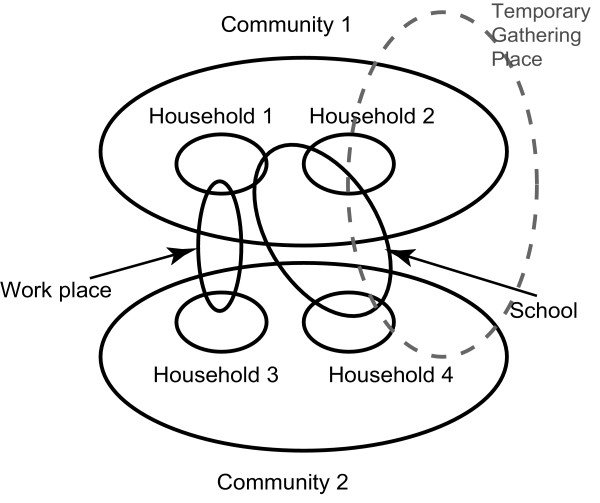
We develop a computer simulation model using detailed data from the state of Georgia to explore how various changes in social mixing and contact patterns, representing mass gatherings and holiday traveling, may affect the course of an influenza pandemic. Various scenarios with different combinations of the length of the mass gatherings or traveling period (range: 0.5 to 5 days), the proportion of the population attending the mass gathering events or on travel (range: 1% to 50%), and the initial reproduction numbers R0 (1.3, 1.5, 1.8) are explored.
Results
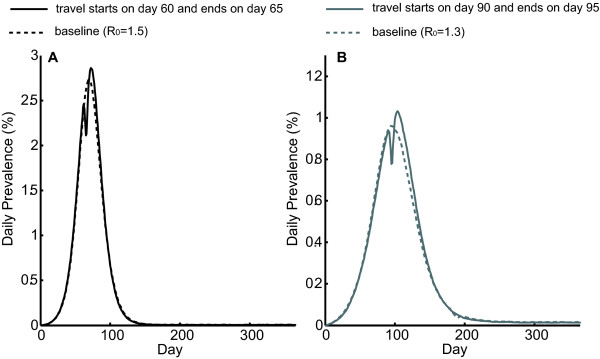
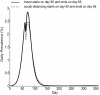
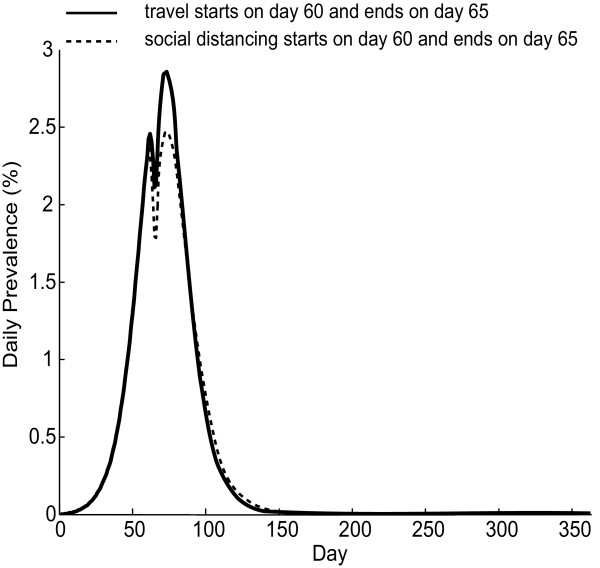
Mass gatherings that occur within 10 days before the epidemic peak can result in as high as a 10% relative increase in the peak prevalence and the total attack rate, and may have even worse impacts on local communities and travelers' families. Holiday traveling can lead to a second epidemic peak under certain scenarios. Conversely, mass traveling or gatherings may have little effect when occurring much earlier or later than the epidemic peak, e.g., more than 40 days earlier or 20 days later than the peak when the initial R0 = 1.5.
Conclusions
Our results suggest that monitoring, postponing, or cancelling large public gatherings may be warranted close to the epidemic peak but not earlier or later during the epidemic. Influenza activity should also be closely monitored for a potential second peak if holiday traveling occurs when prevalence is high.
-
Subjects:
-
Source:BMC Public Health. 2010; 10:778.
-
Pubmed ID:21176155
-
Pubmed Central ID:PMC3022852
-
Document Type:
-
Funding:
-
Place as Subject:
-
Volume:10
-
Collection(s):
-
Main Document Checksum:urn:sha256:9e5f02f62fc8460f89d6f40e3ff921dcb986af53c219e3ec99467c1f655df396
-
Download URL:
-
File Type:
 [PDF
- 425.02 KB
]
[PDF
- 425.02 KB
]
Supporting Files


File Language:
English
ON THIS PAGE


CDC STACKS serves as an archival repository of CDC-published products including
scientific findings,
journal articles, guidelines, recommendations, or other public health information authored or
co-authored by CDC or funded partners.
As a repository, CDC STACKS retains documents in their original published format to ensure public access to scientific information.
As a repository, CDC STACKS retains documents in their original published format to ensure public access to scientific information.
You May Also Like
COLLECTION
CDC Public Access