


Characterizing Hospital Workers' Willingness to Respond to a Radiological Event
Supporting Files

-
Oct 27 2011
-
File Language:
English
Details
-
Alternative Title:PLoS One
-
Personal Author:
-
Description:Introduction
Terrorist use of a radiological dispersal device (RDD, or “dirty bomb”), which combines a conventional explosive device with radiological materials, is among the National Planning Scenarios of the United States government. Understanding employee willingness to respond is critical for planning experts. Previous research has demonstrated that perception of threat and efficacy is key in the assessing willingness to respond to a RDD event.
Methods
An anonymous online survey was used to evaluate the willingness of hospital employees to respond to a RDD event. Agreement with a series of belief statements was assessed, following a methodology validated in previous work. The survey was available online to all 18,612 employees of the Johns Hopkins Hospital from January to March 2009.
Results
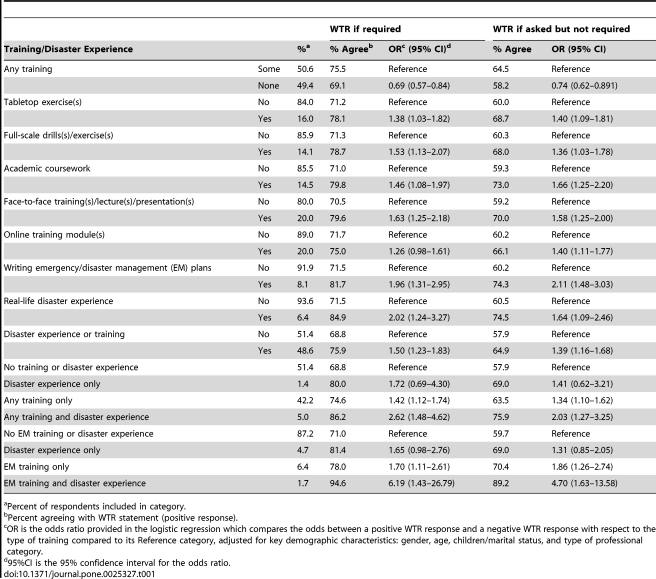
Surveys were completed by 3426 employees (18.4%), whose demographic distribution was similar to overall hospital staff. 39% of hospital workers were not willing to respond to a RDD scenario if asked but not required to do so. Only 11% more were willing if required. Workers who were hesitant to agree to work additional hours when required were 20 times less likely to report during a RDD emergency. Respondents who perceived their peers as likely to report to work in a RDD emergency were 17 times more likely to respond during a RDD event if asked. Only 27.9% of the hospital employees with a perception of low efficacy declared willingness to respond to a severe RDD event. Perception of threat had little impact on willingness to respond among hospital workers.
Conclusions
Radiological scenarios such as RDDs are among the most dreaded emergency events yet studied. Several attitudinal indicators can help to identify hospital employees unlikely to respond. These risk-perception modifiers must then be addressed through training to enable effective hospital response to a RDD event.
-
Subjects:
-
Source:PLoS One. 2011; 6(10).
-
Pubmed ID:22046238
-
Pubmed Central ID:PMC3203116
-
Document Type:
-
Funding:
-
Volume:6
-
Issue:10
-
Collection(s):
-
Main Document Checksum:urn:sha256:914743b5be1c269d957c414f72d16a6e7e14caec9e80ac300028c403f076df4e
-
Download URL:
-
File Type:
 [PDF
- 92.12 KB
]
[PDF
- 92.12 KB
]
Supporting Files


File Language:
English
ON THIS PAGE

CDC STACKS serves as an archival repository of CDC-published products including
scientific findings,
journal articles, guidelines, recommendations, or other public health information authored or
co-authored by CDC or funded partners.
As a repository, CDC STACKS retains documents in their original published format to ensure public access to scientific information.
As a repository, CDC STACKS retains documents in their original published format to ensure public access to scientific information.
You May Also Like
COLLECTION
CDC Public Access