


CAG Repeat Variants in the POLG1 Gene Encoding mtDNA Polymerase-Gamma and Risk of Breast Cancer in African-American Women
Supporting Files

-
Jan 20 2012
-
Details
-
Alternative Title:PLoS One
-
Personal Author:
-
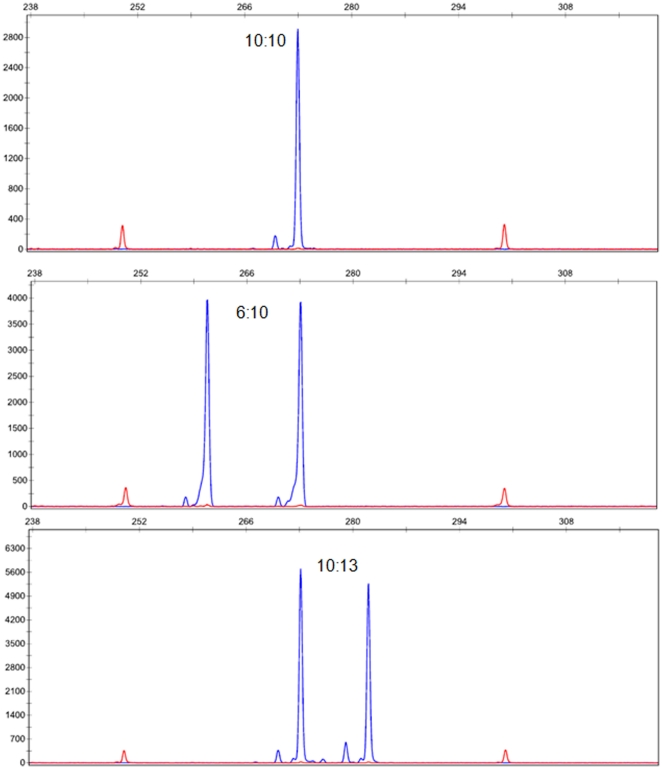
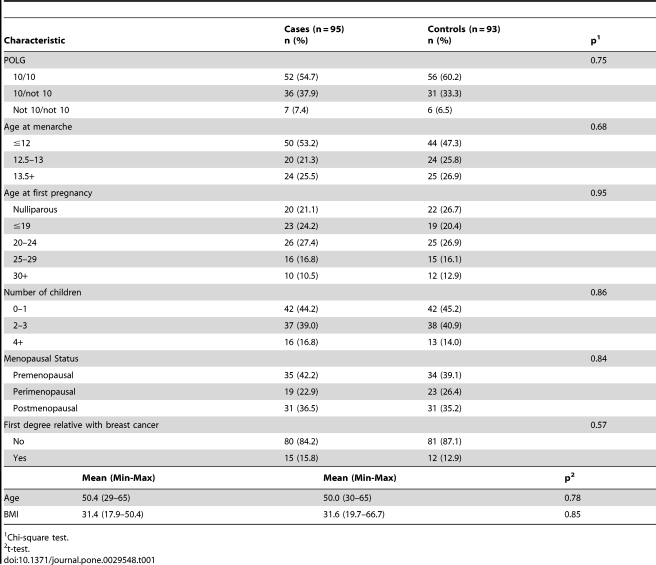
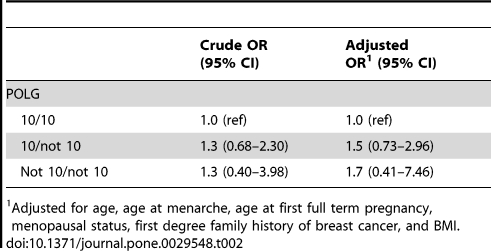
Description:The DNA polymerase-gamma (POLG) gene, which encodes the catalytic subunit of enzyme responsible for directing mitochondrial DNA replication in humans, contains a polyglutamine tract encoded by CAG repeats of varying length. The length of the CAG repeat has been associated with the risk of testicular cancer, and other genomic variants that impact mitochondrial function have been linked to breast cancer risk in African-American (AA) women. We evaluated the potential role of germline POLG-CAG repeat variants in breast cancer risk in a sample of AA women (100 cases and 100 age-matched controls) who participated in the Women's Circle of Health Study, an ongoing multi-institutional, case-control study of breast cancer. Genotyping was done by fragment analysis in a blinded manner. Results from this small study suggest the possibility of an increased risk of breast cancer in women with minor CAG repeat variants of POLG, but no statistically significant differences in CAG repeat length were observed between cases and controls (multivariate-adjusted odds ratio 1.74; 95% CI, 0.49-6.21). Our study suggests that POLG-CAG repeat length is a potential risk factor for breast cancer that needs to be explored in larger population-based studies.
-
Subjects:
-
Source:PLoS One. 2012; 7(1).
-
Pubmed ID:22276120
-
Pubmed Central ID:PMC3262786
-
Document Type:
-
Funding:
-
Volume:7
-
Issue:1
-
Collection(s):
-
Main Document Checksum:urn:sha256:e2c4f01be7ebd0dd08fa9e99389711f7e5ae069ab1cc1b1458aaed515565a0a5
-
Download URL:
-
File Type:
 [PDF
- 151.27 KB
]
[PDF
- 151.27 KB
]
Supporting Files


ON THIS PAGE

CDC STACKS serves as an archival repository of CDC-published products including
scientific findings,
journal articles, guidelines, recommendations, or other public health information authored or
co-authored by CDC or funded partners.
As a repository, CDC STACKS retains documents in their original published format to ensure public access to scientific information.
As a repository, CDC STACKS retains documents in their original published format to ensure public access to scientific information.
You May Also Like
COLLECTION
CDC Public Access