



Effect of Word and Syllable Frequency on Activation During Lexical Decision and Reading Aloud
Supporting Files

-
Dec 2006
File Language:
English
Details
-
Alternative Title:Hum Brain Mapp
-
Personal Author:
-
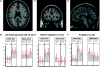
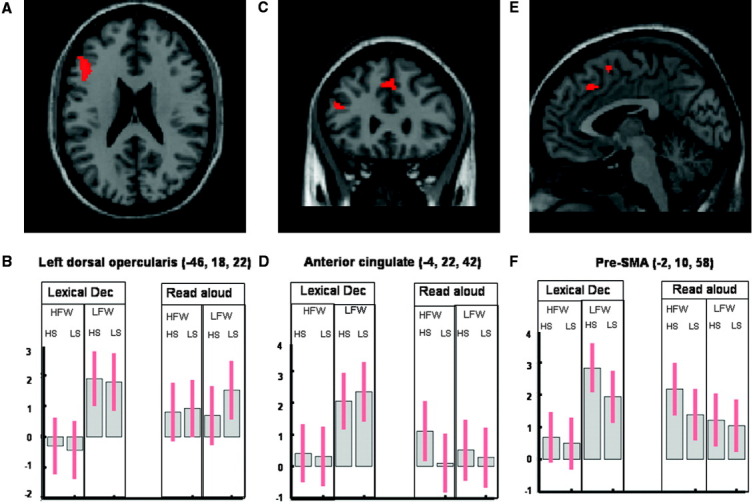
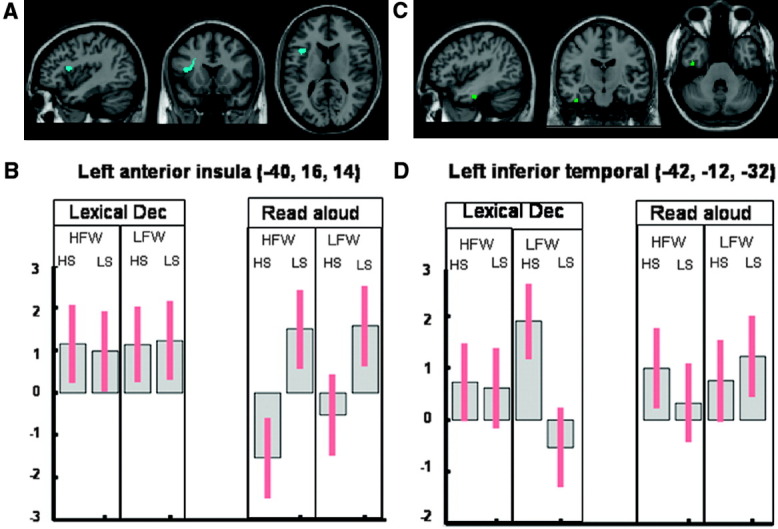
Description:This functional MRI (fMRI) study investigated the effect of lexical and syllable frequency on visual word processing during lexical decision and reading aloud. Previous research has shown a dissociation of syllable and word frequency effects in Spanish using behavioral and electrophysiological measures, suggesting that sublexical (syllabic) representations are computed and mediate the firing of lexical candidates. Here, we characterize the neuroanatomical basis of these lexical and sublexical manipulations and their dependence on task. During lexical decision, words with low vs. high lexical frequency increased activation in left frontal, anterior cingulate, supplemental motor area (SMA), and pre-SMA regions; while words with high vs. low syllable frequency increased activation in a left anterior inferior temporal region. In contrast, when the words were read aloud those with low vs. high syllable frequency increased activation in the left anterior insula, with no other significant effects. On the basis of the neuroanatomy, we propose that the contrasting effects of syllable frequency during lexical decision and reading aloud reflect two different cognitive processes in visual word processing. Specifically, words with high-frequency syllables may increase lexical competition in the inferior temporal lobe while facilitating articulatory planning in the left anterior insula.
-
Subjects:
-
Source:Hum Brain Mapp. 2006; 27(12):963-972.
-
Document Type:
-
Funding:
-
Volume:27
-
Issue:12
-
Download URL:
-
File Type:
 [PDF - 240.45 KB]
 -
Collection(s):
-
Main Document Checksum:urn:sha256:4c442bd8b08fd8359f5d50ef3999a622f771e43bb7762c6f109ccb0d627c93c0
Supporting Files


File Language:
English
 Was this page helpful?
 Found an issue?

CDC STACKS serves as an archival repository of CDC-published products including
scientific findings, journal articles, guidelines, recommendations, or other public health information authored or
co-authored by CDC or funded partners.
As a repository, CDC STACKS retains documents in their original published format to ensure public access to scientific information.
As a repository, CDC STACKS retains documents in their original published format to ensure public access to scientific information.
You May Also Like
COLLECTION
CDC Public Access