


Integrating a framework for conducting public health systems research into statewide operations-based exercises to improve emergency preparedness
Supporting Files

-
Aug 20 2012
-
File Language:
English
Details
-
Alternative Title:BMC Public Health
-
Personal Author:
-
Description:Background
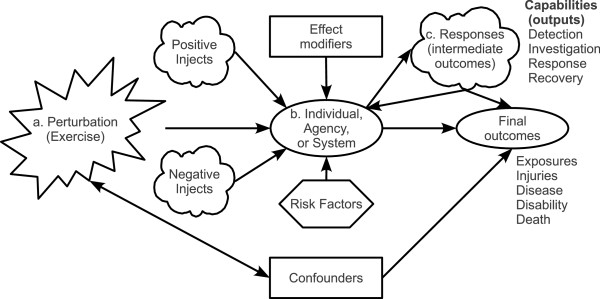
Due to the uncommon nature of large-scale disasters and emergencies, public health practitioners often turn to simulated emergencies, known as “exercises”, for preparedness assessment and improvement. Under the right conditions, exercises can also be used to conduct original public health systems research. This paper describes the integration of a research framework into a statewide operations-based exercise program in California as a systems-based approach for studying public health emergency preparedness and response.
Methods
We developed a research framework based on the premise that operations-based exercises conducted by medical and public health agencies can be described using epidemiologic concepts. Using this framework, we conducted a survey of key local and regional medical and health agencies throughout California following the 2010 Statewide Medical and Health Exercise. The survey evaluated: (1) the emergency preparedness capabilities activated and functions performed in response to the emergency scenario, and (2) the major challenges to inter-organizational communications and information management.
Results
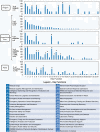
Thirty-five local health departments (LHDs), 24 local emergency medical services (EMS) agencies, 121 hospitals, and 5 Regional Disaster Medical and Health Coordinators/Specialists (RDMHC) responded to our survey, representing 57%, 77%, 26% and 83%, respectively, of target agencies in California. We found two sets of response capabilities were activated during the 2010 Statewide Exercise: a set of core capabilities that were common across all agencies, and a set of agency-specific capabilities that were more common among certain agency types. With respect to one response capability in particular, inter-organizational information sharing, we found that the majority of respondents’ comments were related to the complete or partial failure of communications equipment or systems.
Conclusions
Using the 2010 Statewide Exercise in California as an opportunity to develop our research framework, we characterized several aspects of the public health and medical system’s response to a standardized emergency scenario. From a research perspective, this study provides a potential new framework for conducting exercise-based research. From a practitioner’s perspective, our results provide a starting point for preparedness professionals’ dialogue about expected and actual organizational roles, responsibilities, and resource capacities within the public health system. Additionally, the identification of specific challenges to inter-organizational communications and information management offer specific areas for intervention.
-
Subjects:
-
Source:BMC Public Health. 2012; 12:680.
-
Pubmed ID:22905991
-
Pubmed Central ID:PMC3505730
-
Document Type:
-
Funding:
-
Place as Subject:
-
Volume:12
-
Collection(s):
-
Main Document Checksum:urn:sha256:d7f105c974831501437ce528e8ea1681b1f882047b2c7398e94bcb540ad67dd2
-
Download URL:
-
File Type:
 [PDF
- 333.20 KB
]
[PDF
- 333.20 KB
]
Supporting Files


File Language:
English
ON THIS PAGE


CDC STACKS serves as an archival repository of CDC-published products including
scientific findings,
journal articles, guidelines, recommendations, or other public health information authored or
co-authored by CDC or funded partners.
As a repository, CDC STACKS retains documents in their original published format to ensure public access to scientific information.
As a repository, CDC STACKS retains documents in their original published format to ensure public access to scientific information.
You May Also Like
COLLECTION
CDC Public Access