



Intermittent Preventive Therapy with Sulfadoxine-Pyrimethamine for Malaria in Pregnancy: A Cross-Sectional Study from Tororo, Uganda
Supporting Files

-
Sep 04 2013
File Language:
English
Details
-
Alternative Title:PLoS One
-
Personal Author:
-
Description:Background
Intermittent preventive treatment during pregnancy (IPTp) with sulfadoxine-pyrimethamine (SP) is widely recommended in sub-Saharan Africa to reduce the risk of malaria and improve birth outcomes. However, there are reports that the efficacy of IPTp with SP is waning, especially in parts of Africa where antimalarial resistance to this drug has become widespread.
Methodology/Principal Findings
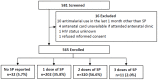
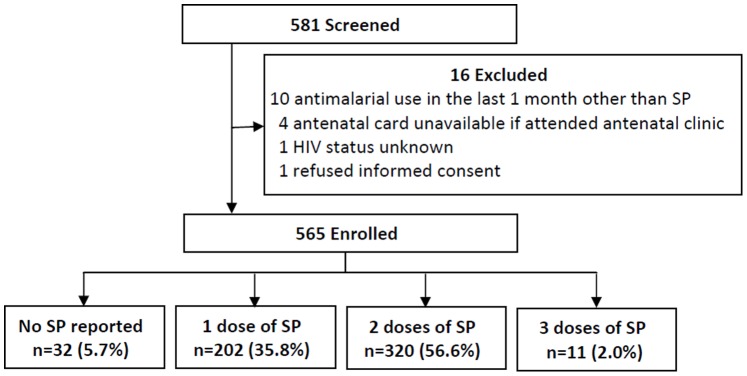
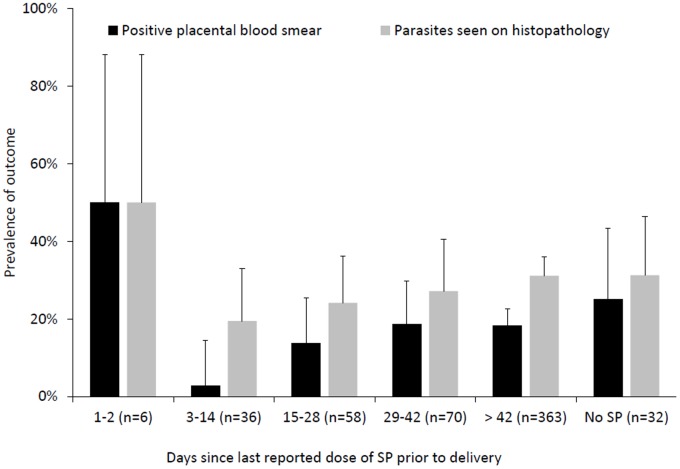
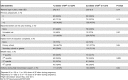
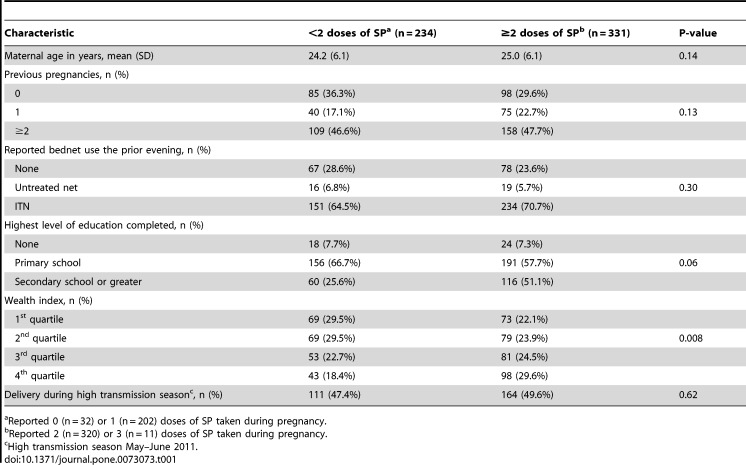
We conducted a cross-sectional study of 565 HIV-uninfected women giving birth at Tororo District Hospital in southeastern Uganda. The primary objective of the study was to measure associations between use of SP during pregnancy from antenatal records and the risk of adverse outcomes including placental malaria, low birth weight, maternal parasitemia and maternal anemia. The proportion of women who reported taking 0, 1, 2, and 3 doses of SP during pregnancy was 5.7%, 35.8%, 56.6% and 2.0% respectively. Overall, the prevalence of placental malaria was 17.5%, 28.1%, and 66.2% by placental smear, PCR, and histopathology, respectively. In multivariate analyses controlling for potential confounders, ≥2 doses of SP was associated with non-significant trends towards lower odds of placental malaria by placental smear (OR = 0.75, p = 0.25), placental malaria by PCR (OR = 0.93, p = 0.71), placental malaria by histopathology (OR = 0.75, p = 0.16), low birth weight (OR = 0.63, p = 0.11), maternal parasitemia (OR = 0.88, p = 0.60) and maternal anemia (OR = 0.88, p = 0.48). Using a composite outcome, ≥2doses of SP was associated with a significantly lower odds of placental malaria, low birth weight, maternal parasitemia, or maternal anemia (OR = 0.52, p = 0.01).
Conclusions/Significance
In this area of Uganda with intense malaria transmission, the prevalence of placental malaria by histopathology was high even among women who reported taking at least 2 doses of SP during pregnancy. The reported use of ≥2 doses of SP was not associated with protection against individual birth and maternal outcome measures but did protect against a composite measure of any adverse outcome. -
Subjects:
-
Source:PLoS One. 2013; 8(9).
-
Pubmed ID:24023811
-
Pubmed Central ID:PMC3762885
-
Document Type:
-
Funding:
-
Place as Subject:
-
Volume:8
-
Issue:9
-
Download URL:
-
File Type:
 [PDF - 418.95 KB]
 -
Collection(s):
-
Main Document Checksum:urn:sha256:ca8af6fee5109c0e8d9e17487d91b0ec6aa809203bb1409bfca36c3ec0fcaf9c
Supporting Files


File Language:
English
 Was this page helpful?
 Found an issue?




CDC STACKS serves as an archival repository of CDC-published products including
scientific findings, journal articles, guidelines, recommendations, or other public health information authored or
co-authored by CDC or funded partners.
As a repository, CDC STACKS retains documents in their original published format to ensure public access to scientific information.
As a repository, CDC STACKS retains documents in their original published format to ensure public access to scientific information.
You May Also Like
COLLECTION
CDC Public Access