


Extreme Precipitation and Beach Closures in the Great Lakes Region: Evaluating Risk among the Elderly
Supporting Files

-
Feb 14 2014
-
Details
-
Alternative Title:Int J Environ Res Public Health
-
Personal Author:
-
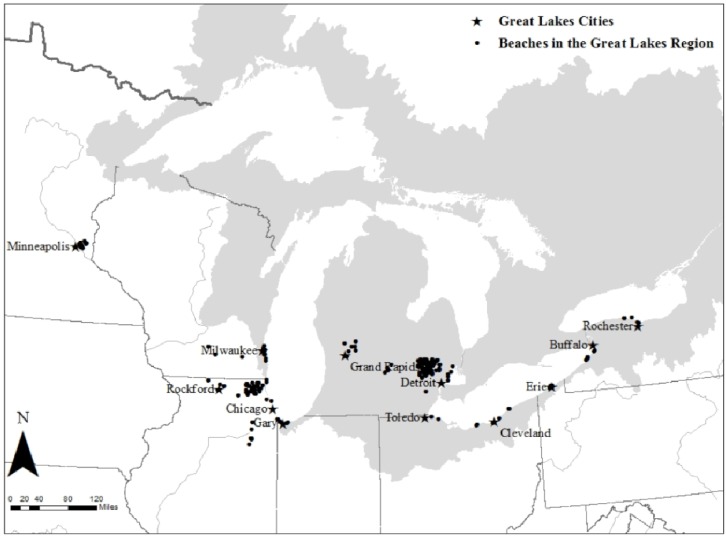
Description:As a result of climate change, extreme precipitation events are expected to increase in frequency and intensity. Runoff from these extreme events poses threats to water quality and human health. We investigated the impact of extreme precipitation and beach closings on the risk of gastrointestinal illness (GI)-related hospital admissions among individuals 65 and older in 12 Great Lakes cities from 2000 to 2006. Poisson regression models were fit in each city, controlling for temperature and long-term time trends. City-specific estimates were combined to form an overall regional risk estimate. Approximately 40,000 GI-related hospital admissions and over 100 beach closure days were recorded from May through September during the study period. Extreme precipitation (≥90th percentile) occurring the previous day (lag 1) is significantly associated with beach closures in 8 of the 12 cities (p < 0.05). However, no association was observed between beach closures and GI-related hospital admissions. These results support previous work linking extreme precipitation to compromised recreational water quality.
-
Subjects:
-
Source:Int J Environ Res Public Health. 2014; 11(2):2014-2032.
-
Pubmed ID:24534768
-
Pubmed Central ID:PMC3945582
-
Document Type:
-
Funding:
-
Volume:11
-
Issue:2
-
Collection(s):
-
Main Document Checksum:urn:sha256:654b99e8fd37b799dc1d9fcb48047658ceeefb3e5c689b39be6429e741b4abf4
-
Download URL:
-
File Type:
 [PDF
- 1.01 MB
]
[PDF
- 1.01 MB
]
Supporting Files


ON THIS PAGE


CDC STACKS serves as an archival repository of CDC-published products including
scientific findings,
journal articles, guidelines, recommendations, or other public health information authored or
co-authored by CDC or funded partners.
As a repository, CDC STACKS retains documents in their original published format to ensure public access to scientific information.
As a repository, CDC STACKS retains documents in their original published format to ensure public access to scientific information.
You May Also Like
COLLECTION
CDC Public Access