



Rapid Increase in Pertactin-deficient Bordetella pertussis Isolates, Australia
Supporting Files
Public Domain

-
Apr 2014
File Language:
English
Details
-
Alternative Title:Emerg Infect Dis
-
Personal Author:
-
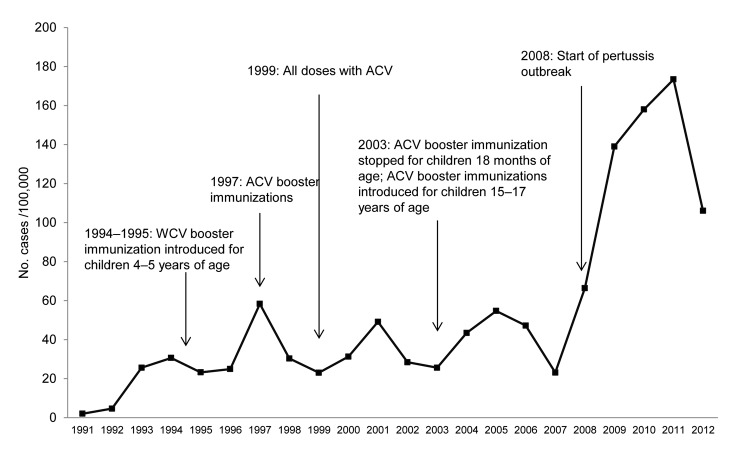
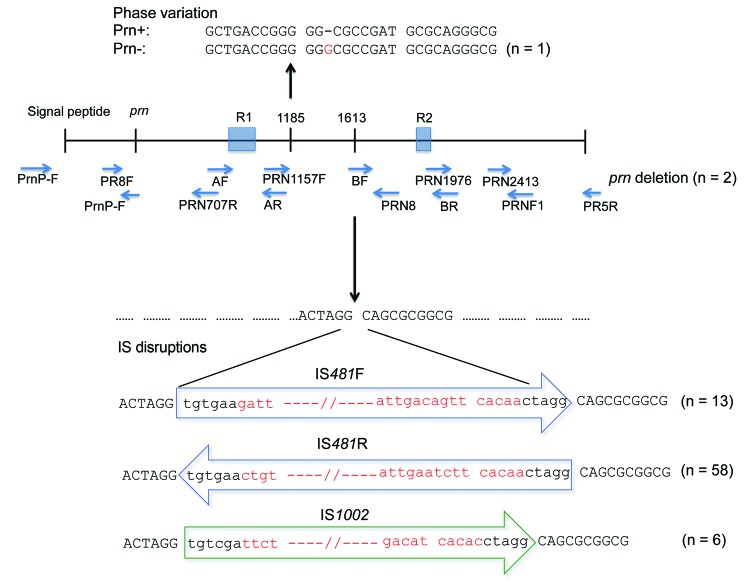
Description:Acellular vaccines against Bordetella pertussis were introduced in Australia in 1997. By 2000, these vaccines had replaced whole-cell vaccines. During 2008-2012, a large outbreak of pertussis occurred. During this period, 30% (96/320) of B. pertussis isolates did not express the vaccine antigen pertactin (Prn). Multiple mechanisms of Prn inactivation were documented, including IS481 and IS1002 disruptions, a variation within a homopolymeric tract, and deletion of the prn gene. The mechanism of lack of expression of Prn in 16 (17%) isolates could not be determined at the sequence level. These findings suggest that B. pertussis not expressing Prn arose independently multiple times since 2008, rather than by expansion of a single Prn-negative clone. All but 1 isolate had ptxA1, prn2, and ptxP3, the alleles representative of currently circulating strains in Australia. This pattern is consistent with continuing evolution of B. pertussis in response to vaccine selection pressure.
-
Subjects:
-
Source:Emerg Infect Dis. 20(4):626-633.
-
Document Type:
-
Place as Subject:
-
Volume:20
-
Issue:4
-
Download URL:
-
File Type:
 [PDF - 565.65 KB]
 -
Collection(s):
-
Main Document Checksum:urn:sha256:d10ce8da51d58e129b30f1af00520bbac819bc21663b10d225aafb2be5f78146
Supporting Files


File Language:
English
 Was this page helpful?
 Found an issue?



CDC STACKS serves as an archival repository of CDC-published products including
scientific findings, journal articles, guidelines, recommendations, or other public health information authored or
co-authored by CDC or funded partners.
As a repository, CDC STACKS retains documents in their original published format to ensure public access to scientific information.
As a repository, CDC STACKS retains documents in their original published format to ensure public access to scientific information.
You May Also Like
COLLECTION
Emerging Infectious Diseases