



Relationships Between Housing and Food Insecurity, Frequent Mental Distress, and Insufficient Sleep Among Adults in 12 US States, 2009
Supporting Files
Public Domain

-
Mar 13 2014
File Language:
English
Details
-
Journal Article:Preventing Chronic Disease (PCD)
-
Personal Author:
-
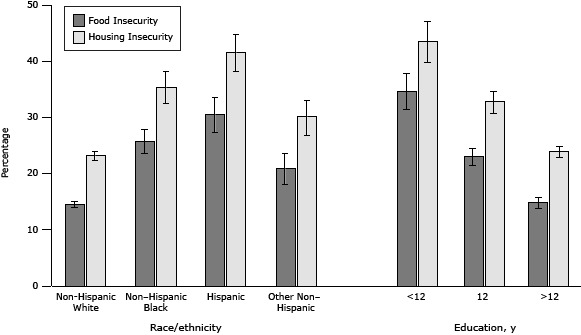
Description:Introduction ; Housing insecurity and food insecurity may be psychological stressors associated with insufficient sleep. Frequent mental distress may mediate the relationships between these variables. The objective of this study was to examine the relationships between housing insecurity and food insecurity, frequent mental distress, and insufficient sleep. ; Methods ; We analyzed data from the 2009 Behavioral Risk Factor Surveillance System in 12 states. Housing insecurity and food insecurity were defined as being worried or stressed “sometimes,” “usually,” or “always” during the previous 12 months about having enough money to pay rent or mortgage or to buy nutritious meals. ; Results ; Of 68,111 respondents, 26.4% reported frequent insufficient sleep, 28.5% reported housing insecurity, 19.3% reported food insecurity, and 10.8% reported frequent mental distress. The prevalence of frequent insufficient sleep was significantly greater among those who reported housing insecurity (37.7% vs 21.6%) or food insecurity (41.1% vs 22.9%) than among those who did not. The prevalence of frequent mental distress was also significantly greater among those reporting housing insecurity (20.1% vs 6.8%) and food insecurity (23.5% vs 7.7%) than those who did not. The association between housing insecurity or food insecurity and frequent insufficient sleep remained significant after adjustment for other sociodemographic variables and frequent mental distress. ; Conclusion ; Sleep health and mental health are embedded in the social context. Research is needed to assess whether interventions that reduce housing insecurity and food insecurity will also improve sleep health and mental health.
-
Subjects:
-
Source:Prev Chronic Dis. 11.
-
DOI:
-
ISSN:1545-1151
-
Document Type:
-
Place as Subject:
-
Location:
-
Volume:11
-
Download URL:
-
File Type:
 [PDF - 510.50 KB]
 -
Collection(s):
-
Main Document Checksum:urn:sha-512:74b777c69a3b5d59d983ed823315d4cc457fe1b684f03dc3b0103e9c444fe096562c220f57bba05f26fc0f7c30a7cfcf6ae95d4bcd9e5e88991f11bb933c7670
Supporting Files


File Language:
English
 Was this page helpful?
 Found an issue?

CDC STACKS serves as an archival repository of CDC-published products including
scientific findings, journal articles, guidelines, recommendations, or other public health information authored or
co-authored by CDC or funded partners.
As a repository, CDC STACKS retains documents in their original published format to ensure public access to scientific information.
As a repository, CDC STACKS retains documents in their original published format to ensure public access to scientific information.
You May Also Like
COLLECTION
Preventing Chronic Disease