


Vector Contact Rates on Eastern Bluebird Nestlings Do Not Indicate West Nile Virus Transmission in Henrico County, Virginia, USA
Supporting Files

-
November 27 2013
-
File Language:
English
Details
-
Alternative Title:Int J Environ Res Public Health
-
Personal Author:
-
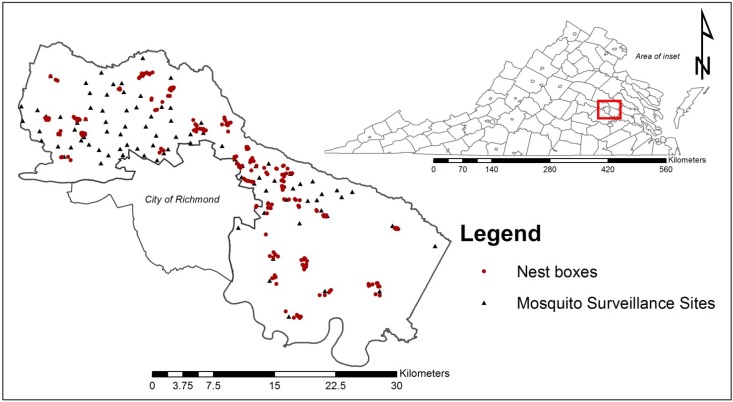
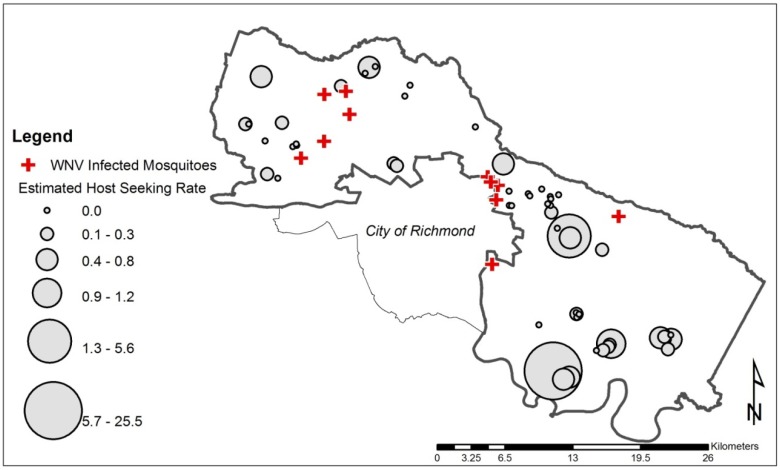
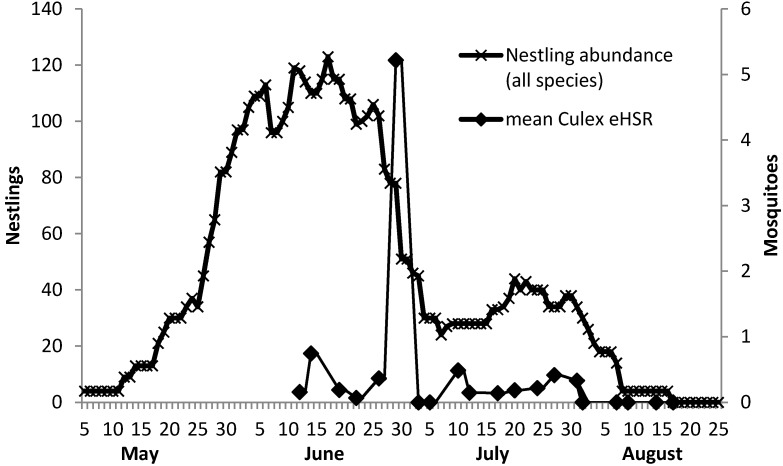
Description:Sensitive indicators of spatial and temporal variation in vector-host contact rates are critical to understanding the transmission and eventual prevention of arboviruses such as West Nile virus (WNV). Monitoring vector contact rates on particularly susceptible and perhaps more exposed avian nestlings may provide an advanced indication of local WNV amplification. To test this hypothesis we monitored WNV infection and vector contact rates among nestlings occupying nest boxes (primarily Eastern bluebirds; Sialia sialis, Turdidae) across Henrico County, Virginia, USA, from May to August 2012. Observed host-seeking rates were temporally variable and associated with absolute vector and host abundances. Despite substantial effort to monitor WNV among nestlings and mosquitoes, we did not detect the presence of WNV in these populations. Generally low vector-nestling host contact rates combined with the negative WNV infection data suggest that monitoring transmission parameters among nestling Eastern bluebirds in Henrico County, Virginia, USA may not be a sensitive indicator of WNV activity.
-
Subjects:
-
Source:Int J Environ Res Public Health. 2013; 10(12):6366-6379
-
Pubmed ID:24287858
-
Pubmed Central ID:PMC3881119
-
Document Type:
-
Funding:
-
Place as Subject:
-
Volume:10
-
Issue:12
-
Collection(s):
-
Main Document Checksum:urn:sha256:38764bd9a61ae5e7b89840c64c1273ba7109631b6560cae56f1bcb22c1be5bbe
-
Download URL:
-
File Type:
 [PDF
- 961.21 KB
]
[PDF
- 961.21 KB
]
Supporting Files


File Language:
English
ON THIS PAGE



CDC STACKS serves as an archival repository of CDC-published products including
scientific findings,
journal articles, guidelines, recommendations, or other public health information authored or
co-authored by CDC or funded partners.
As a repository, CDC STACKS retains documents in their original published format to ensure public access to scientific information.
As a repository, CDC STACKS retains documents in their original published format to ensure public access to scientific information.
You May Also Like
COLLECTION
CDC Public Access