



Estimating the U.S. prevalence of chronic obstructive pulmonary disease using pre- and post-bronchodilator spirometry: the National Health and Nutrition Examination Survey (NHANES) 2007–2010
Supporting Files
Public Domain

-
Oct 09 2013
File Language:
English
Details
-
Alternative Title:Respir Res
-
Personal Author:
-
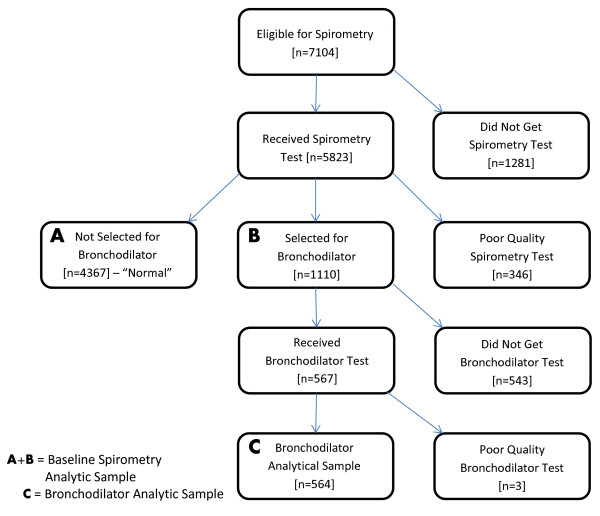
Description:Background ; During 2007–2010, the National Health and Nutrition Examination Survey (NHANES) conducted a spirometry component which obtained pre-bronchodilator pulmonary lung function data on a nationally representative sample of US adults aged 6–79 years and post-bronchodilator pulmonary lung function data for the subset of adults with airflow limitation. The goals of this study were to 1) compute prevalence estimates of chronic obstructive pulmonary disease (COPD) using pre-bronchodilator and post-bronchodilator spirometry measurements and fixed ratio and lower limit of normal (LLN) diagnostic criteria and 2) examine the potential impact of nonresponse on the estimates. ; Methods ; This analysis was limited to those aged 40–79 years who were eligible for NHANES pre-bronchodilator spirometry (n=7,104). Examinees with likely airflow limitation were further eligible for post-bronchodilator testing (n=1,110). Persons were classified as having COPD based on FEV1/FVC < 70% (fixed ratio) or FEV1/FVC < lower limit of normal (LLN) based on person’s age, sex, height, and race/ethnicity. Those without spirometry but self-reporting both daytime supplemental oxygen therapy plus emphysema and/or current chronic bronchitis were also classified as having COPD. The final analytic samples for pre-bronchodilator and post-bronchodilator analyses were 77.1% (n=5,477) and 50.8% (n=564) of those eligible, respectively. To account for non-response, NHANES examination weights were adjusted to the eligible pre-bronchodilator and post-bronchodilator subpopulations. ; Results ; In 2007–2010, using the fixed ratio criterion and pre-bronchodilator test results, COPD prevalence was 20.9% (SE 1.1) among US adults aged 40–79 years. Applying the same criterion to post-bronchodilator test results, prevalence was 14.0% (SE 1.0). Using the LLN criterion and pre-bronchodilator test results, the COPD prevalence was 15.4% (SE 0.8), while applying the same criterion to post-bronchodilator test results, prevalence was 10.2% (SE 0.8). ; Conclusions ; The overall COPD prevalence among US adults aged 40–79 years varied from 10.2% to 20.9% based on whether pre- or post-bronchodilator values were used and which diagnostic criterion (fixed ratio or LLN) was applied. The overall prevalence decreased by approximately 33% when airflow limitation was based on post-bronchodilator as compared to pre-bronchodilator spirometry, regardless of which diagnostic criterion was used.
-
Subjects:
-
Source:Respir Res. 2013; 14(1):103.
-
Document Type:
-
Corporate as Subject:
-
Place as Subject:
-
Volume:14
-
Issue:1
-
Download URL:
-
File Type:
 [PDF - 280.36 KB]
 -
Collection(s):
-
Main Document Checksum:urn:sha256:eef9793859720303c71f517115de77e9be723f58c06e725ea0acf52762488e7b
Supporting Files


File Language:
English
 Was this page helpful?
 Found an issue?

CDC STACKS serves as an archival repository of CDC-published products including
scientific findings, journal articles, guidelines, recommendations, or other public health information authored or
co-authored by CDC or funded partners.
As a repository, CDC STACKS retains documents in their original published format to ensure public access to scientific information.
As a repository, CDC STACKS retains documents in their original published format to ensure public access to scientific information.
You May Also Like
COLLECTION
CDC Public Access