


Preservice laboratory education strengthening enhances sustainable laboratory workforce in Ethiopia
Supporting Files

-
Oct 28 2013
-
File Language:
English
Details
-
Alternative Title:Hum Resour Health
-
Personal Author:
-
Description:Background
There is a severe healthcare workforce shortage in sub Saharan Africa, which threatens achieving the Millennium Development Goals and attaining an AIDS-free generation. The strength of a healthcare system depends on the skills, competencies, values and availability of its workforce. A well-trained and competent laboratory technologist ensures accurate and reliable results for use in prevention, diagnosis, care and treatment of diseases.
Methods
An assessment of existing preservice education of five medical laboratory schools, followed by remedial intervention and monitoring was conducted. The remedial interventions included 1) standardizing curriculum and implementation; 2) training faculty staff on pedagogical methods and quality management systems; 3) providing teaching materials; and 4) procuring equipment for teaching laboratories to provide practical skills to complement didactic education.
Results
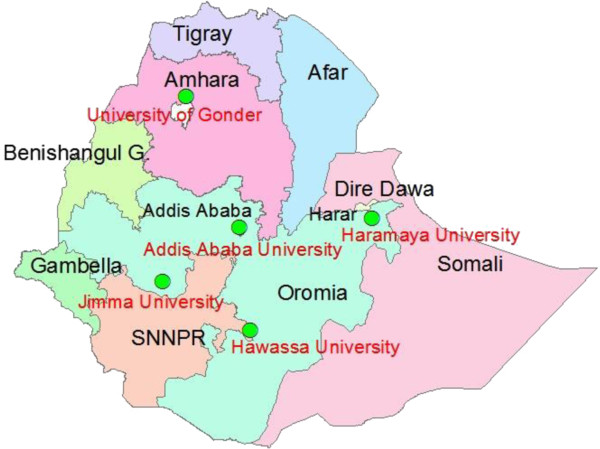
A total of 2,230 undergraduate students from the five universities benefitted from the standardized curriculum. University of Gondar accounted for 252 of 2,230 (11.3%) of the students, Addis Ababa University for 663 (29.7%), Jimma University for 649 (29.1%), Haramaya University for 429 (19.2%) and Hawassa University for 237 (10.6%) of the students. Together the universities graduated 388 and 312 laboratory technologists in 2010/2011 and 2011/2012 academic year, respectively. Practical hands-on training and experience with well-equipped laboratories enhanced and ensured skilled, confident and competent laboratory technologists upon graduation.
Conclusions
Strengthening preservice laboratory education is feasible in resource-limited settings, and emphasizing its merits (ample local capacity, country ownership and sustainability) provides a valuable source of competent laboratory technologists to relieve an overstretched healthcare system.
-
Subjects:
-
Source:Hum Resour Health. 2013; 11:56.
-
DOI:
-
Pubmed ID:24164781
-
Pubmed Central ID:PMC3815253
-
Document Type:
-
Funding:
-
Name as Subject:
-
Place as Subject:
-
Volume:11
-
Collection(s):
-
Main Document Checksum:urn:sha-512:5c134c4f7dc1a427d43ef52fd142cdbf8ddcca9111b849f09126c2346e173bf49026a8f3a48b25d9d87b51e0e7c63654bb988bb93d5efb0d868519f2f004c4f2
-
Download URL:
-
File Type:
 [PDF
- 376.23 KB
]
[PDF
- 376.23 KB
]
Supporting Files


File Language:
English
ON THIS PAGE

CDC STACKS serves as an archival repository of CDC-published products including
scientific findings,
journal articles, guidelines, recommendations, or other public health information authored or
co-authored by CDC or funded partners.
As a repository, CDC STACKS retains documents in their original published format to ensure public access to scientific information.
As a repository, CDC STACKS retains documents in their original published format to ensure public access to scientific information.
You May Also Like
COLLECTION
CDC Public Access