


Colorectal cancer survival in the USA and Europe: a CONCORD high-resolution study
Supporting Files

-
Sep 10 2013
-
File Language:
English
Details
-
Alternative Title:BMJ Open
-
Personal Author:Allemani, Claudia ; Rachet, Bernard ; Weir, Hannah K ; Richardson, Lisa C ; Lepage, Côme ; Faivre, Jean ; Gatta, Gemma ; Capocaccia, Riccardo ; Sant, Milena ; Baili, Paolo ; Lombardo, Claudio ; Aareleid, Tiiu ; Ardanaz, Eva ; Bielska-Lasota, Magdalena ; Bolick, Susan ; Cress, Rosemary ; Elferink, Marloes ; Fulton, John P ; Galceran, Jaume ; Góźdź, Stanisław ; Hakulinen, Timo ; Primic-Žakelj, Maja ; Rachtan, Jadwiga ; Diba, Chakameh Safaei ; Sánchez, Maria-José ; Schymura, Maria J ; Shen, Tiefu ; Tagliabue, Giovanna ; Tumino, Rosario ; Vercelli, Marina ; Wolf, Holly J ; Wu, Xiao-Cheng ; Coleman, Michel P
-
Description:Objectives
To assess the extent to which stage at diagnosis and adherence to treatment guidelines may explain the persistent differences in colorectal cancer survival between the USA and Europe.
Design
A high-resolution study using detailed clinical data on Dukes’ stage, diagnostic procedures, treatment and follow-up, collected directly from medical records by trained abstractors under a single protocol, with standardised quality control and central statistical analysis.
Setting and participants
21 population-based registries in seven US states and nine European countries provided data for random samples comprising 12 523 adults (15–99 years) diagnosed with colorectal cancer during 1996–1998.
Outcome measures
Logistic regression models were used to compare adherence to ‘standard care’ in the USA and Europe. Net survival and excess risk of death were estimated with flexible parametric models.
Results
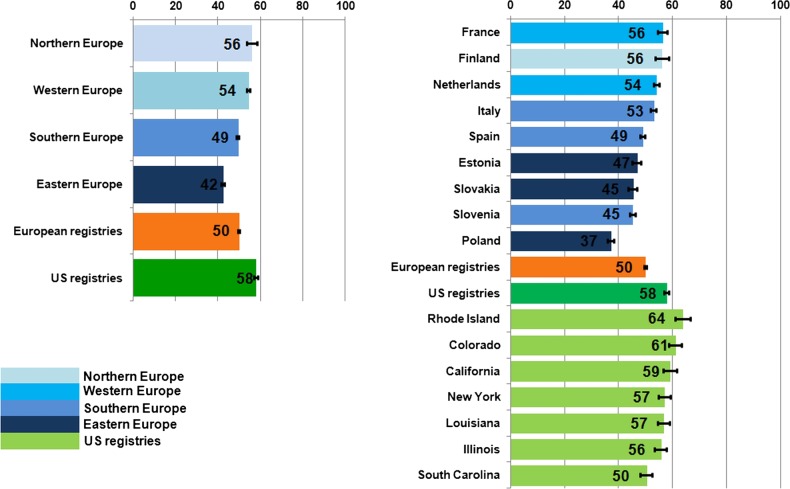
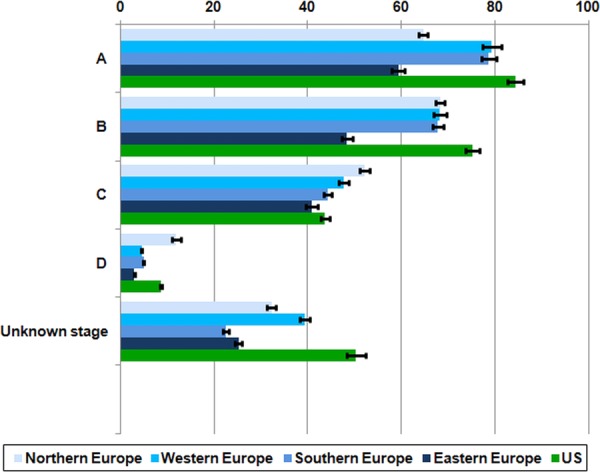
The proportion of Dukes’ A and B tumours was similar in the USA and Europe, while that of Dukes’ C was more frequent in the USA (38% vs 21%) and of Dukes’ D more frequent in Europe (22% vs 10%). Resection with curative intent was more frequent in the USA (85% vs 75%). Elderly patients (75–99 years) were 70–90% less likely to receive radiotherapy and chemotherapy. Age-standardised 5-year net survival was similar in the USA (58%) and Northern and Western Europe (54–56%) and lowest in Eastern Europe (42%). The mean excess hazard up to 5 years after diagnosis was highest in Eastern Europe, especially among elderly patients and those with Dukes’ D tumours.
Conclusions
The wide differences in colorectal cancer survival between Europe and the USA in the late 1990s are probably attributable to earlier stage and more extensive use of surgery and adjuvant treatment in the USA.
-
Subjects:
-
Source:BMJ Open. 2013; 3(9).
-
Document Type:
-
Funding:
-
Name as Subject:
-
Volume:3
-
Issue:9
-
Collection(s):
-
Main Document Checksum:urn:sha256:35bb25e62320153b7536262da47201b62ef028f1249b2b6a67e69154a74da0f4
-
Download URL:
-
File Type:
 [PDF
- 1.23 MB
]
[PDF
- 1.23 MB
]
Supporting Files


File Language:
English
ON THIS PAGE



CDC STACKS serves as an archival repository of CDC-published products including
scientific findings,
journal articles, guidelines, recommendations, or other public health information authored or
co-authored by CDC or funded partners.
As a repository, CDC STACKS retains documents in their original published format to ensure public access to scientific information.
As a repository, CDC STACKS retains documents in their original published format to ensure public access to scientific information.
You May Also Like
COLLECTION
CDC Public Access