


Infection Frequency of Hepatitis C Virus and IL28B Haplotypes in Papua New Guinea, Fiji, and Kiribati
Supporting Files
Public Domain

-
Aug 20 2013
-
Details
-
Alternative Title:PLoS One
-
Personal Author:
-
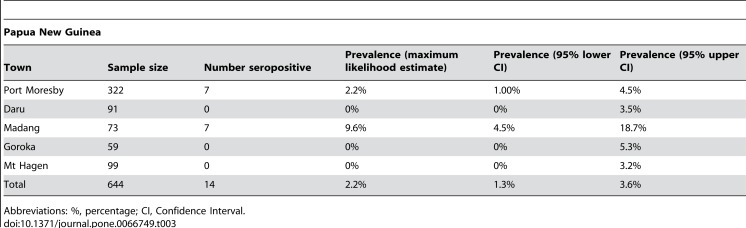
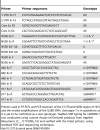
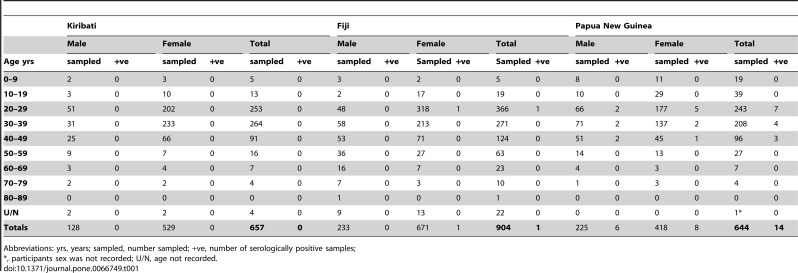
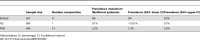
Description:It has been estimated that there are more than 60 million Hepatitis C virus (HCV) carriers in the World Health Organisation's Western Pacific region (WHO-WPR), where liver cancer is among the top three causes of cancer death. WHO and the US Centres for Disease Control and Prevention report the prevalence of HCV in the South Pacific islands (countries within the WHO-WPR) to be high (5-10% and >2% respectively). However, since HCV is not tested for in many of these countries, there is sparse data available to support this assertion. We screened ∼2000 apparently healthy individuals from Papua New Guinea, Fiji and Kiribati and found a sero-prevalence of 2.0%, 0.1% and 0%, respectively. All sero-positive samples tested negative for HCV RNA. Curious as to why all the sero-positive individuals were negative for HCV-RNA, we also screened them for the HCV protective IL28B SNP markers rs12979860 and rs8099917. All antibody-positive participants bar one had HCV protective haplotypes. Our results suggest that HCV is present in these Pacific island countries, albeit at a prevalence lower than previous estimates. As none of our participants had undergone antiviral treatment, and therefore must have cleared infection naturally, we hypothesise that genotypes 1 and/or 4 are circulating in South Pacific Island people and that these peoples are genetically predisposed to be more likely to spontaneous resolve HCV infection than to become chronic carriers.
-
Subjects:
-
Source:PLoS One. 2013; 8(8).
-
Document Type:
-
Volume:8
-
Issue:8
-
Collection(s):
-
Main Document Checksum:urn:sha256:52b3968c068fbf6ccaa81d7a18ea1042866e5659a76b665a7193c67b6df7d778
-
Download URL:
-
File Type:
 [PDF
- 159.87 KB
]
[PDF
- 159.87 KB
]
Supporting Files


ON THIS PAGE




CDC STACKS serves as an archival repository of CDC-published products including
scientific findings,
journal articles, guidelines, recommendations, or other public health information authored or
co-authored by CDC or funded partners.
As a repository, CDC STACKS retains documents in their original published format to ensure public access to scientific information.
As a repository, CDC STACKS retains documents in their original published format to ensure public access to scientific information.
You May Also Like
COLLECTION
CDC Public Access