



Evolutionary History and Phylogeography of Rabies Viruses Associated with Outbreaks in Trinidad
Supporting Files
Public Domain

-
Aug 22 2013
File Language:
English
Details
-
Alternative Title:PLoS Negl Trop Dis
-
Personal Author:Seetahal, Janine F. R. ; Velasco-Villa, Andres ; Allicock, Orchid M. ; Adesiyun, Abiodun A. ; Bissessar, Joseph ; Amour, Kirk ; Phillip-Hosein, Annmarie ; Marston, Denise A. ; McElhinney, Lorraine M. ; Shi, Mang ; Wharwood, Cheryl-Ann ; Fooks, Anthony R. ; Carrington, Christine V. F.
-
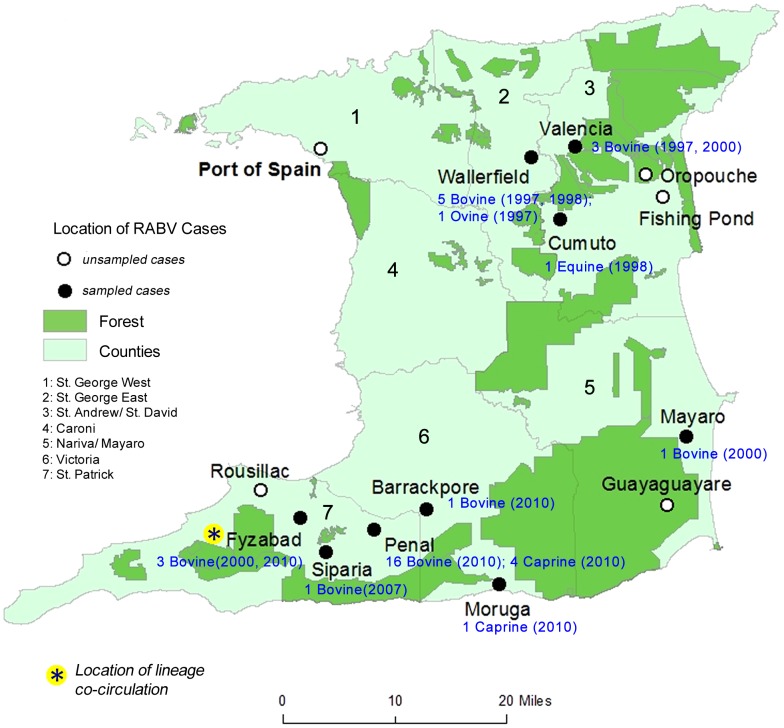
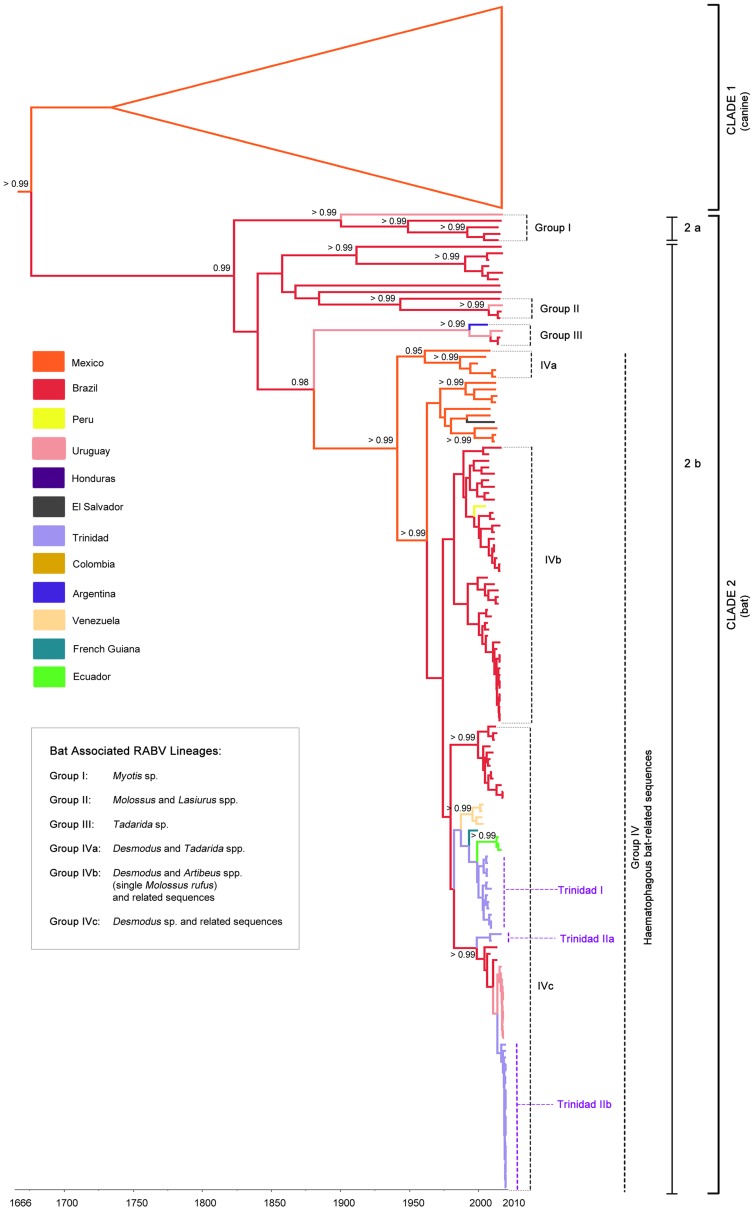
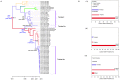
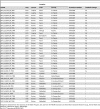
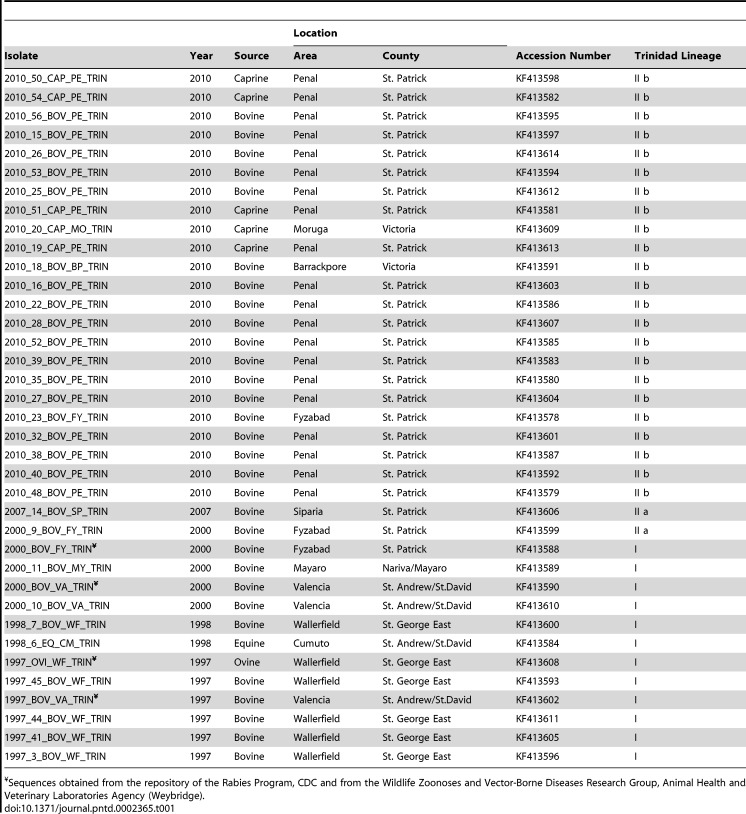
Description:Bat rabies is an emerging disease of public health significance in the Americas. The Caribbean island of Trinidad experiences periodic outbreaks within the livestock population. We performed molecular characterisation of Trinidad rabies virus (RABV) and used a Bayesian phylogeographic approach to investigate the extent to which outbreaks are a result of in situ evolution versus importation of virus from the nearby South American mainland. Trinidadian RABV sequences were confirmed as bat variant and clustered with Desmodus rotundus (vampire bat) related sequences. They fell into two largely temporally defined lineages designated Trinidad I and II. The Trinidad I lineage which included sequences from 1997-2000 (all but two of which were from the northeast of the island) was most closely related to RABV from Ecuador (2005, 2007), French Guiana (1990) and Venezuela (1993, 1994). Trinidad II comprised sequences from the southwest of the island, which clustered into two groups: Trinidad IIa, which included one sequence each from 2000 and 2007, and Trinidad IIb including all 2010 sequences. The Trinidad II sequences were most closely related to sequences from Brazil (1999, 2004) and Uruguay (2007, 2008). Phylogeographic analyses support three separate RABV introductions from the mainland from which each of the three Trinidadian lineages arose. The estimated dates for the introductions and subsequent lineage expansions suggest periods of in situ evolution within Trinidad following each introduction. These data also indicate co-circulation of Trinidad lineage I and IIa during 2000. In light of these findings and the likely vampire bat origin of Trinidadian RABV, further studies should be conducted to investigate the relationship between RABV spatiotemporal dynamics and vampire bat population ecology, in particular any movement between the mainland and Trinidad.
-
Subjects:
-
Source:PLoS Negl Trop Dis. 2013; 7(8).
-
Document Type:
-
Volume:7
-
Issue:8
-
Download URL:
-
File Type:
 [PDF - 755.00 KB]
 -
Collection(s):
-
Main Document Checksum:urn:sha256:5c763d8eca8c3dd9f74a8553cf84ada609649d2ceefaa244b0e91517fbf0e31d
Supporting Files


File Language:
English
 Was this page helpful?
 Found an issue?


CDC STACKS serves as an archival repository of CDC-published products including
scientific findings, journal articles, guidelines, recommendations, or other public health information authored or
co-authored by CDC or funded partners.
As a repository, CDC STACKS retains documents in their original published format to ensure public access to scientific information.
As a repository, CDC STACKS retains documents in their original published format to ensure public access to scientific information.
You May Also Like
COLLECTION
CDC Public Access