



Are Physical Education Policies Working? A Snapshot From San Francisco, 2011
Supporting Files
Public Domain

-
Aug 22 2013
File Language:
English
Details
-
Journal Article:Preventing Chronic Disease (PCD)
-
Personal Author:
-
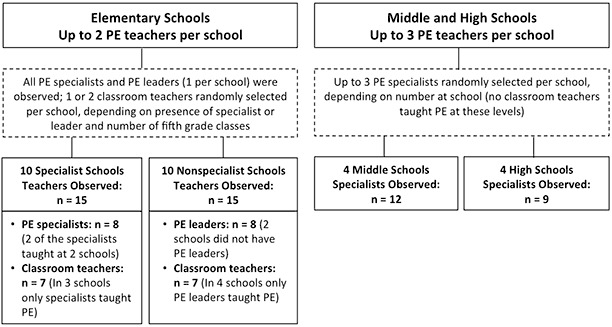
Description:Introduction ; School physical education (PE) has been identified as a critical public health tool to increase physical activity among youths. We sought to objectively assess compliance with PE quantity mandates and quality recommendations in a large urban California school district. ; Methods ; We collected PE schedules and systematically observed PE lessons (n = 154) in 20 elementary, 4 middle, and 4 high schools from February through May 2011. ; Results ; On the basis of schools’ master schedules, 83% of elementary schools met the California state mandate of 100 PE minutes per week. Teachers' actual schedules indicated that 20% of schools met the mandate, and observation showed that only 5% were in compliance. All middle and high schools met the mandated 200 minutes per week. On average, classes at all school levels met the recommended 50% of PE lesson time in moderate-to-vigorous physical activity. No teacher- or school-level factors significantly predicted PE quantity, but credentialed elementary PE teachers spent more time building students’ motor skills. ; Conclusions ; Our results suggest that current national estimates of PE, which are based on schools’ self-report, overestimate the amount of PE provided in elementary schools. Although more than half of PE class time was spent in moderate-to-vigorous physical activity, total physical activity in elementary schools from PE is minimal and may do little to contribute to students’ overall health.
-
Subjects:
-
Source:Prev Chronic Dis. 10.
-
ISSN:1545-1151
-
Document Type:
-
Volume:10
-
Download URL:
-
File Type:
 [PDF - 594.87 KB]
 -
Collection(s):
-
Main Document Checksum:urn:sha-512:9d3552ca15c2b0f784b5c23cf52b2b6ea9b85772304c535c8a95b9e50516719b0ab4ec567fae7ebaa5437b743aafa9a76f8bd4c8736e11877c3e5cdee46186cc
Supporting Files


File Language:
English
 Was this page helpful?
 Found an issue?


CDC STACKS serves as an archival repository of CDC-published products including
scientific findings, journal articles, guidelines, recommendations, or other public health information authored or
co-authored by CDC or funded partners.
As a repository, CDC STACKS retains documents in their original published format to ensure public access to scientific information.
As a repository, CDC STACKS retains documents in their original published format to ensure public access to scientific information.
You May Also Like
COLLECTION
Preventing Chronic Disease